
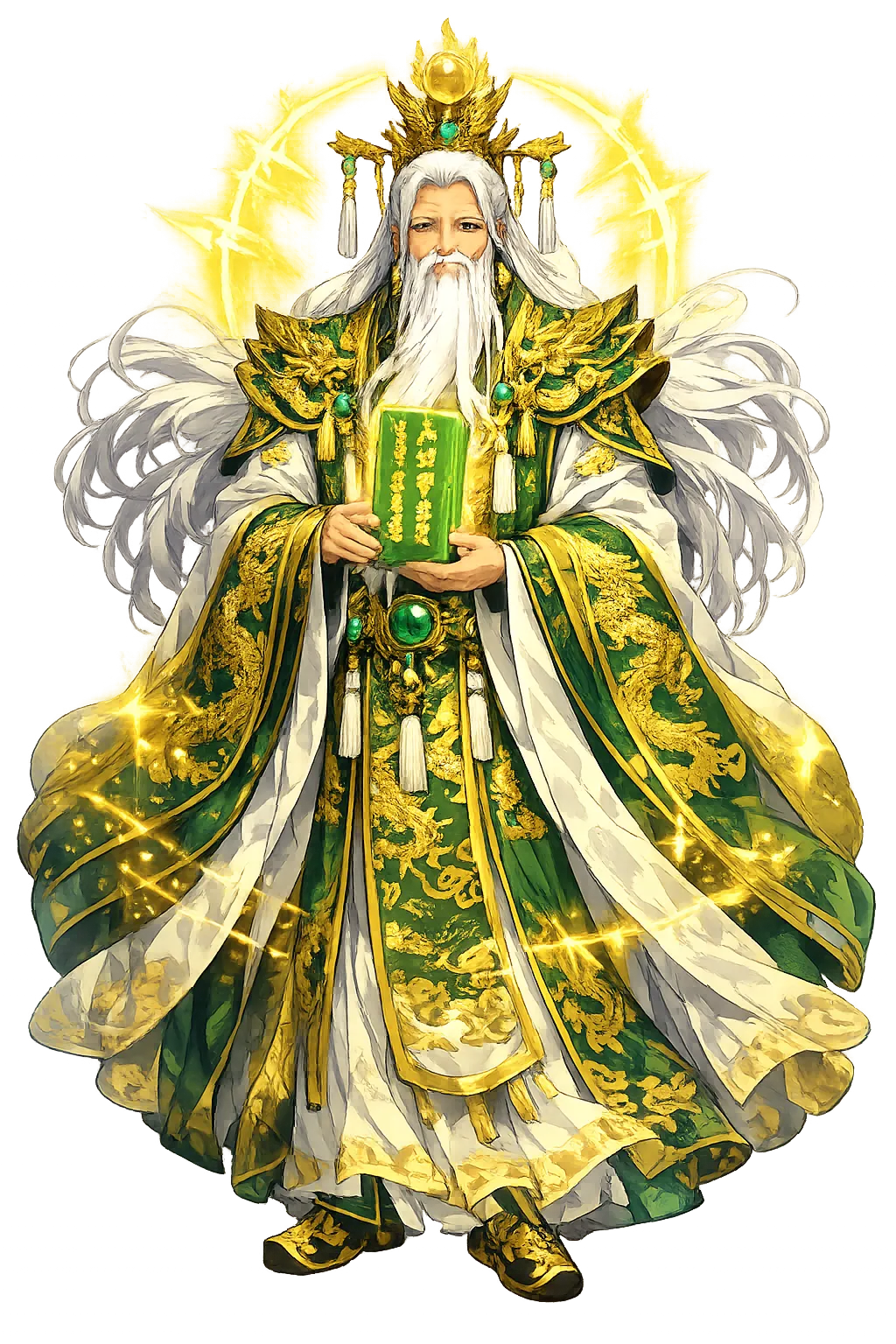
How Tàishàng was rebuilt, mark by mark
The workshop file for Tàishàng. Every rejected form is recorded here too — that is the point of keeping notes.
What We Found
The attestation, on the evidence Laozi, Daodejing (Tao Te Ching) and Daozang (Daoist Canon) set down: 太上. Meaning: "Supreme, great".
The figure behind the name: Tàishàng's mythology moves between history and cosmology: the shadowy philosopher Laozi becomes the celestial teacher who reveals the Dao to emperors, hermits, and alchemists.
What the Name Carried In
Laozi Leaves the Pass. Sima Qian's biography (Shiji, ch. 63) makes Laozi keeper of the royal archives of Zhou, a man so deep that even Confucius sought him out and came away comparing him to a dragon.
The Conversion of the Barbarians. Medieval Daoist apocrypha claimed that Tàishàng Lǎojūn travelled west after leaving the pass and, finding the barbarians of India unreceptive to his teaching, transformed himself into the Buddha in order to convert them — the doctrine of the Huáhú jīng, the Classic of the Conversion of the Barbarians, which circulated from at least the third century CE. The claim was polemic, not history: it subordinated Buddhism, then flooding into China, by making its founder a mere avatar of Laozi, and it provoked angry Buddhist counter-pamphlets and several imperial suppressions of the text.
A spelling that has to carry stories like these is not a label. It is equipment.
Where It Stood Before Us
The deification of Laozi is attested in Han dynasty texts and inscriptions, with imperial cults developing under the Tang dynasty, which claimed Laozi as an ancestor. Archaeological finds include Dàodéjīng manuscripts from Mawangdui and Guodian, Daoist talismans, steles, and temple inscriptions honouring Tàishàng Lǎojūn. Temples dedicated to him survive across China and the Chinese diaspora. The bench inherits all of it — the web temple is the newest site, not the first.
What We Kept
The evidence, mark by mark — 2 features the keyboard form taishang cannot hold:
- a → à — Stress on a. Kept.
- a → à — Stress on a. Kept.
What We Rejected
The plain ASCII taishang — admissible as a fallback, never as the primary. A wrong accent would have been worse: the rulebook is explicit that a misplaced mark is worse than none.
What We Set Down
Tàishàng — The restoration preserves more than the ASCII form can express — stress, length, or a letter the Latin keyboard lost — which places it, mechanically, in Tier-1.
For the voice: tIE-SHUHNG — 'tai' like 'tie' with a sharp falling tone, 'shang' with a retroflex 'sh' and a falling tone.
The temple stands at /taishang/ — the notes above are public in its Scholarly Edition, sources and all.
At a Glance
- Restored name: Tàishàng
- ASCII form: taishang
- Meaning: "Supreme, great"
- Domain of influence: Supreme Lord, Dao
- Pantheon: Chinese
- Classification: Tier 1
- Original script: 太上
- Series: The Restoration Files, No. 470 of 546
The File Continues
The temple's founding dispatch tells the name's story; its Resonance File reads the myths into the industries; the blog index holds the whole archive.
Continue the series — previous file: Tàijí (read it here) · next file: Tajikarao (read it here).
The Restoration Files are written from the same canonical record as the temples themselves: the lexicon, the lore catalog, the pattern atlas, and the cited scholarly sources. If a file ever disagrees with its temple, the temple is right — tell us, and the file will be corrected.