
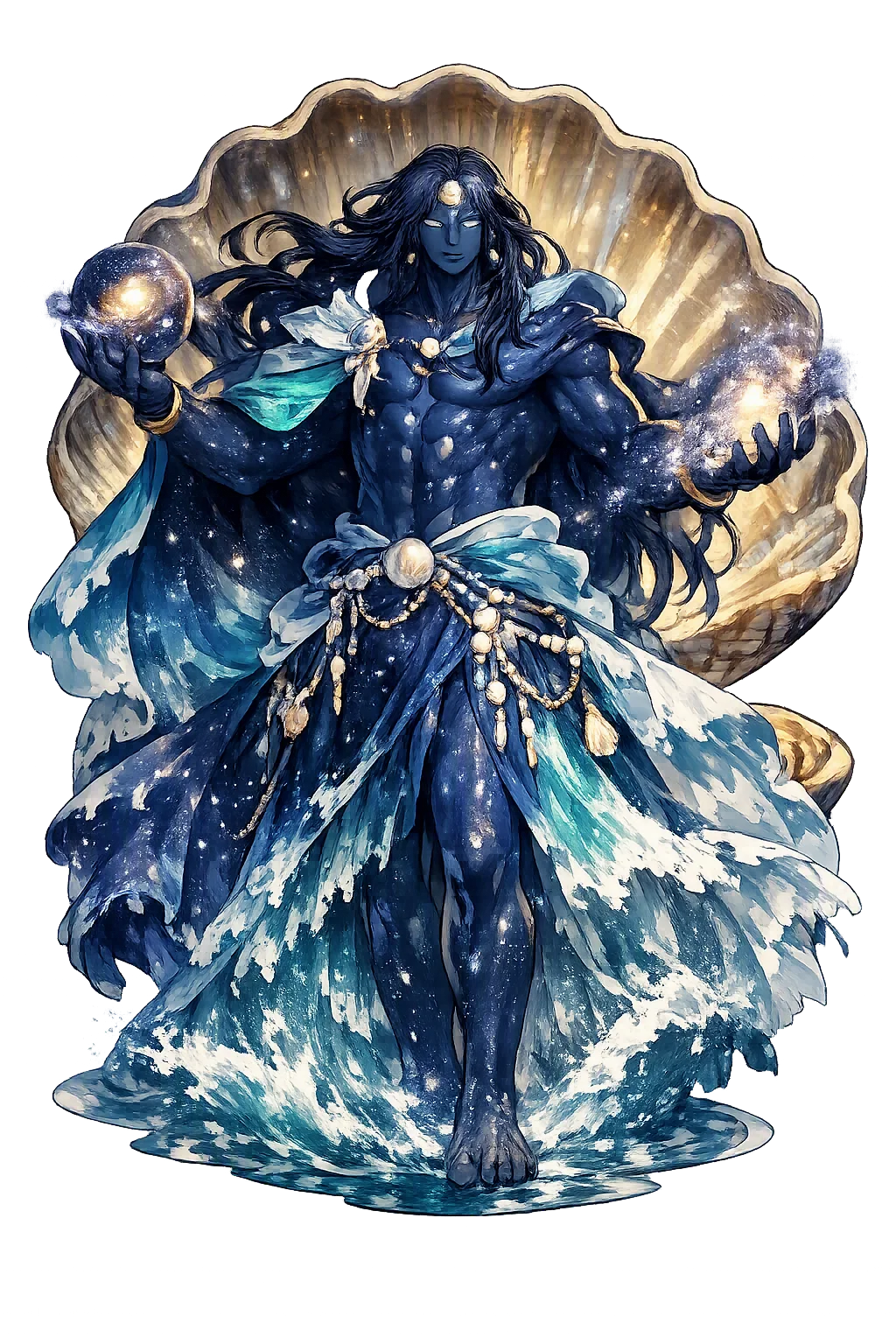
Taaroa: The Tahitian Creator Who Spoke the World from Night
In the beginning, according to the traditions of Tahiti, there was only Taaroa. There was no sky, no earth, no sea, no gods, only Taaroa existing in the void, in the primal darkness called te pō. From within himself, from his own body and word, he brought forth the world. He is the supreme creator of Tahitian mythology, the first and only being before creation, and the source from whom all other gods, humans, and natural phenomena descend. To write his name as taaroa in lowercase is to place the creator of everything on the same level as any ordinary word. The restoration Taaroa returns the capital that befits the first name.
At a Glance
- Restored name: Taaroa
- ASCII form: taaroa
- Meaning: "The distant one" / primordial creator
- Domain of influence: Creator, Supreme Being
- Pantheon: Polynesian (Tahitian)
- Classification: Tier 2
Overview
Taaroa is the high god of Tahiti and the Society Islands, cognate with the Māori Tangaroa and the Hawaiian Kanaloa, though in Tahiti he occupies a more exalted position as the supreme creator. In some versions of the myth, he is alone in the void, containing within himself all the elements of the future cosmos. He creates by separating parts of himself or by speaking things into existence. In other versions, he emerges from a shell or an egg, the cosmic egg from which the world hatches.
In the PUNICODEX lexicon, Taaroa is catalogued under "Creator, Supreme Being." These are the highest possible domains. He is not a god of one aspect of life but the source of life itself. The creator is the one who makes the conditions for all other domains, and the supreme being is the one who stands above all other beings. Taaroa's name therefore represents the apex of the Tahitian theological hierarchy.
Etymology and Meaning
The name Taaroa is related to the Proto-Polynesian Tangaroa, the god of the sea and creation known throughout Polynesia. In Tahitian, the consonants have shifted: ng becomes ʻ (glottal stop) or disappears, and k often becomes ʻ or is lost. Thus Tangaroa becomes Taʻaroa, and in some orthographies simply Taaroa. The meaning "the distant one" or "the far-reaching one" may refer to the vastness of the ocean over which his cult spread, or to the remoteness of the supreme creator from ordinary human affairs.
The name thus contains a paradox. Taaroa is distant, beyond reach, yet he is also the origin of everything near and familiar. He is the far-off first cause and the immediate ground of being. This paradox is typical of supreme creator deities, who must be both transcendent and immanent, both utterly other and intimately present.
Some interpretations emphasize that roa means "long" or "far," so that Taaroa is "the far-reaching lord." This fits his role as a creator whose influence extends across the entire cosmos. The name is not a description of appearance or function but a statement of scope and authority.
Mythology and Domain
The Tahitian creation myth begins with Taaroa alone in te pō, the night, the darkness before creation. He is often described as existing within a shell or an egg, which is himself. From this enclosed state, he begins to create. In one version, he says "Let the sky be" and the sky appears; he says "Let the earth be" and the earth appears. In another version, he stands within his shell and pushes against it until it breaks, the upper part becoming the sky and the lower part becoming the earth. The shell's ribs become the mountains and valleys, and his body becomes the land and sea.
From Taaroa come the other gods. Some are born from his thought or word; others are aspects of his own being given independent form. The major Tahitian gods, including Tāne, ʻOro, and Tu, are thus his children or emanations. Humans too descend from Taaroa, either directly or through the intermediate gods. The whole cosmos is therefore a family, with Taaroa as the ultimate ancestor.
Taaroa's cult was centered at temples called marae, particularly at the great marae of Taputapuātea on the island of Raʻiātea, which was a pan-Polynesian religious center. Priests offered prayers, chants, and sacrifices to Taaroa and his divine offspring, seeking fertility, victory, health, and favorable weather. The god's supreme status meant that his cult was closely tied to chiefly authority; the high chiefs of Tahiti claimed descent from Taaroa and his children.
The relationship between Taaroa and ʻOro, the god of war and fertility, is particularly important. In some traditions, ʻOro rises to prominence as the active face of Taaroa's power, the deity who intervenes in human affairs while Taaroa remains transcendent. This division of labor allows the supreme creator to remain distant while his son or emanation handles the messy business of war and reproduction.
Pronunciation, Orthography, and the Restored Form
The name Taaroa is pronounced with three syllables in Tahitian: ta-a-ro-a, with the glottal stop between the two initial a sounds in the ideal form Taʻaroa. The vowels are pure and sustained, giving the name a resonant, expansive quality. The PUNICODEX form Taaroa omits the ʻokina for registrability but preserves the doubled vowel as a hint of the glottal separation and restores the capital letter. The ASCII form taaroa reduces the creator of everything to a lowercase string, an indignity that the restoration corrects. The entry is classified as Tier 2.
Cultural Legacy
Taaroa's legacy is most visible in the archaeology and continued cultural significance of the marae, especially Taputapuātea. This site, now a UNESCO World Heritage area, was once the religious heart of eastern Polynesia, a place where chiefs and priests from multiple islands gathered for ceremonies and negotiations. The name of Taaroa was invoked there for centuries, and the site's restoration in recent decades has renewed interest in traditional Tahitian religion.
In Tahiti today, Taaroa is remembered in cultural festivals, in the work of artists and writers, and in the ongoing efforts to revive the Tahitian language and traditional knowledge. He is also a figure in comparative Polynesian studies, where scholars trace the transformations of the Proto-Polynesian Tangaroa into the Hawaiian Kanaloa, the Māori Tangaroa, and the Tahitian Taaroa. These comparisons show both the unity and the diversity of Polynesian religious thought.
The name Taaroa has also entered global consciousness through the wider fame of Tahiti as a symbol of paradise. That fame can obscure the depth of Tahitian culture, reducing it to beaches and tourism. The restoration of Taaroa's name is a small counterweight, a reminder that Tahiti has a complex theological and artistic heritage that long preceded European contact.
The Unicode Restoration
PUNICODEX restores the name as Taaroa, classified as Tier 2 because the restoration recovers the capitalization of a proper noun without adding diacritics unavailable in the .com IDN table. The ASCII form taaroa is especially inadequate for a supreme creator, since it reduces the first name, the source of all names, to a lowercase string. The restoration returns the capital that marks Taaroa as a person and a power, not a thing.
A Unicode domain in the name Taaroa is a fitting acknowledgment of the Tahitian creator. If the cosmos began with a word, then the digital word that resolves to his name continues an ancient practice: naming as an act of creation. The address bar becomes a tiny marae, a place where the first name can still be spoken.
Sources and Further Reading
This account draws on Teuira Henry's Ancient Tahiti, the collections of Tahitian traditions by Teuira Henry and others, and the comparative scholarship of Robert D. Craig and Margaret Orbell on Polynesian religion. These sources preserve the Taaroa creation narratives and the marae traditions that sustained them.
The Digital Life of a Polynesian Name
The story of Taaroa does not end with mythology or ethnography. It continues every time someone types the name into a search engine, a chat message, or a browser's address bar. For most of the internet's history, that act has been constrained by the ASCII character set, the limited alphabet of the early domain-name system. The result is that a name like Taaroa appears as taaroa, stripped of its initial capital and, in many cases, of the diacritics that carry its pronunciation and meaning. This is not a minor formatting issue. It is a structural feature of the digital world that has systematically disadvantaged languages and cultures whose names do not fit inside the English typewriter's character set.
The Domain Name System was designed in an era when network engineers assumed that all meaningful identifiers could be written with the letters A to Z, the digits zero to nine, and a handful of punctuation marks. That assumption encoded a particular linguistic hierarchy into the infrastructure of the internet. English and a few closely related languages fit naturally; Hawaiian, Māori, Samoan, Tahitian, Rapa Nui, and hundreds of other languages did not. For decades, the only way for a Polynesian name to become a web address was to anglicize it, to drop its glottal stops, to flatten its macrons, and to lowercase its first letter until it looked like an ordinary English word.
The introduction of Internationalized Domain Names, or IDNs, changed the technical situation without fully changing the cultural one. IDNs allow Unicode characters in domain names, which means that Taaroa can in principle exist as a working address. The mechanism that makes this possible is called punycode, a way of encoding Unicode strings within the ASCII-only DNS. When you type Taaroa into a modern browser, the address bar may display the Unicode form while the underlying DNS request uses the punycode form beginning with xn--. This dual life, visible Unicode and hidden ASCII, is a fitting metaphor for the status of indigenous names online: present, but often unreadable to the systems that route traffic.
PUNICODEX exists to make the visible form authoritative. By restoring Taaroa as the canonical domain, the project insists that the name should be encountered in its proper shape, not merely as a punycode translation. The restoration is not a rejection of technology; it is a use of technology to correct an earlier limitation. The punycode form still does the routing, but the user sees the name as it is spelled in scholarly and cultural contexts. This matters for search engines, which increasingly take Unicode into account; for AI training corpora, which need accurate names to avoid amplifying anglicized biases; and for human readers, who deserve to encounter Polynesian culture without first passing through an ASCII filter.
The choice to restore Taaroa also has implications for education and cultural transmission. Teachers and students who encounter the name in its correct form are more likely to ask the right questions: Where does this name come from? What language does it belong to? What stories and obligations does it carry? A lowercase ASCII string does not invite those questions; it looks like any other internet handle, stripped of history. The restored name, by contrast, announces itself as a proper noun and invites inquiry.
The classification of Taaroa as Tier 2 reflects a specific philological judgment. In the PUNICODEX tier system, Tier 1 names are those whose restored forms include distinctive letters or diacritics that the ASCII form cannot represent, such as macrons or the ʻokina. Tier 2 names are those whose restoration primarily recovers the conventional capitalization of a proper noun, without adding characters blocked by the .com IDN table. For Taaroa, the restoration from taaroa to Taaroa is therefore a restoration of grammatical dignity rather than a recovery of lost phonetic marks. It says that this is a name, a person, a power, and not a common noun or a string of lowercase letters.
The practical effects of this restoration ripple outward. A student searching for Taaroa is more likely to find serious cultural and scholarly material if the name is spelled correctly across the web. A language learner sees a model of how Polynesian names should appear in formal contexts. A descendant of the culture encounters a small but concrete assertion that their ancestral names belong in the digital public square. And a casual visitor, arriving at the temple page, receives the implicit message that the name is worth spelling with care.
There is also a subtle but important effect on link integrity and citation. When scholars, journalists, and educators link to a domain that spells Taaroa correctly, they reinforce that spelling with every click. Over time, the correct form accumulates authority in search rankings and in collective memory. The lowercase form, by contrast, circulates as a kind of error that becomes harder to correct the more often it is repeated. Restoration is therefore not only a matter of present dignity but of future accuracy.
There is also a defensive value to restoration. When names are routinely rendered in lowercase ASCII, they become easier to misappropriate, to reduce to generic fantasy tropes, or to separate from their cultural context. A domain that resolves to Taaroa is a kind of digital landmark, a place where the correct spelling is maintained and the full story can be told. It does not solve every problem of cultural appropriation, but it establishes a baseline: this name has a home, and that home spells it correctly.
In the end, the restoration of Taaroa is part of a larger project that extends far beyond any single name. It is part of the effort to make the internet multilingual not only in its content but in its architecture, to ensure that the address bar can carry the world's names in their own forms. The myths tell us that names have power, that to know a name is to know something of the being it names. The digital restoration of Taaroa is an act of that kind of knowing: a recognition that the goddess, god, ancestor, or power called Taaroa deserves to be named fully, even and especially in the most technologized spaces of contemporary life.
When you visit the restored temple at Taaroa, you are not merely visiting a page. You are witnessing a small but real correction in the way the digital world handles indigenous names. You are affirming that Taaroa is not a fragment to be anglicized, a curiosity to be lowercased, or a myth to be filed away. You are affirming that Taaroa is a name, and that names, properly restored, remain one of the most durable forms of sovereignty. In a world of rapid technological change, that durability matters more than ever. The restoration of Taaroa is therefore both backward-looking and forward-looking: it honors the past by preserving the name, and it prepares the future by making that name available to the next generation of speakers, learners, and builders.
Reading Taaroa Today
To encounter Taaroa in the twenty-first century is to step into a conversation that spans centuries, islands, and technologies. The name has traveled from oral chant to manuscript, from manuscript to print, and now from print to the address bar. Each transition risks loss, especially when the receiving medium was built for a narrower alphabet than the one that carries the name. The restoration of Taaroa as a Unicode domain is therefore not an endpoint but a checkpoint, a way of ensuring that the next stage of the journey begins with the name intact rather than diminished.
Readers who come to Taaroa through the PUNICODEX temple are invited to do more than learn a fact. They are invited to recognize that Polynesian names are living entities, embedded in languages, landscapes, and communities that continue to thrive. The name Taaroa is not a relic of the past, even when its oldest stories are ancient. It is a thread connecting those stories to contemporary hula, to indigenous activism, to scientific nomenclature, and to the ordinary decisions people make about how to spell and say the names they inherit. In that sense, restoring Taaroa is one small way of keeping the thread unbroken.
Related Names
- Kāne — Creator, Light, Life
- Kū — War, Forests, Fishing
- Māui — Trickery, Fishing, Fire, Islands
- Papatūānuku — Earth, Creation, Fertility
- Rūaumoko — Earthquakes, Volcanoes
Sources
- George Grey, Polynesian Mythology and Ancient Traditional History of the New Zealand Race (1855).
- Elsdon Best, Māori Religion and Mythology (1924).
- Martha Beckwith, Hawaiian Mythology (1940).