PuniCodex

Extended Lore

Taaroa

Etymology · Orthography · Cult · Iconography · Reception · Sources

Tier 2 Taaroa
Taaroa — Creator, Supreme Being
01

Quick Facts

Essential information about Taaroa, Creator, Supreme Being

Scholarly TransliterationTaaroa
Unicode RestorationTaaroa
Reconstructed Pronunciation/ta.ʔa.ˈɾo.a/
PantheonPolynesian
DomainCreator, Supreme Being
MeaningThe distant one
ClassificationTier 2
Primary DomainTaaroa
Sacred SymbolsThe world-shell, The spiral, The primal darkness (Te Pō), The opening invocation, The raised stones of the marae
02

Etymology & Word Family

From original script to Unicode restoration

Scholarly Transliteration Taaroa Taaroa — "The distant one"
Unicode Restoration Taaroa Canonical scholarly spelling — ASCII-identical
Modern ASCII taaroa Plain-ASCII fallback

The name Taaroa reaches the modern world through scholarly transliteration of the polynesian tradition. Because the conventional spelling uses only Latin letters, its Unicode and ASCII forms coincide — the tradition it carries is in the name itself, not in diacritics.

03

Unicode Character Breakdown

Character-by-character philological analysis

CharacterUnicodeNameBlockPhonetic Role
TU+0054Latin Capital Letter TBasic LatinSame, capitalized
aU+0061Latin Small Letter ABasic LatinSame
rU+0072Latin Small Letter RBasic LatinSame
oU+006FLatin Small Letter OBasic LatinSame
aU+0061Latin Small Letter ABasic LatinSame

The Tier 2 classification here reflects fidelity to the attested tradition, not recovered diacritics: every character of Taaroa already survives in ASCII. What the restoration preserves is the canonical spelling itself — the form scholarship standardised.

04

Cult & Worship

How the sacred was kept — rites, sanctuaries, remains

The Cult

Ta'aroa's cult was the summit of the Society Islands' religion, administered by the ta'unga priesthood from the open-air stone marae — paved platforms with their upright back-slabs and stepped ʻōroʻō god-houses. The greatest was Taputapuātea at 'Ōpōa on Ra'iatea, dedicated to his son 'Oro but governed by the rule Henry records: every prayer on the marae, whatever lesser god was petitioned, began and ended with Ta'aroa's name. The rites mixed first-fruits, feasting, and large offerings of pigs and fish; under the 'Oro brotherhood the national cult admitted human sacrifice, attested alike by early missionaries and by island historians. Investitures of chiefs and priests ran through the marae, binding rank to the creator's charter. The cult ended fast — the great marae were abandoned within a generation of the 1797 mission landing — but its platforms still stand by the hundred across the islands.

In the Earth

No temple of Ta'aroa survives intact — the LMS converts dismantled the marae — but the stone platforms do: hundreds of paved marae with their upright back slabs (unu) and stepped god-houses (ʻōroʻō) dot the Society Islands, most famously the great complex of Taputapuātea at 'Ōpōa, Ra'iatea (UNESCO World Heritage, 2017). The restored valley marae of 'Ārahurahu in Papeari preserves the setting Henry's informants described. Carved tiki figures attest the anthropomorphic image of the gods: the celebrated figure A'a, from Rurutu in the Austral Islands (British Museum), a deity studded with thirty small figures, is widely read as the creator teeming with the gods and people he brought forth.

05

Iconography

How Taaroa was imaged across the ages

The Image

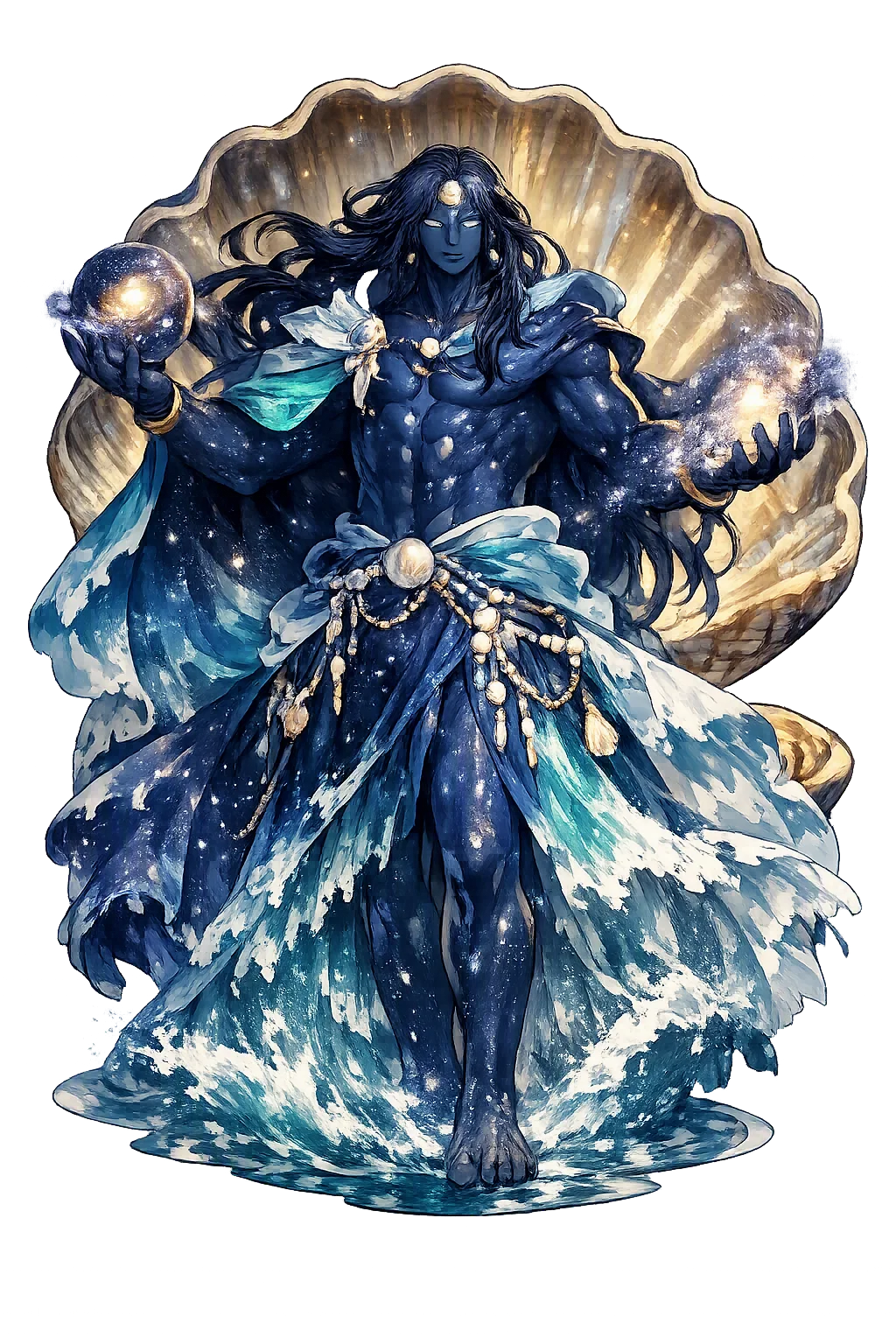
The Tahitian gods were imaged as tiki — carved anthropomorphic figures, large and small — and Ta'aroa's body was the model of them all, since every god was his offspring. The most celebrated surviving carving of the creator is the figure A'a from Rurutu in the Austral Islands, now in the British Museum: a torso studded with thirty small figures, widely read as the creator teeming with the gods and people he brought forth — though that identification is interpretation, not inscription. The marae themselves formed his larger image: the upright unu slabs and the ʻōroʻō god-houses staged the gods' presence rather than picturing it, and the carved war-god staffs of the 'Oro cult inherited the family likeness. Henry's informants described the god's hair as the spiral of growth, the ʻōro pattern by which creation proceeds, and the spiral remains his emblem in modern Tahitian art.

06

Reception & Transformation

The name after its own age — transmission, translation, survival

Afterlives

Ta'aroa's reception begins with a surprise: the missionaries who came to abolish him wrote him down with respect. John Davies took the cosmogony from Tahitian scholars in 1818; William Ellis printed it in Polynesian Researches (1829), noting openly that it resembled Genesis — a comparison that eased conversion and doomed the cult together, as the great marae were abandoned within a generation. Teuira Henry's Ancient Tahiti (1928), built from the priestly families of Papeari, gave the tradition its definitive text and fixed Ta'aroa in the scholarly literature. The comparative school then read him across the ocean: Tregear and Fornander had already reconstructed *Taŋaroa as the Proto-Polynesian god from whom Tangaloa, Tangaroa, and Kanaloa all descend, and Peter Buck carried the synthesis into the twentieth century. Modern Tahiti keeps the name in ʻōrero oratory and ori dance as the word for origins, and the 2017 UNESCO inscription of Taputapuātea returned his marae to living ceremony — a record first saved by the men who destroyed the cult.

Identifications Across Traditions

When the London Missionary Society reached Tahiti in 1797, the first catechists did not find a clutter of squabbling idols — they found a supreme god whose creation narrative sounded uncomfortably like Genesis, and they said so in their journals. Tahitian scholars who worked with them, the deacons of the mission schools, readily compared Ta'aroa to Jehovah, a comparison that eased conversion and ultimately doomed the cult: the great marae were abandoned within a generation, the god-houses burned or left to rot. Ta'aroa survived in the cult of his son 'Oro, whose war-god religion absorbed the national priesthood. In the western islands his own name lived on as Tangaloa, creator of Tonga and Samoa; in Aotearoa it had already become Tangaroa, lord of the sea; in Hawai'i, Kanaloa, god of the deep. One god, three more names, many biographies — the comparative method's favorite case.

Modern Legacy

Taaroa's direct cult ended in the early nineteenth century, but his name never left Tahiti. It lives in the great marae the Polynesian nations are rebuilding: Taputapuātea on Ra'iatea, dedicated to his son 'Oro, was inscribed as a UNESCO World Heritage site in 2017 and re-consecrated by delegations from across the triangle. The cosmogony recorded by Henry remains a foundational text of Polynesian studies, taught wherever the old religion is taken seriously as theology rather than curiosity. Contemporary Tahitian dancers and orators invoke Ta'aroa as the name of origins in the renaissance of ʻōrero and ori Tahiti. And because the creation chant opens every traditional ceremony with his name, 'Ta'aroa' has become the shorthand Polynesians reach for when they want to say: this is where we begin.

07

The Meditation

What Taaroa means — beyond the dictionary

Most creation stories start with a problem: chaos to be fought, a dragon to be split, a rival to be overthrown. Taaroa's story starts with something rarer — sufficiency. Before there was anything, there was a being who needed nothing: no parents, no materials, no opponent. The world is not a conquest but an overflow, the cracking of a shell that had become too small for the being inside it. And there is a loneliness in this that the myth does not hide: the first thing the god does in the darkness is call out, and no one answers. Creation, on this reading, is not an act of power but of company — the universe as the solution to solitude.

When the work is done, Ta'aroa withdraws to the highest heaven and leaves the world to his children. Power that creates and then steps back is the most difficult kind to imagine, and the Tahitians imagined it — a supreme being whose supremacy consists in having delegated everything and in being, still, the direction of every prayer. That is a theology of confidence: the maker does not need to manage, because the making was perfect. The name Ta'aroa, with its gentle glottal catch like a held breath, is the sound of that confidence.

08

Frequently Asked Questions

Common questions about Taaroa, Creator, Supreme Being, and Unicode restoration

01How do you pronounce Taaroa?

In reconstructed pronunciation, Taaroa is /ta.ʔa.ˈɾo.a/ — approximately 'tah-ah-ROH-ah' — keep all four vowels pure, tap the r lightly, and let the middle syllable catch on a gentle glottal stop.

02What does Taaroa mean?

Taaroa means The distant one in the polynesian tradition.

03What are the symbols of Taaroa?

Taaroa is associated with The world-shell (The egg-like shell in which Ta'aroa crouched alone in the darkness; when he broke it, sky rose from the upper half and earth spread from the lower (Henry, Ancient Tahiti).), The spiral (The ʻōro spiral of growth by which creation proceeds outward from a point — the geometry the priests saw in the unfolding world and in the sacred hair of the gods.), The primal darkness (Te Pō) (The night in which Ta'aroa existed alone before anything else; creation is not the defeat of darkness but its self-opening.), The opening invocation (Every Tahitian prayer and chant began with Ta'aroa's name and closed with it — the priests named him 'the god of gods' before any other name was spoken (Henry, Ancient Tahiti).), The raised stones of the marae (The open-air temple platforms of Tahiti with their carved god-houses (ʻōroʻō); his cult was administered by the highest priesthood of the islands.).

04Why restore Taaroa in Unicode?

Taaroa is written entirely in ASCII letters, so its restoration is about canonical fidelity rather than recovered diacritics: the temple fixes the name in its scholarly standard spelling, attested in the source tradition, instead of leaving it to drift.

05What is the most important myth about Taaroa?

“Before There Was Anything” — the The Self-Existent story that anchors the mythology of Taaroa, told in full on the lore page.

09

Scholarly Sources

The philological foundations of this restoration

Every claim on this page is grounded in established scholarship. The orthographic restorations follow disciplinary convention. The etymological chain follows the best available reference works. This is not invention — it is resurrection through scholarship.

◈

Lexicography & Philology

  • Henry
  • Handy
◎

Primary Texts

  • Primary sources in the polynesian tradition for Taaroa.
◉

Archaeology & Art History

  • Material evidence — iconography, inscriptions, and temple archaeology — for Taaroa and related cults.
✦

Religious Studies

  • Henry, Ancient Tahiti
  • Ellis, Polynesian Researches I
  • Craig, Dictionary of Polynesian Mythology
  • Buck (Te Rangi Hīroa), Vikings of the Sunrise
  • Beckwith, Hawaiian Mythology
Return

The Surface Awaits

You have traced the name from its earliest attestation to its Unicode restoration. Now return to the myth. The story is where the name lives.

Back to Lore
Taaroa mascot