Stories of Taaroa
Taaroa's mythology is a cosmogony in the strict sense — an account of how anything at all came to be. The Tahitian priests told it to the first missionaries, and it survives in two nineteenth-century witnesses: the narrative taken down by the missionary John Davies and the longer version preserved by Teuira Henry from the scholars of Papeari.
The old scholars of Tahiti told the missionary John Davies — and Teuira Henry heard it again two generations later — that before there was sky, sea, land, light, or any other being, Taaroa was. He had no father and no mother, for nothing existed before him that could beget him; his cult name Ta'aroa-'onohi-'ote-na'i-'atu means 'Ta'aroa, the self-existing, the origin of all things.' He dwelt in the primal darkness called Te Pō, wrapped in his own shell like a chick in the egg, calling into the void — and no one answered, because there was no one else to answer. The whole of the world-to-come lay folded inside him, as the tree lies folded in its seed, and the first act of the cosmos was that loneliness outgrew its shell. (Davies' account, preserved in Ellis, Polynesian Researches I; Henry, Ancient Tahiti 336–338.) The myth makes the first moment of existence a soliloquy: creation begins as a being who has no one else to speak to, speaking himself into company.
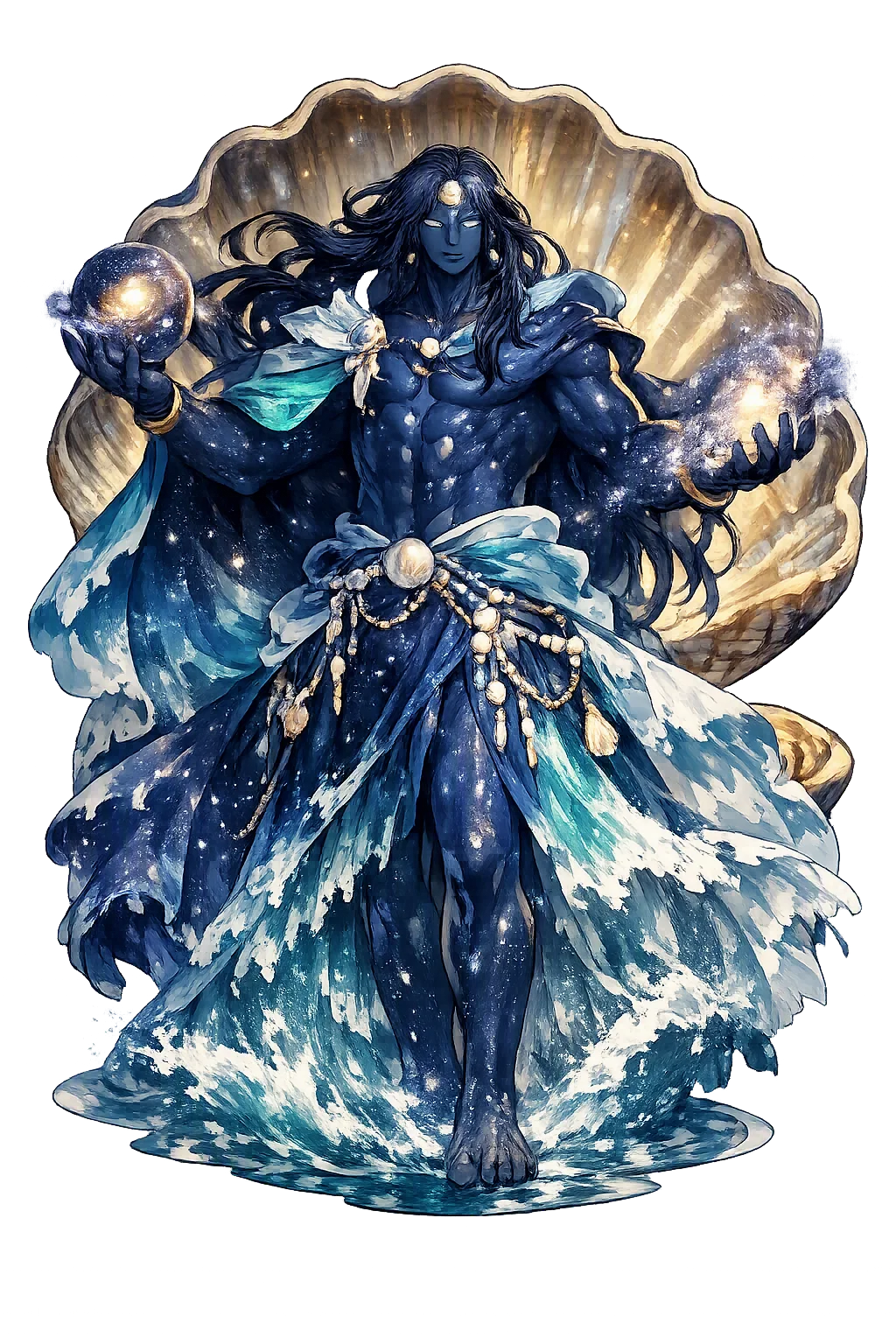
Weary of confinement, Ta'aroa broke his shell open. The upper half of it he raised high above him and made the sky; the lower half he spread out beneath him and made the earth. From himself he brought forth the sea, the springs, the rocks and sands, the trees and plants, the fish and birds, and the land animals — the whole inventory of the world drawn, item by item, out of his own being, nothing borrowed and nothing left over. In Henry's version he then turned to its government, which is where the third myth begins. (Henry, Ancient Tahiti 336–349; Ellis, Polynesian Researches I.) The image is precise and strange: the cosmos is not built from outside materials but hatched — the world as the broken shell of a god who could no longer bear to be alone.
In the fuller tellings, Ta'aroa did not keep the world to himself. He fashioned the other great gods — Tane of the forests and birds, Rono of peace and cultivated food, Tū of war and of humankind, Ta'ata, and the young warrior god 'Oro who would inherit the great national marae — and set each over his portion of creation. He then made men and women to people the earth he had spread. The sources are early and do not always agree on the details — Davies' version, gathered in 1818, is sober where Henry's, drawn from priestly families of Papeari, is expansive — but all agree on the order: gods first, then people, and Ta'aroa before and above both. (Davies in Ellis, Polynesian Researches I; Henry, Ancient Tahiti.) The theology is remarkably austere: a single unbegotten power delegates everything, and rules by having made the rulers.
When the work of creation was complete, Ta'aroa did not remain to govern the world day by day. He withdrew to the highest heaven, above the dwelling of Tane and all the other gods, and from that remove he was invoked as 'the god of gods.' Every prayer and every sacrifice on the marae began with his name and ended with his name, whatever lesser deity was being petitioned in between; the priests addressed him as the root from which the other divinities grew, the trunk of which they were branches. It is this withdrawal that his name's traditional gloss — 'the distant one' — is usually taken to mean. (Henry, Ancient Tahiti.) The pattern is the deus otiosus, the resting god familiar from many traditions: having made the world, the creator leaves it running and becomes a direction — the vertical axis toward which all prayer climbs.
Creator
In the old religion of Tahiti, Taaroa is not one god among many but the ground of all divinity — the self-existent one who dwelt alone in the primal darkness, burst the shell of his own being to make sky and earth, and fathered or simply is every other god. The first missionary scholars recorded his cosmogony with respect verging on awe.
Ta'aroa has no father and no mother: the accounts insist he was never made, because before him there was nothing that could make him.
He broke his world-shell: the upper half became the sky, the lower half the earth, and the space between them the living world.
In the fuller tellings he fashioned the other great gods — Tane, Rono, Tū, 'Oro — and set each over a domain of the world.
When creation was finished he withdrew to the highest heaven; every prayer began and ended with his name.
From the original script to the living URL
Taaroa
The name survives in scholarly transliteration. Taaroa is the standard Polynesian romanisation, documented in academic sources — “The distant one”. Because the spelling uses only Latin letters, the form is the same in both ASCII and Unicode.
No indigenous writing system is securely attested for individual polynesian names. The form shown is a modern scholarly transliteration.
taaroa
The plain taaroa form is identical to the Unicode restoration. Because this name is already written in Latin letters, no diacritics, stress, or script information were lost — only capitalization differs.
Taaroa
The Unicode restoration does not need to recover lost marks for Taaroa. Its value is canonical spelling and consistent cataloguing, not the reconstruction of erased orthography. The domain is readable as-is to both DNS and humanity.
Taaroa.com
This restoration is written entirely in ASCII letters — no Punycode encoding stands between Taaroa and the DNS. The domain reads identically to machines and to human eyes.
Owned, ideal, and ASCII forms of Taaroa
Taaroa
The full Unicode restoration. taaroa.com is not in the PuniCodex collection — it is watched for release; if it drops, this temple upgrades to an owned flagship.
How Taaroa was spoken
How Taaroa is preserved in writing
No indigenous writing system is securely attested for individual polynesian names. The form shown is a modern scholarly transliteration.
Contribute scholarly provenance →The lore you have read is the living myth. Extended Lore opens the scholarly vault beneath it: the cult and its material remains, a history of the image, the name after antiquity, a meditation on what the name still means, and the full scholarly apparatus — etymology, orthography, sources.
Enter Extended Lore