PuniCodex

Extended Lore

Sūnwùkōng — The Deeper Record

Etymology · Orthography · Cult · Iconography · Reception · Sources

Preserves stress & vowel length Sūnwùkōng.com
Sūnwùkōng — Monkey King, Chaos, Enlightenment
01

At a Glance

Sūnwùkōng — every fact links to its home

PantheonChinese
DomainMonkey King, Chaos, Enlightenment
Original Script孫悟空 →
Cited Works8 cited →
02

Etymology & Word Family

From original script to Unicode restoration — the full etymology page →

Original Script 孫悟空 Sūnwùkōng — "Monkey awakened to emptiness"
Unicode Restoration Sūnwùkōng Restored stress, length, and script
Modern ASCII sunwukong Plain-ASCII fallback

Sūn (猴) the monkey clan name; Wù (悟) 'awakened'; Kōng (空) 'emptiness' — the name given by the Buddhist Patriarch Subhūti in Journey to the West.

03

Unicode Character Breakdown

Character-by-character philological analysis

CharacterUnicodeNameBlockPhonetic Role
SU+0053Latin Capital Letter SBasic LatinSame, capitalized
ūU+016BLatin Small Letter U with MacronLatin Extended-AMacron: long vowel
nU+006ELatin Small Letter NBasic LatinSame
wU+0077Latin Small Letter WBasic LatinSame
ùU+00F9Latin Small Letter U with GraveLatin-1 SupplementGrave tone mark
kU+006BLatin Small Letter KBasic LatinSame
ōU+014DLatin Small Letter O with MacronLatin Extended-AMacron: long vowel
nU+006ELatin Small Letter NBasic LatinSame
gU+0067Latin Small Letter GBasic LatinSame

The restoration of Sūnwùkōng preserves what it can of the original phonology — stress and vowel length for Greek names, distinctive letters and diacritics for every other tradition.

04

Cult & Worship

How the sacred was kept — rites, sanctuaries, remains

The Cult

The Great Sage was a god before he was a character — and he has never stopped being one. The cult of Qítiān Dàshèng, 'Great Sage Equal to Heaven,' in Fujian and Taiwan demonstrably predates the novel: a Song-dated stone shrine at Baoshan in Shunchang County, Fujian, dedicated to the Great Sage and his brother Tōngtiān Dàshèng, is among the earliest material witnesses, generations before 1592. Across Fujian, Taiwan, and the Chinese diaspora of Southeast Asia his temples are served by spirit-mediums (the jītóng tradition), whose trance performances dramatize the monkey's martial vigor, and he is invoked as an exorcistic protector and a fearsome witness to oaths. His birthday, the sixteenth of the second lunar month, is kept with opera and procession in Taiwanese and southern Fujianese practice. This is a living popular-religion cult, not an ancient state one — no court liturgy ever addressed him — and communities across the region have built the novel's own fictional sanctuaries in stone, finding the book's god worth actually worshipping.

In the Earth

Wùkōng's material record tracks the novel's. The earliest narrative stratum is the Song Poetic Tale of Tripitaka's Pilgrimage; the Ming zaju play was preserved in part through the Yongle Encyclopedia; and the 1592 Shidetang woodblock edition of Journey to the West is the earliest extant complete text. The cult beneath the literature is older than the novel: a Song-dated stone shrine at Baoshan, Shunchang County, Fujian, dedicated to Qítiān Dàshèng and his brother Tōngtiān Dàshèng, is among the earliest material evidence of the Great Sage's worship — decades, at least, before the novel fixed his story. Qítiān Dàshèng temples remain active across Fujian and Taiwan, where the Great Sage's spirit-medium rites are among the most dramatic survivals of Chinese popular religion.

05

Iconography

How Sūnwùkōng was imaged across the ages

The Image

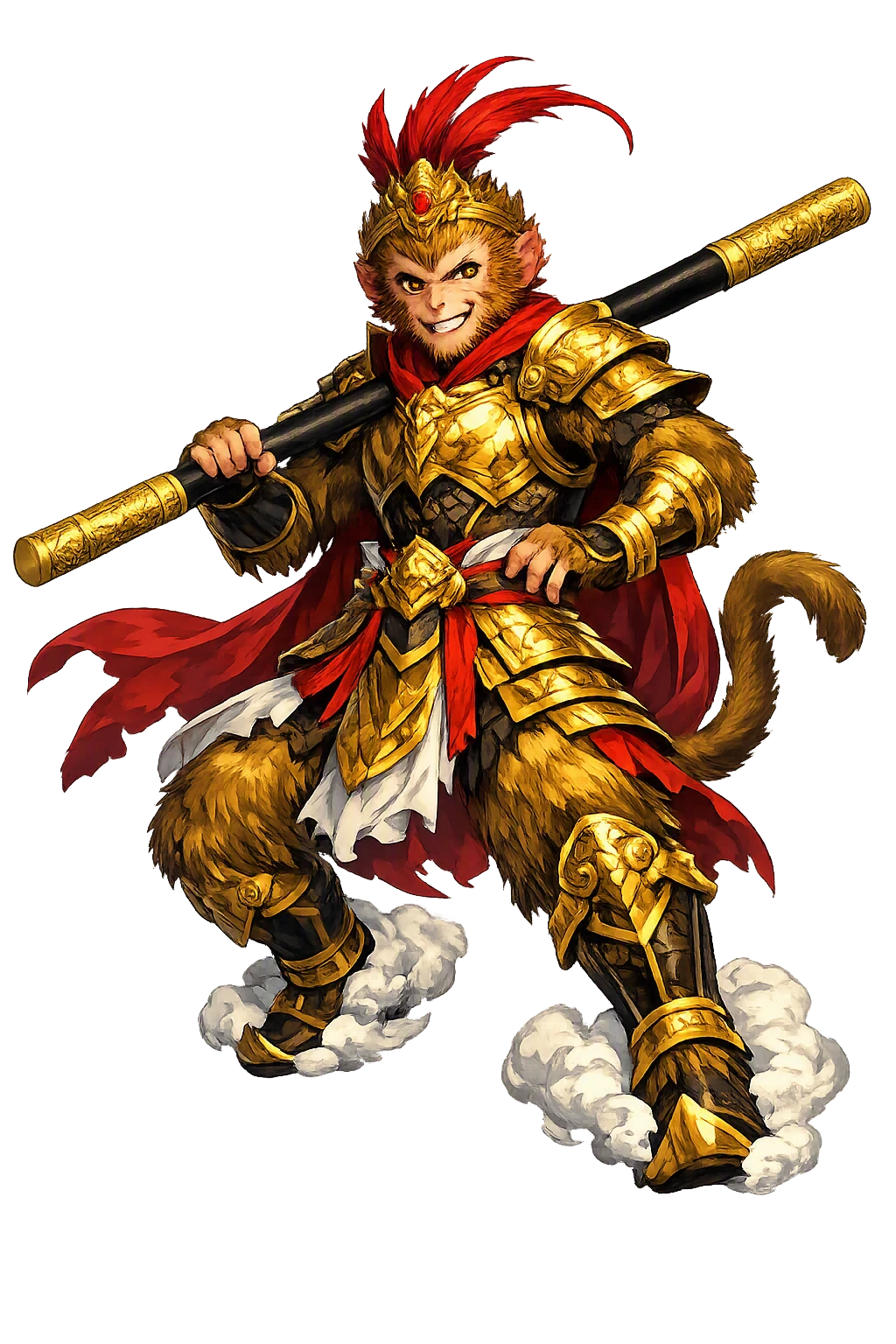
No image of Sūnwùkōng survives from before the novel — the figure is Ming, and his iconography crystallized with the book. The canonical image is fully specified by the text: a gold-furred monkey in chain-mail (suǒzǐ huángjīn jiǎ), the phoenix-winged purple-gold cap, lotus-silk cloud-treading boots, and the Compliant Gold-Banded Staff, shown in temple statues and prints as an iron bar banded at both ends, often shrunk to ear-fitting size. The oldest substantial image corpus is late-imperial: temple wood carvings, porcelain figures, and Qing-dynasty New Year woodblock prints (niánhuà) spread his face into every household. Peking opera then fixed the stage mask — gold and red, the monkey of the mind made paint — and the temple statues of Fujian and Taiwan add a regional likeness: the Great Sage in golden armor, staff in hand, flanked by his sworn brothers.

06

Reception & Transformation

The name after its own age — transmission, translation, survival

Afterlives

The Monkey King's transmission runs from history to travelogue to scripture-novel and outward. The foundation is the pilgrim Xuánzàng's journey to India (629–645) and the record compiled by his disciple Biànjí, the Great Tang Records on the Western Regions (646). Over that sober travelogue the storytellers layered a monkey-disciple: by the Song a Poetic Tale of Tripitaka's Pilgrimage was circulating — it survives in a Yuan-dated print rediscovered in the early twentieth century — and a Yuan-Ming stage play added havoc in heaven. The hundred-chapter novel, printed complete in the 1592 Shidetang edition and attributed by tradition to Wú Chéng'ēn, fused the cycles into the book that conquered East Asian letters. Twentieth-century scholarship made even the authorship a debate — Lǔ Xùn and Hú Shì championed Wú Chéng'ēn, and later critics have never quite let the question rest — while Arthur Waley's 1942 abridged translation, Monkey, carried the story to English readers and fixed his English name. The manuscript and print lineage — Ming commercial publishing, Qing illustrated editions, the modern critical texts — is unusually continuous for so unruly a hero.

Identifications Across Traditions

Sūnwùkōng is a palimpsest, and scholarship has mapped his layers. At the bottom lies the historical pilgrimage: the monk Xuánzàng's journey to India (629–645 CE) and its biography, the Great Tang Records on the Western Regions. Over it the storytellers laid a monkey-disciple motif that appears by the Song in the Poetic Tale of Tripitaka's Pilgrimage and in the Yuan-Ming zaju play attributed to Yang Jingxian — and beneath that, some argue, the Tang tale of the water-monster Wuzhiqi, chained by Yu the Great (Li Gongzuo, Guwuyue jing). The Indian Hanuman has been proposed as a source since the twentieth century; the case is suggestive but contested, and most scholarship now treats Wùkōng as a largely indigenous synthesis dressed in Buddhist pilgrimage clothes. Daoist readers then recast the whole novel as inner alchemy: Wùkōng is the xīnyuán, the monkey of the mind, whose harnessing is the work of cultivation. The figure travelled onward as Son Goku in Japan, Tôn Ngộ Không in Vietnam, and Seoyugi's pilgrim in Korea.

Modern Legacy

The Monkey King is arguably the most retold character in Chinese history. The 1592 Shidetang edition fixed the novel; Peking opera made havoc-in-heaven a signature sequence; the 1986 CCTV television series became one of the most-watched dramas ever aired in the Chinese-speaking world, rebroadcast every summer since. The diaspora carried him into global pop culture — Japan's Son Goku, and through it the Dragon Ball franchise — and the 2024 video game Black Myth: Wukong carried him to the top of world sales charts, a Ming-dynasty pilgrim headlining a global entertainment industry. Meanwhile he never ceased to be a god: the cult of Qítiān Dàshèng persists in Fujian and Taiwan, where his temples, mediums, and festival troupes treat the Great Sage as a living, oath-binding power. The rebel has two afterlives, and neither cancels the other.

08

The Original Script Note

What the written record preserves — and what it does not

Original Script

The original script is 孫悟空 in traditional Chinese, 孙悟空 simplified. Sūn 孫 is the surname ("grandchild, descendant"); wù 悟 is "awakening, enlightenment"; kōng 空 is "emptiness, the void" — the Buddhist technical term. The novel glosses the full name as the monkey awakened to emptiness. The tone-marked restoration Sūnwùkōng keeps all three citation tones (sūn Tone 1, wù Tone 4, kōng Tone 1); no apostrophe is needed, as the segmentation sūn·wù·kōng is unambiguous.

09

The Meditation

What Sūnwùkōng means — beyond the dictionary

Wùkōng is the mind itself, and every reader of the novel eventually notices the allegory hiding in plain sight. Chan literature had long called the restless spirit the "monkey of the mind" (xīnyuán) — the faculty that somersaults from thought to thought faster than any storm, sees through every disguise, and cannot sit still inside even the walls of heaven. The novel gives that monkey a body, a weapon, and a résumé, then asks the only question that matters: what finally disciplines him? Not the armies of heaven, not the furnace of Laozi, not five hundred years under a mountain. A vow — freely accepted, and administered by the weakest person on the road.

That is why the story never goes stale. Every age has its own Wùkōng: the prodigy too gifted for the institution, the startup too unruly for the regulator, the talent the system first insults and then needs. And every age gets the same ending — not the destruction of the monkey, which would be a loss, but his employment, which is a redemption. The five phases mountain becomes a pilgrimage. The hand that beats him also frees him. The mind, fully employed, is a Buddha.

10

Frequently Asked Questions

Deep-dives into the cult, attestation, reception, and sources of Sūnwùkōng

01How do we know how Sūnwùkōng was worshipped?

Wùkōng's material record tracks the novel's. The full cult record →

02Where do the earliest attestations of Sūnwùkōng come from?

The record rests on Wu Cheng'en (attrib.), Xīyóujì (Journey to the West), 1592 Shidetang edition, Dà Táng Sānzàng qǔjīng shīhuà (Poetic Tale of Tripitaka's Pilgrimage), Song, Yáng Jǐngxián (attrib.), Xīyóujì zàjù (Yuan-Ming zaju play), among 6 cited works. The full source apparatus →

03How did later traditions reinterpret Sūnwùkōng?

The Monkey King's transmission runs from history to travelogue to scripture-novel and outward. Reception & transformation →

04What do the surviving images of Sūnwùkōng actually show?

No image of Sūnwùkōng survives from before the novel — the figure is Ming, and his iconography crystallized with the book. The iconography →

05What does the written record of Sūnwùkōng actually preserve?

The original script is 孫悟空 in traditional Chinese, 孙悟空 simplified. The Original Script note →

11

Scholarly Sources

The philological foundations of this restoration

Every claim on this page is grounded in established scholarship. The orthographic restorations follow disciplinary convention. The etymological chain follows the best available reference works. This is not invention — it is resurrection through scholarship.

◈

Lexicography & Philology

  • Journey to the West
  • Wu Cheng'en
◎

Primary Texts

  • The Shan Hai Jing (Classic of Mountains and Seas); the Huainanzi; the Chuci.
◉

Archaeology & Art History

  • Chang, K. C. Art, Myth, and Ritual: The Path to Political Authority in Ancient China.
✦

Religious Studies

  • Wu Cheng'en (attrib.), Xīyóujì (Journey to the West), 1592 Shidetang edition
  • Dà Táng Sānzàng qǔjīng shīhuà (Poetic Tale of Tripitaka's Pilgrimage), Song
  • Yáng Jǐngxián (attrib.), Xīyóujì zàjù (Yuan-Ming zaju play)
  • Lǐ Gōngzuò, Guwuyue jing (Tang tale, preserved in Tàipíng Guǎngjì 467)
  • Chinese Text Project
  • Unihan Database (Unicode Consortium)
Return

The Surface Awaits

You have traced the name from its earliest attestation to its Unicode restoration. Now return to the myth. The story is where the name lives.

Back to Lore
Sūnwùkōng mascot