
How Sūnwùkōng got its accent back
The ASCII form sunwukong is missing something. Sūnwùkōng restores the marks the source language used to distinguish this name from a thousand others — and those marks change how the name is read, pronounced, and understood. This post explains, with the full scholarly record behind it, what each restored mark preserves: the Chinese characters evidence, the reconstructed sound, the myths the name carries, and the classification logic that separates Tier 1 restorations from Tier 2. By the end, the marks in Sūnwùkōng will look less like ornaments and more like what they are — recovered evidence, pinned back in its proper place.
At a Glance
- Restored name: Sūnwùkōng
- ASCII form: sunwukong
- Meaning: "Monkey awakened to emptiness"
- Domain of influence: Monkey King, Chaos, Enlightenment
- Pantheon: Chinese
- Classification: Tier 1
- Original script: 孙悟空 (Chinese characters)
- Live domain: sunwukong.com
Overview
Sūnwùkōng (sunwukong) — Monkey King, Chaos, Enlightenment · Monkey awakened to emptiness — belongs to the Chinese tradition, where it is catalogued under the domain "Monkey King, Chaos, Enlightenment". The name means "Monkey awakened to emptiness".
Sūnwùkōng belongs to the Chinese tradition, where it is associated with monkey king, chaos, enlightenment.
PuniCodex restores the name as Sūnwùkōng and serves its temple at sunwukong.com. The restoration preserves at least one distinctive feature — a diacritic or a distinctive letter — that the ASCII form loses, and exactly one historically valid Unicode restoration exists, which places the name in Tier 1. The plain ASCII form sunwukong survives as a modern convenience imposed by the early domain-name system; the restoration, not the fallback, is the form the project defends as philologically complete.
The Name
The name is attested in Chinese characters as 孙悟空. Etymologically it means "Monkey awakened to emptiness".
Sūn (猴) the monkey clan name; Wù (悟) 'awakened'; Kōng (空) 'emptiness' — the name given by the Buddhist Patriarch Subhūti in Journey to the West.
The ASCII form sunwukong survives only because the early domain-name system could not carry diacritics; it is a technological compromise, not an ancient spelling. The Unicode restoration Sūnwùkōng recovers both the stress accent and the vowel length of the original directly in the address bar. The restoration preserves at least one distinctive feature — a diacritic or a distinctive letter — that the ASCII form loses, and exactly one historically valid Unicode restoration exists, which places the name in Tier 1.
The letter-by-letter transformation runs:
- s → S — Same, capitalized
- u → ū — Macron: long vowel
- n → n — Same
- w → w — Same
- u → ù — Grave tone mark
- k → k — Same
- o → ō — Macron: long vowel
- n → n — Same
- g → g — Same
The canonical temple for this name is served at sunwukong.com.
Etymology & Roots
The recorded derivation reads: Sūn (猴) the monkey clan name; Wù (悟) 'awakened'; Kōng (空) 'emptiness' — the name given by the Buddhist Patriarch Subhūti in Journey to the West.
The reconstruction is classed as attested.
The Original Script
The name is written in Chinese characters as 孙悟空. This original script is the form against which the ASCII fallback sunwukong and the PuniCodex restoration Sūnwùkōng are measured: the restoration preserves both its pitch accent and its vowel quantity of the written form, so that a reader typing the modern address still speaks the ancient name.
Pronunciation
The reconstructed pronunciation of the name is /sunwukong/ — Chinese Reconstruction.
Phoneme by phoneme:
- S — Initial character of the restored form Sūnwùkōng.
- ūnwùkōng — Remainder of the name, preserving the distinctive marks of the Chinese tradition.
For the modern speaker, the closest approximation is: 'SUNWUKONG' — pronounce the restored form with attention to the preserved diacritics and length.
Kindred and historical forms of the name:
- Chinese — Sūnwùkōng, the restored Unicode form of the name
Sūnwùkōng is Tier 1 because the Chinese form preserves distinctive features that ASCII loses: stress, length, or special characters.
Mythology
The stories of Sūnwùkōng circulate within the Chinese corpus, where the figure embodies monkey king, chaos, enlightenment.
Primary Attestation (Sources)
Sūnwùkōng is attested in the canonical Chinese sources as a figure associated with monkey king, chaos, enlightenment.
Name and Meaning (Etymology)
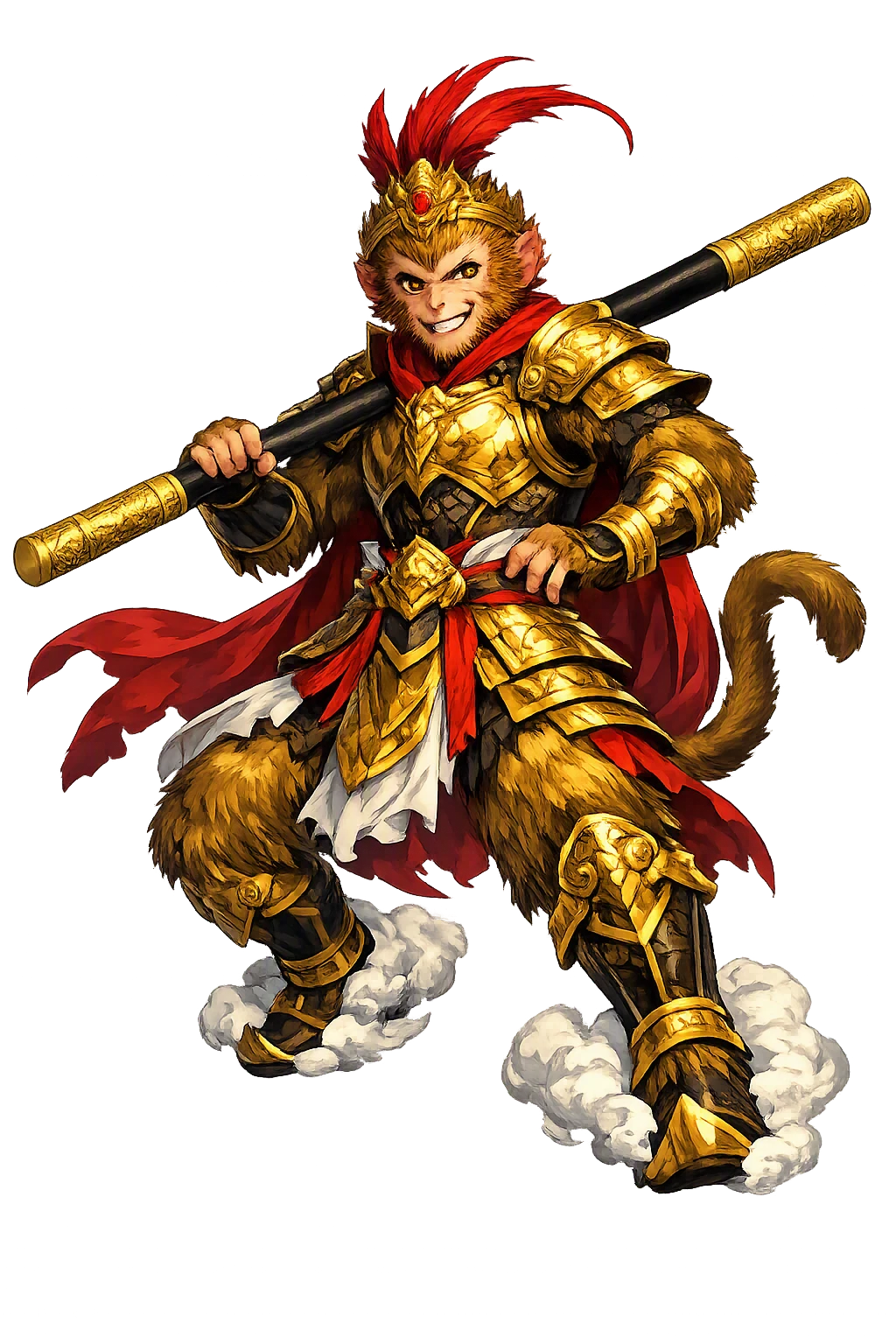
The name means "Monkey awakened to emptiness" and reflects the figure's role in the tradition. Sūn Wùkōng, the Monkey King, is the rebellious protagonist of Journey to the West. Born from a stone egg on the Mountain of Flowers and Fruit, he learns daoist arts, acquires his iron staff from the Dragon King, and wreaks havoc in heaven before being imprisoned under Five Elements Mountain by the Buddha. His later conversion and service to the monk Xuánzàng frame the epic pilgrimage, transforming unchecked power into disciplined spiritual energy.
Symbols & Iconography
The iconography associated with Sūnwùkōng concentrates in a small set of recurring attributes, each a compressed statement about the name:
- Restored Name — The Unicode form Sūnwùkōng carries the original marks of the Chinese tradition.
- Source Script — Attested in the original script as 孙悟空.
- Domain — Monkey King, Chaos, Enlightenment
- Etymology — Monkey awakened to emptiness
Archaeology & Evidence
The material record for Sūnwùkōng survives in a small number of securely identified remains, catalogued below; the corpus is thin but unambiguous, and each site is tied to the name by ancient testimony.
Sūnwùkōng is attested in the textual and iconographic record of the Chinese tradition.
Realm & Domain
Sūnwùkōng belongs to the Chinese tradition, where it is associated with monkey king, chaos, enlightenment.
Monkey King
The central domain of Sūnwùkōng in the chinese tradition.
Monkey awakened to emptiness
The name signifies "Monkey awakened to emptiness".
Unicode Restoration
The restoration Sūnwùkōng recovers what plain ASCII sunwukong flattens.
Original Attestation
Attested in the sources as 孙悟空.
Across Cultures
Sūnwùkōng appears within the Chinese tradition and has influenced later retellings, artistic depictions, and scholarly study. The Unicode restoration preserves the name's distinctive orthography for contemporary use.
Kindred figures in the PuniCodex cross-tradition index include Loki (trickster / shape-shifter), ꜥꜣpp (chaos / primordial / world serpent), Cháos (chaos / primordial / world serpent), Ẹṣù (trickster / mischief), Hati (chaos / primordial / world serpent), and Jǫrmungandr (chaos / primordial / world serpent).
Cultural Legacy
Sūnwùkōng continues to appear in scholarship, art, and popular reception as a significant figure of the Chinese tradition. Restoring the name in Unicode returns the original marks that ASCII removes. Sun Wukong has become a global emblem of trickster heroism, appearing in opera, film, manga, video games, and political satire across East and Southeast Asia.
The Scholarly Record
The account of Sūnwùkōng given in this edition rests on the witnesses and reference works listed below. Lexica and etymological dictionaries secure the form and meaning of the name; the literary and religious texts supply the narrative evidence.
- Unihan Database.
- Hanyu Da Zidian. The primary source is Wu Cheng'en's Journey to the West; scholarship also examines earlier monkey-hero tales in Chinese and Indian narrative.
A Meditation
Sūnwùkōng embodies monkey king, chaos, enlightenment in the Chinese imagination. The name's restoration is not merely cosmetic: it recovers the stress, length, and script that make the figure recognizable in the source tradition.
The Unicode Restoration
Sūnwùkōng is classified as Tier 1: the restoration preserves at least one distinctive feature — a diacritic or a distinctive letter — that the ASCII form loses. The ASCII fallback sunwukong still resolves everywhere, but it is the restored form that carries the name's full information. Across the 9 characters of the name, the restoration adjusts 3: 1 mark of stress (ù); 2 marks of length (ū, ō). That is the whole thesis of this temple: the marks are the message.
Character by Character
The journey from sunwukong to Sūnwùkōng, one character at a time:
- s → S — Same, capitalized
- u → ū — Macron: long vowel
- n → n — Same
- w → w — Same
- u → ù — Grave tone mark
- k → k — Same
- o → ō — Macron: long vowel
- n → n — Same
- g → g — Same
The Domain Name
The restored name is live as a working domain: sunwukong.com. Behind the scenes the DNS carries it in punycode form — an ASCII-compatible encoding that lets a non-ASCII name travel the global network without breaking older infrastructure. The visitor sees Sūnwùkōng; the machines see the encoding. That duality is the engineering compromise on which the entire restoration rests, and it is why a name written the way its own tradition wrote it in Chinese characters can now be typed into any browser on earth.
The Chinese Pantheon
Sūnwùkōng is one of 59 entries the PuniCodex lexicon catalogues under the Chinese pantheon. The Pantheon page gathers the tradition's major figures in one place, and the Lexicon lets you filter all 974 restorations by tradition, tier, or script — the fastest way to see where this name sits among its kin.
Frequently Asked Questions
What does Sūnwùkōng mean? The traditional gloss is "Monkey awakened to emptiness."
Which tradition does Sūnwùkōng belong to? Sūnwùkōng is catalogued in the Chinese pantheon of the PuniCodex lexicon.
Why is Sūnwùkōng classified as Tier 1? Because the restoration preserves at least one distinctive feature — a diacritic or a distinctive letter — that the ASCII form loses — and the marks in the restored spelling preserve exactly that evidence.
Is Sūnwùkōng a working domain? Yes — sunwukong.com resolves today and routes to this temple.
Can I use Sūnwùkōng in a normal browser? Yes. The DNS resolves the punycode form automatically, and the type tool on this site converts sunwukong to Sūnwùkōng for copying and pasting.
Where does the scholarly information come from? The entry is built from lexica, inscriptional evidence, and reviewed scholarly sources listed in the Scholarly Edition. Every claim is traceable to a canonical source.
Typing Sūnwùkōng
You do not need a special keyboard to use this restoration. The PuniCodex Type Tool converts the ASCII form sunwukong into Sūnwùkōng as you type, and the browser extension offers the same conversion inside any text field. Copy the restored form, paste it into the address bar, and the DNS does the rest.
Sister Temples
Other temples in the Chinese pantheon include Hòuyì, Kǒngzǐ, and Lánlíng — each with its own restoration story, its own scholarly record, and its own place in the lexicon.
Why This Restoration Matters
The marks in Sūnwùkōng were never lost; they were only waiting for a carrier that could hold them. Now that the carrier exists, the burden flips: every use of sunwukong is a choice to leave evidence on the table. The PuniCodex temple keeps the restored form in circulation — as a domain, a dataset entry, and a scholarly argument — so that the choice to use it stays easy. Accent by accent, macron by macron, that is how the original names come back: not with a single grand gesture, but with a spelling that finally works everywhere.
Explore Further
This post is one doorway into the temple. The home page carries the full character breakdown and the ambient canvas; the lore page tells the myths in long form; the Scholarly Edition preserves the sources, pronunciation data, and revision history; and the patron wall supports the restoration directly. For the wider map, browse the Lexicon, explore the Pantheon, or return to the PuniCodex blog.
A Closer Look at the Marks
A restored name is a small map. In Sūnwùkōng, the journey from the ASCII fallback sunwukong to the Unicode form can be read letter by letter, and each letter tells a story. Of the 9 characters, 6 remain unchanged; they anchor the name to its modern shape. The remaining adjustments recover marks the source tradition used to distinguish this name from every other word built from the same letters.
The s stays as it is — Same, capitalized.
The u becomes ū — Macron: long vowel.
The n stays as it is — Same.
The w stays as it is — Same.
The u becomes ù — Grave tone mark.
The k stays as it is — Same.
The o becomes ō — Macron: long vowel.
The n stays as it is — Same.
The g stays as it is — Same.
Together these changes are not decoration. They are the minimum set of marks needed to keep the name legible in its own tradition. Remove them and you still have a string of letters; you no longer have the name as it was written.
Sūnwùkōng in Its Tradition
Sūnwùkōng does not stand alone. It belongs to the Chinese tradition, where it is counted among 59 names in the PuniCodex lexicon. Its sphere — Monkey King, Chaos, Enlightenment — places it beside other figures who govern similar aspects of experience. The restored spelling is therefore not only a philological decision; it is a way of keeping the name in the company of its kin. When the address bar shows Sūnwùkōng, it marks the boundary between a generic search term and a named entry in a living catalog of myth. That catalog is the point of the project. Every restored name is a vote for specificity: the web should know the difference between a figure and a keyword, between a tradition and a trend. Sūnwùkōng is one such vote.
What You Will Find in the Temple
The temple page for Sūnwùkōng is more than a landing page. The home tab presents the character breakdown, the pronunciation guide, and the live domain status in a single view. The lore tab gathers the myths and narratives that give the name its depth. The Scholarly Edition tab publishes the sources, variant forms, and review history that justify the restoration. Industry patterns show where the name appears in modern commerce and culture, while the gallery and creatives tabs collect visual and sponsor material. The patron wall lets visitors support the restoration directly. Each tab is generated from the same canonical sources, so the domain, the blog, the scholars page, and the search index all agree. The result is a single source of truth about a name, delivered through several doors.
The Restoration on the Live Web
A domain name is a kind of publication. When Sūnwùkōng resolves, it proves that the restored spelling is not a theoretical exercise; it is a working address on the public internet. Search engines can index it, language models can encounter it, and anyone who copies it from a manuscript can paste it into a browser. That practical reality changes the status of the restoration. Before Unicode domains, a scholar could write the name correctly in an article while the public web flattened it to sunwukong. Now the public web can carry the correct form end to end. The punycode translation happens silently, so the infrastructure remains compatible while the visible name keeps its marks. That compromise — human-readable restoration, machine-readable encoding — is the foundation of every PuniCodex temple.
Related Names
Sources
The full scholarly apparatus — every citation, revision, and review — lives in the Scholarly Edition. Key references for this post:
- Wu Cheng'en, Journey to the West (Xīyóu Jì), c. 1592.
- Chinese classics (Ming-drama and encyclopedic antecedents).
- Daoist Canon (Daozang), inner-alchemy (neidan) texts.
- Chinese Buddhist canon (Dàzàngjīng / Taishō Tripiṭaka).
- Huili and Yancong, Biography of the Tripiṭaka Master of the Great Ci'en Monastery.
- Unihan Database.
- Unihan Database.
- Hanyu Da Zidian.
- Lexicon authorities for this entry: Journey to the West, Wu Cheng'en.