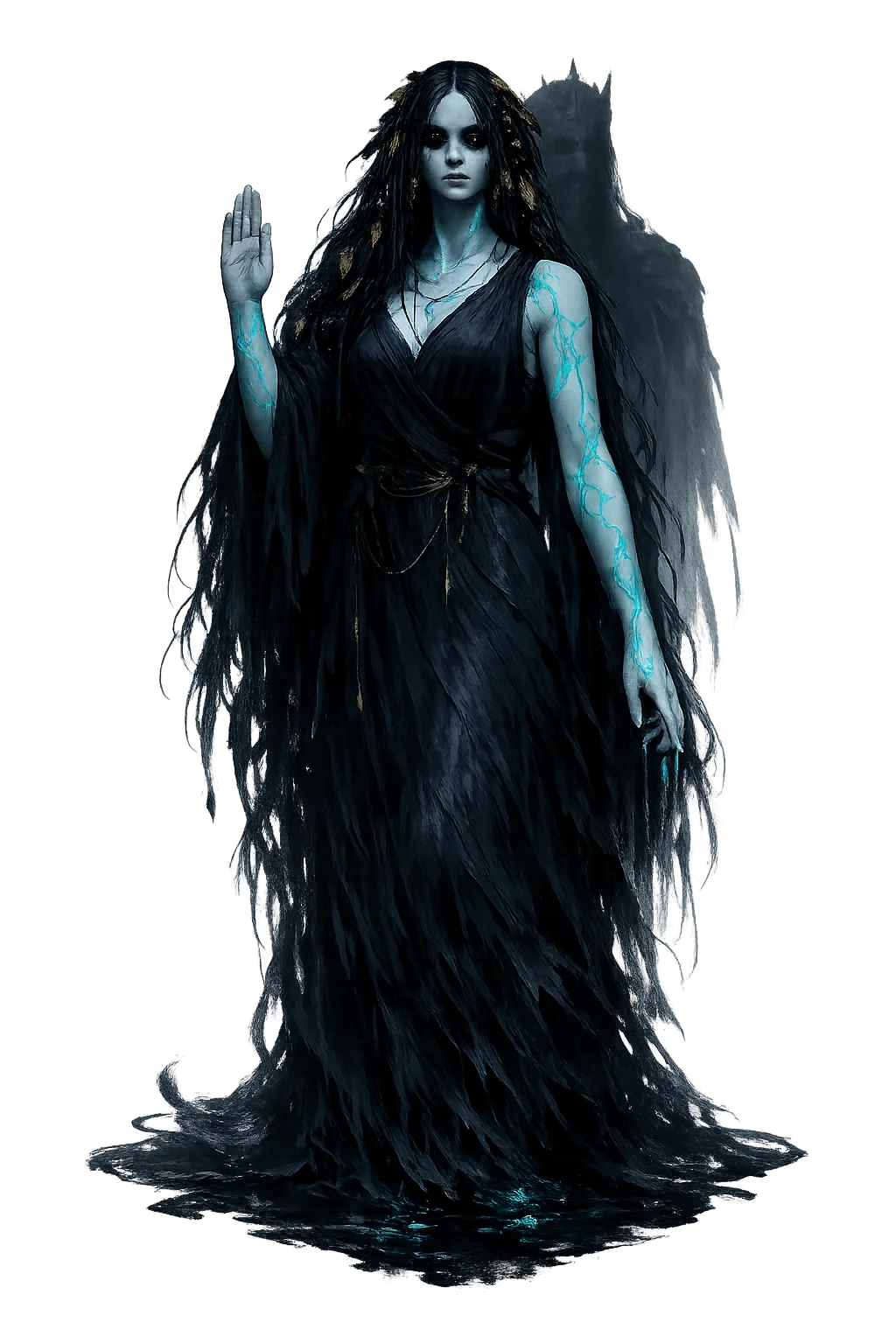
Stories of Stýx
Stýx's myths are about the one thing stronger than the gods: the word that cannot be taken back. She is eldest daughter of the Ocean, mother of the powers that prop Zeús' throne, boundary of the dead — and the water that makes even Olympus keep its promises.
The Iliad's formula runs through the epic: when Zeus wishes to make an oath unanswerable, he swears 'by the earth and the broad heaven above and the down-flowing water of Styx' (Iliad 15.36–38). Hera, buying the cooperation of Sleep, swears by 'the inviolable water of Styx, which is the greatest and most dread oath for the blessed gods', and pledges him one of the Graces in marriage (Iliad 14.271–279). No epic shows the penalty ever collected — the oath exists precisely so that it need never be. Hesiod's Theogony (793–806) sets the penalty for perjury: the god who pours her water in libation and forswears lies breathless for a full year, cut off from the gods' counsils and feasts for nine more, and returns only in the tenth. Even heaven polices itself — and its police is a river.
Hesiod's Theogony (383–403) makes her the hinge of Zeus' kingdom. Styx, eldest daughter of Ocean and Tethys, joined herself to the Titan Pallas and bore four children — Zelos (Rivalry), Nike (Victory), Kratos (Power), and Bia (Force). When the war against the Titans began, she was the first of the immortals to bring her children to Zeus' side, remembering how her father Ocean had suffered under the old dispensation — an eldest daughter's memory of the old regime deciding the new. Zeus rewarded her above all: her children were granted to dwell forever beside him, and the oath by Styx was established as the supreme bond of the gods. The king's throne, the poets say, is propped by a river and her brood — rivalry and victory, power and force, the whole grammar of rule, born of the boundary itself.
Her water is the underworld's own. Homer sends Odysseus across Ocean to the land of the Cimmerians, where 'the streams of the river Ocean flow' beside the gates of the sun (Odyssey 10.508–515), and the later tradition fixed Styx among the rivers of the dead, with Charon ferrying the unburied across her dark flood (Virgil, Aeneid 6.295–330). Hesiod (Theogony 775–806) makes her a tenth part of Ocean's whole flow, falling from a cliff far beneath the earth, where Night and Day pass each other at the threshold. The dead drink nothing from her, but she fences them: Styx is not a place you cross so much as a condition you accept. In the Orphic gold tablets her name is already there, one of the guardians of the boundary between the living and the company below.
The Greeks placed her on earth in Arcadia. Near the forsaken city of Nonakris in the northern Peloponnese, Pausanias reports (8.17.6–18.6), a water called Styx drips from a high cliff — black, cold beyond any other water, said to destroy whatever vessel it touches. Herodotus (6.74) records the Arcadians' claim that the water can be held in no vessel but a horse's hoof, and links it with the strange end of the Spartan king Kleomenes, who died raving in Arcadian exile. Whether poison spring or simply meltwater of terrible cold, the identification made the divine oath locally tangible: an oath sworn 'by Styx' at Nonakris could point downhill at the thing itself. Later geographers repeat the Arcadian notice, and modern travelers have matched the description to the waterfall above the Krathis gorge. It is the rare case where a goddess's material trace outlasted her cult.
The Boundary, the Vow, and the Water the Gods Fear
Stýx is the river by which the gods themselves are bound: the underworld stream whose water makes an oath unbreakable even for Olympos, the eldest daughter of the Ocean, and the mother of Force, Rivalry, Power, and Victory.
Swear on her and the vow is iron — Zeús himself cannot break it.
The river of the threshold: between the living and the dead, the world and the under.
First-born of Ōkeanos and Tēthys — the river with seniority among all waters.
Her children: Bía (Force), Zêlos (Rivalry), Krátos (Power), Níkē (Victory).
From the original script to the living URL
Στύξ
The name in its original Greek form. Stýx (Στύξ) is attested in the source tradition — “Hateful”. Its acute accents carry the full phonetic and orthographic weight of the source tradition.
styx
Reduced to plain styx, the name loses everything that made it specific: acute accents. What remains is an ASCII string that machines can parse but that no longer speaks with its original voice.
Stýx
The Unicode restoration recovers what ASCII flattened. Stýx restores acute accents, returning the name to its original written dignity. The domain encodes to Punycode, but the browser displays the truth.
Stýx.com → xn--stx-moa.com
The non-ASCII characters in Stýx are encoded while the ASCII remains visible. To the DNS, it is Punycode. To humanity, it is Stýx.
Owned, ideal, and ASCII forms of Stýx
Stýx
Restores Στύξ. The live temple domain — stýx.com.
styx
Flattens Στύξ. The plain ASCII fallback — what DNS and legacy systems see.
How Stýx was spoken
How Stýx is preserved in writing
A bespoke provenance study for Stýx is being prepared by the PUNICODEX scholarly team.
Contribute scholarly provenance →The lore you have read is the living myth. Extended Lore opens the scholarly vault beneath it: the cult and its material remains, a history of the image, the name after antiquity, a meditation on what the name still means, and the full scholarly apparatus — etymology, orthography, sources.
Enter Extended Lore