PuniCodex

Extended Lore

Στύξ Stýx

Etymology · Orthography · Cult · Iconography · Reception · Sources

Tier 2 Stýx.com
Stýx — River of Hate, Oaths
01

Quick Facts

Essential information about Stýx, River of Hate, Oaths

Original ScriptΣτύξ
Unicode RestorationStýx
Reconstructed Pronunciation/stýks/
PantheonGreek
DomainRiver of Hate, Oaths
MeaningHateful
ClassificationTier 2
Primary DomainStýx.com
Sacred SymbolsThe dark water, The libation cup, The four children, The cliff of Nonakris
02

Etymology & Word Family

From original script to Unicode restoration

Original Script Στύξ Stýx — "Hateful"
Unicode Restoration Stýx Restored stress, length, and script
Modern ASCII styx Plain-ASCII fallback

The name Stýx carries the orthographic signature of the greek tradition: Στύξ. Unicode restoration recovers what ASCII flattens.

03

Unicode Character Breakdown

Character-by-character philological analysis

CharacterUnicodeNameBlockPhonetic Role
SU+0053Latin Capital Letter SBasic LatinS uppercase
tU+0074Latin Small Letter TBasic Latint same
ýU+00FDLatin Small Letter Y with AcuteLatin-1 SupplementAcute on y
xU+0078Latin Small Letter XBasic Latinx same

The Tier 2 classification reflects how much of the original phonology this restoration preserves — stress and vowel length for Greek names, distinctive letters and diacritics for every other tradition.

04

Cult & Worship

How the sacred was kept — rites, sanctuaries, remains

The Cult

No ancient city organized a festival of Stýx; her cult was the cult of the oath. Warriors and envoys swore by her water, and the Arcadian waterfall near Nonakris was shown to visitors as the actual stream by which the gods themselves bound their word. Libation and curse rites accompanied serious oaths, but temples, priesthoods, and regular sacrifice are absent from the record. Her power lay in the terrifying idea that even Olympians could not break a vow sworn in her name.

In the Earth

The Greeks placed her water in Arcadia: the Styx waterfall near Nonakris in the northern Peloponnese — a cliff-plunge so cold it was said to be her true stream, and Pausanias reports the locals' oath by it. The gorge at Aroania (Krathis river) is shown to visitors still as the legendary drop. Homer's and Hesiod's lines are her oldest attestations; the Roman poets from Virgil to Statius keep her darkly flowing in every underworld scene.

05

Iconography

How Stýx was imaged across the ages

The Image

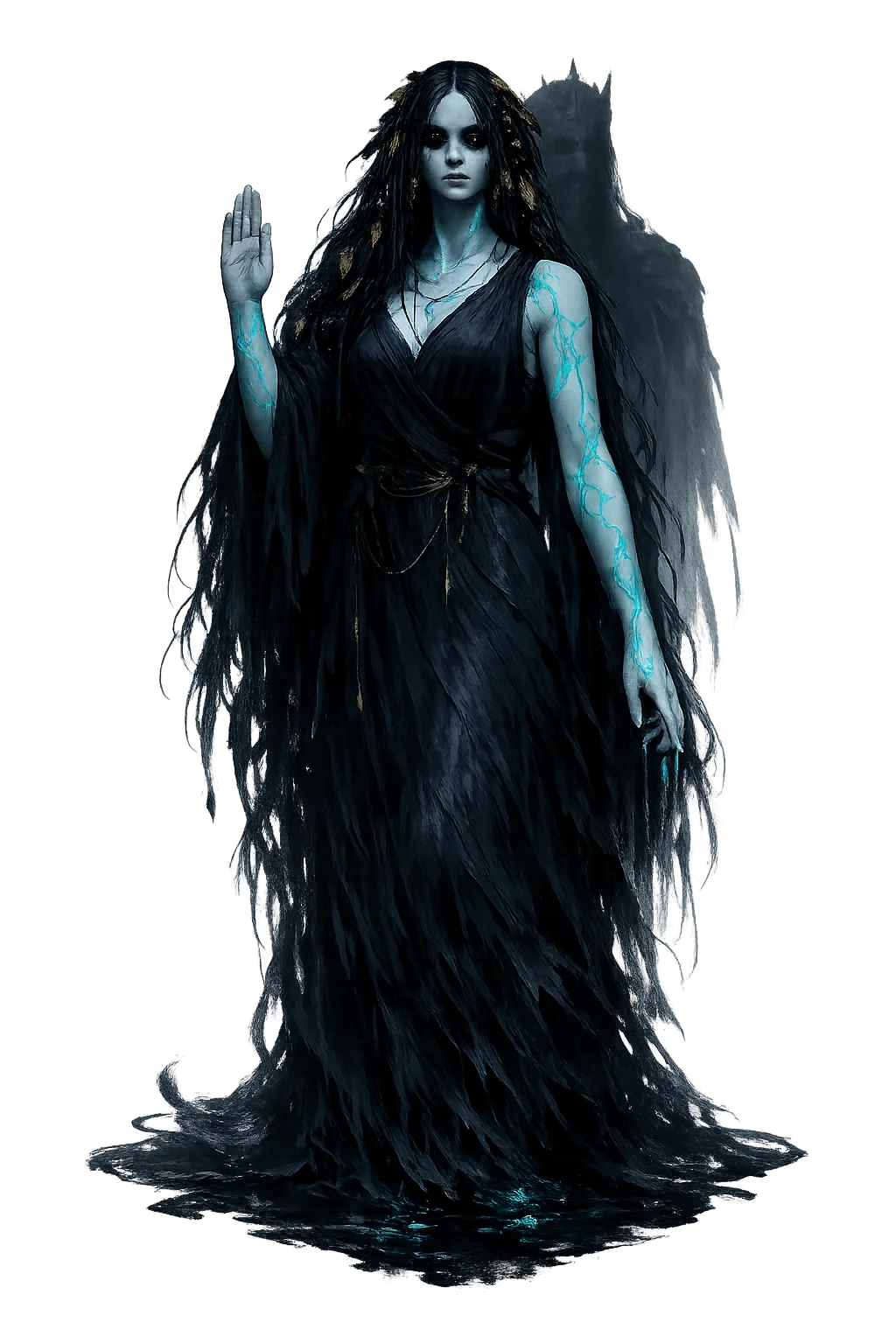
Attic red-figure vase-painters personified the hateful river as a veiled, dark-robed nymph, sometimes seated in the underworld landscape or witnessing the oaths of gods and heroes. Roman sarcophagi, manuscript illuminations of Dante’s Inferno, and later emblem books kept the same somber figure, while Romantic painters such as Fuseli and Turner turned the waterfall at Nonakris into a sublime emblem of mortality. Modern astronomy later gave her name to a small moon of Pluto, continuing the personification in a new register.

06

Reception & Transformation

The name after its own age — transmission, translation, survival

Afterlives

Stýx passed from Homeric epic through Virgil, Ovid, and Statius into the Christian and Stoic imagination as the boundary river of death and the irreversible oath. Dante placed her among the infernal waters, and Renaissance readers rediscovered her through the classics, through mythographies, and through emblematic engravings. Medieval moralizations used her as a warning against perjury, while modern astronomy, fantasy literature, psychology, and video games keep her name alive as the obligatory river of the underworld and a symbol of unbreakable contract. Legal and political rhetoric still speaks of crossing the Rubicon or the River Styx when describing irreversible decisions, showing how deeply the metaphor has entered ordinary language. Her reception is therefore one of the most durable examples of a minor divine concept becoming a universal metaphor for finality and commitment.

Identifications Across Traditions

Rome transliterated rather than translated her: Styx remained Styx in Virgil and Ovid, the river Charon plies in Aeneid 6 and the oath by which Jupiter himself swears. Dante lowered her into the fifth circle of the Inferno, the marsh where the wrathful tear at one another in the mud — the oath-river become the swamp of anger. Her name became the English adjective 'Stygian' for whatever is dark, cold, and absolute, and her children govern the modern vocabulary: zeal, power, victory. Milton keeps 'Tartarus and Styx' among the fallen angels' retreats in Paradise Lost, and every fantasy underworld since has kept her dark water on file.

Modern Legacy

'Stygian' is her everyday immortality: the word for the unbreakably dark and the absolutely binding. Her children govern the modern vocabulary — force, zeal, power, victory — and her water gave literature its favourite contract: the deal that cannot be exited, from Faust to fantasy fiction, from sworn testimony in a courtroom to the 'Stygian' underworlds of games, novels, and films, where she appears more often than any other classical borrowing. Astronomers keep the name current: a small moon of Pluto, found by the New Horizons mission, is named Styx. Every 'I swear' spoken in earnest is a small draught of her river, drunk in public.

07

The Meditation

What Stýx means — beyond the dictionary

Stýx is the god of the word that costs something. Contracts, vows, marriage promises, courtroom oaths — all of them work because somewhere, at some depth, a culture decided that speech must bind, and her water is that decision made into a river. She asks the question every oath answers: what are you willing to swear on, and what will it cost you to keep?

The Greeks gave the office to a daughter of the Ocean rather than to a judge or a king — as if to say that binding power is older than law, older than Zeus, as old as the waters under the world. Nine days and nine nights, Hesiod says, an anvil would fall before it touched her stream. Trust itself, the myth implies, is the deepest thing in the universe: everything we build rests on promises, and promises rest on something that cannot be bargained with.

08

Frequently Asked Questions

Common questions about Stýx, River of Hate, Oaths, and Unicode restoration

01How do you pronounce Stýx?

In reconstructed pronunciation, Stýx is /stýks/ — approximately STEEX — one syllable, acute on the only vowel there is.

02What does Stýx mean?

Stýx means Hateful in the greek tradition.

03What are the symbols of Stýx?

Stýx is associated with The dark water (The stream that chills even gods — oaths made absolute), The libation cup (The poured offering that accompanies every divine oath — her water drunk, not merely named), The four children (Force, Rivalry, Power, Victory — the engines of Zeús' reign, born of a river), The cliff of Nonakris (The Arcadian waterfall identified with her — the one earthly place where the oath-river could be seen and touched).

04Why restore Stýx in Unicode?

Plain ASCII styx strips the stress, length, and script that make the name specific. Unicode restoration returns the name to its original written dignity.

05What is the most important myth about Stýx?

“The Water the Gods Swear By” — the The Oath story that anchors the mythology of Stýx, told in full on the lore page.

09

Scholarly Sources

The philological foundations of this restoration

Every claim on this page is grounded in established scholarship. The orthographic restorations follow disciplinary convention. The etymological chain follows the best available reference works. This is not invention — it is resurrection through scholarship.

◈

Lexicography & Philology

  • Liddell, H. G., Scott, R., & Jones, H. S. A Greek-English Lexicon. Oxford: Clarendon Press, 9th ed. 1996.
◎

Primary Texts

  • Hesiod
  • Homer, Iliad 14.271–279; 15.36–38
  • Homer, Odyssey 10.508–515
  • Hesiod, Theogony 383–403, 775–806
  • Pausanias 8.17–18
  • Virgil, Aeneid 6.295–330
◉

Archaeology & Art History

  • Material evidence — iconography, inscriptions, and temple archaeology — for Stýx and related cults.
✦

Religious Studies

  • Herodotus 6.74
Return

The Surface Awaits

You have traced the name from its earliest attestation to its Unicode restoration. Now return to the myth. The story is where the name lives.

Back to Lore
Stýx mascot