Stories of Sphínx
The Greek Sphinx is a daughter of monstrous parents, sent by Hera to punish Thebes. Her story is inseparable from the tragedy of Oedipus — the man who answered her question and thereby walked straight into the fate he had fled. Every telling of the riddle is a small treatise on what it means to be human.
Hesiod gives the Sphinx an unexpected pedigree: in the Theogony (325–327) she is born to the Chimaira by Orthrus, the two-headed hound — a pairing that also produces the Nemean Lion — which makes her Typhon's granddaughter, twice removed from the storm-giant's challenge to Zeus. Apollodorus, Library 3.5.8, streamlines the line and calls her simply 'daughter of Typhon and Echidna', kin to Cerberus and the Hydra. The sources disagree, and the disagreement is itself instructive: both genealogies place her inside the same brood of hybrid terrors, children whose mixed bodies embody the world's refusal to keep its categories clean. What the Sphinx inherited is a compound nature — speech joined to claws, a question delivered by a predator. Her lineage tells us what her riddle will confirm: the monster at the threshold is never only a monster, and neither is the answerer only a man.
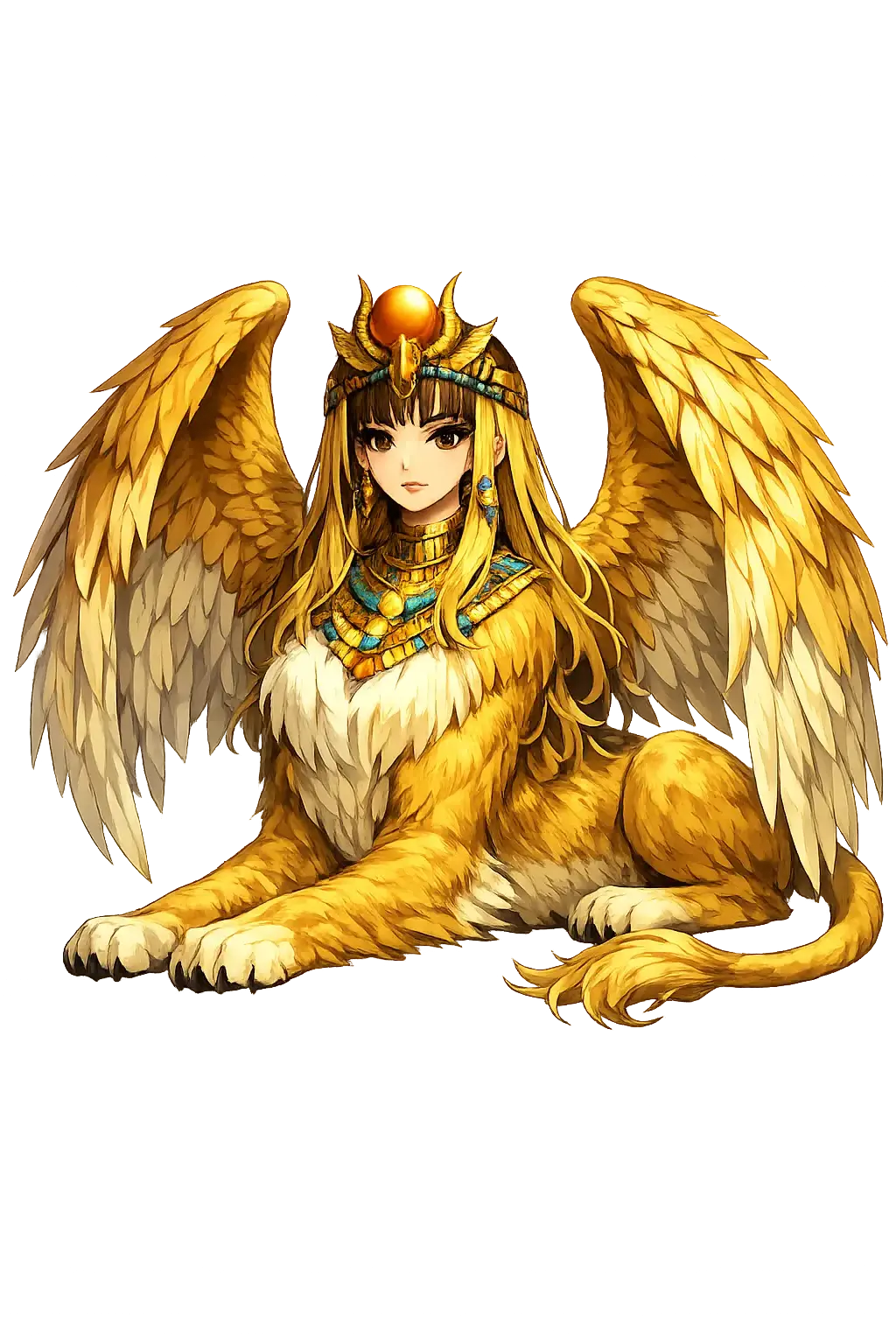
While Laius was king of Thebes, Hera sent the Sphinx against the city as a plague, Apollodorus reports (Library 3.5.8): a creature with the face of a woman, the breast and feet and tail of a lion, and the wings of a bird. She took up station on Mount Phicium above the city and waylaid travellers with a riddle the Muses had taught her. Those who failed to solve it she snatched up and devoured, until the roads fell silent and Thebes starved behind its walls. Creon, ruling for the young Laodamas, proclaimed that whoever freed the city of the monster should have the kingdom — and the hand of the widowed Jocasta. The Sphinx was therefore never a random horror: she was a siege engine of divine anger, a blockade of knowledge laid against a city already burdened with an old, unconfessed crime. Her questions stopped the mouths of Thebes as surely as famine; only a stranger willing to answer for all mankind could lift the blockade.
Oedipus, the Corinthian exile with the pierced ankles, came to the crossroads beneath Mount Phicium and heard the Sphinx's question: what creature walks on four feet at morning, two feet at noon, and three feet at evening? 'Man,' he answered — crawling in infancy, upright in maturity, leaning on a staff in age (Sophocles, Oedipus Tyrannus 130–151, 390–398; Apollodorus 3.5.8). In a later, harsher version of the question the feet are 'crippled', and the answer must carry Oedipus's own lameness inside it. Defeated by the one answer she could not survive, the Sphinx — cursing him even in defeat, Sophocles says — threw herself from the rock and died (Apollodorus 3.5.8; Hyginus, Fabulae 67; Pausanias 9.26.2–4 discusses the monument the Thebans later raised to her). The myth's economy is perfect: a single word ends a siege, wins a throne, and delivers the answerer to the incest and patricide he believed he had outrun. To solve the riddle of man is to inherit man's whole fate.
The Greek sphinx did not invent its own body. For more than two thousand years before the Theban monster was conceived, Egypt carved the androsphinx — lion's body, king's head — to guard temples, tombs, and processional ways; the Great Sphinx at Giza, cut from the living rock beside Khafre's pyramid around 2500 BCE, is the supreme survivor of that tradition, and Herodotus (2.175) saw sphinxes still standing in the sanctuaries of Egypt. But the Egyptian sphinx asks no riddles and strangles no one: it is royal power at rest, vigilance made monumental, the king as sun-guardian at the horizon. What the Greeks did was fuse that hieratic form to a characteristically Greek terror — the lethal question, the exam at the threshold — and the fusion proved unforgettable. The borrowed body shows how freely the Greeks looted older cultures for monsters; the invented voice shows what they added. Egypt made the sphinx a wall; Greece made it an interrogator.
Guardian, Strangler, and Threshold Terror
The Sphinx is the winged lion-woman who crouched outside Thebes and strangled those who could not answer her riddle. She is not merely a monster but a guardian of thresholds: the creature who bars the road until the traveller proves worthy of understanding — and who destroys those who cannot name what they are.
Sent by Hera, she perched on Mount Phicium and posed her riddle to every traveller on the road (Apollodorus 3.5.8).
'What walks on four feet in the morning, two at noon, and three in the evening?' — a compressed life of man.
Her name means 'the strangling one'; all who failed the riddle she seized and devoured.
Oedipus answered 'man'; in fury or shame she threw herself from the rock (Apollodorus 3.5.8; Hyginus, Fab. 67).
From the original script to the living URL
Σφίγξ
The name in its original Greek form. Sphínx (Σφίγξ) is attested in the source tradition — “Strangler”. Its aspirated consonants and acute accents carry the full phonetic and orthographic weight of the source tradition.
sphinx
Reduced to plain sphinx, the name loses everything that made it specific: aspirated consonants and acute accents. What remains is an ASCII string that machines can parse but that no longer speaks with its original voice.
Sphínx
The Unicode restoration recovers what ASCII flattened. Sphínx restores aspirated consonants and acute accents, returning the name to its original written dignity. The domain encodes to Punycode, but the browser displays the truth.
Sphínx.com → xn--sphnx-1sa.com
The non-ASCII characters in Sphínx are encoded while the ASCII remains visible. To the DNS, it is Punycode. To humanity, it is Sphínx.
Owned, ideal, and ASCII forms of Sphínx
Sphínx
Restores Σφίγξ. The live temple domain — sphínx.com.
sphinx
Flattens Σφίγξ. The plain ASCII fallback — what DNS and legacy systems see.
How Sphínx was spoken
How Sphínx is preserved in writing
A bespoke provenance study for Sphínx is being prepared by the PUNICODEX scholarly team.
Contribute scholarly provenance →The lore you have read is the living myth. Extended Lore opens the scholarly vault beneath it: the cult and its material remains, a history of the image, the name after antiquity, a meditation on what the name still means, and the full scholarly apparatus — etymology, orthography, sources.
Enter Extended Lore