PuniCodex

Extended Lore

Σφίγξ Sphínx

Etymology · Orthography · Cult · Iconography · Reception · Sources

Tier 2 Sphínx.com
Sphínx — Riddling Monster
01

Quick Facts

Essential information about Sphínx, Riddling Monster

Original ScriptΣφίγξ
Unicode RestorationSphínx
Reconstructed Pronunciation/spʰíŋks/
PantheonGreek
DomainRiddling Monster
MeaningStrangler
ClassificationTier 2
Primary DomainSphínx.com
Sacred SymbolsLion's body, Wings, Woman's head, Cliff at the crossroads
02

Etymology & Word Family

From original script to Unicode restoration

Original Script Σφίγξ Sphínx — "Strangler"
Unicode Restoration Sphínx Restored stress, length, and script
Modern ASCII sphinx Plain-ASCII fallback

The name Sphínx carries the orthographic signature of the greek tradition: Σφίγξ. Unicode restoration recovers what ASCII flattens.

03

Unicode Character Breakdown

Character-by-character philological analysis

CharacterUnicodeNameBlockPhonetic Role
SU+0053Latin Capital Letter SBasic LatinSame, capitalized
pU+0070Latin Small Letter PBasic LatinSame
hU+0068Latin Small Letter HBasic LatinSame
íU+00EDLatin Small Letter I with AcuteLatin-1 SupplementAcute on i (Σφίγξ)
nU+006ELatin Small Letter NBasic LatinSame
xU+0078Latin Small Letter XBasic LatinSame

The Tier 2 classification reflects how much of the original phonology this restoration preserves — stress and vowel length for Greek names, distinctive letters and diacritics for every other tradition.

04

Cult & Worship

How the sacred was kept — rites, sanctuaries, remains

The Cult

The Greek Sphínx had no cult in the proper sense: she is a riddling monster whose function is to be defeated by Oidipous. There were no priesthoods, festivals, or altars dedicated to her; the religious energy of her story flows to Apollo and the Delphic oracle, and to the civic cults of Thebes. The Egyptian sphinx is a different being—the living royal ḥr-m-ꜣḫt ('Horus of the Horizon')—and the Great Sphinx at Giza was embedded in pharaonic solar cult, New Kingdom stelae, and processional ways. For the Greek Sphinx, however, the absence of worship is precisely what defines her: she is a theological obstacle, not a deity.

05

Iconography

How Sphínx was imaged across the ages

The Image

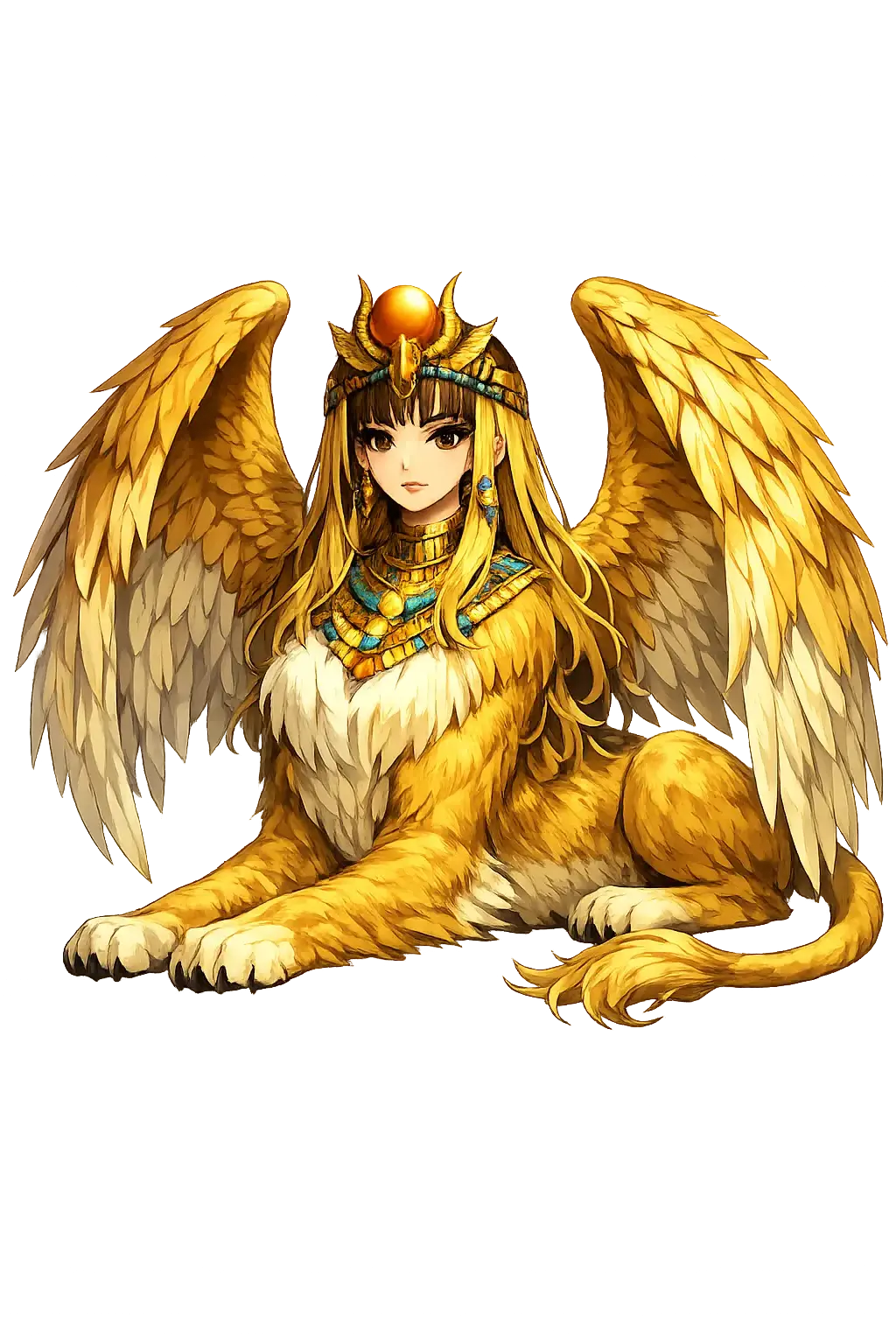
The Greek Sphínx is a winged lion with a woman's head and breasts, often shown seated or crouching, sometimes with a snake tail. Attic and Corinthian vases from the sixth century BCE onward place her on Theban cliffs or attacking youths, while fifth-century sculpture and reliefs emphasize her composite body. The Egyptian sphinx—a recumbent royal lion with the king's head—conflated with her only in later Greek and Roman eyes. Hellenistic and Roman art multiplied her image on gems, mosaics, and sarcophagi. In the modern era Ingres, Moreau, and Klimt painted her as a femme fatale, and she became an emblem of enigma and psychoanalysis.

06

Reception & Transformation

The name after its own age — transmission, translation, survival

Afterlives

The Greek Sphínx entered European consciousness through Sophocles' Oedipus Tyrannus and the mythographic handbooks of Apollodorus and Hyginus, then survived in Byzantine scholia and medieval Latin compendia. The Renaissance rediscovery of Sophocles gave her a permanent place in tragedy; she appears on Neoclassical vases and in the decorative programs of palaces. Nineteenth-century French Symbolism and early psychoanalysis transformed her from a monster into an image of feminine mystery and the unsolved riddle of desire, above all in Freud's reading of the Oedipus complex. The Sphinx of Thebes remains a required figure in any retelling of Greek myth, from classroom primers to opera libretti and video-game quests. Today she persists as a popular symbol of enigma—literary prizes, intelligence agencies, and AI projects borrow her name—though her modern fame owes more to the riddle than to any ancient cult.

Identifications Across Traditions

The Greek Sphinx merged with the much older Egyptian sphinx guardian, and the composite figure travelled through Roman, Byzantine, and medieval art — Virgil places a sphinx among the eternal torments at the underworld's gate (Aeneid 6.289). In medieval Europe she became an emblem of sin, especially deceit and luxuria; by the Enlightenment she stood for enigma itself. Egyptology returned her to Giza, where the Great Sphinx remains the world's most famous sculpture. Modern psychology borrowed her question as the emblem of the Oedipus complex, and her name has become the common noun for any inscrutable person. At every stage the fusion holds: Egypt's silent guardian wearing Greece's dangerous voice.

Modern Legacy

The Sphinx is one of the most durable images in world art. The Great Sphinx of Giza anchors every account of ancient Egypt, while the Greek riddling sphinx dominates literature from Sophocles through Freud to the present. The word itself has become a verb for any mysterious or inscrutable presence, and the 'riddle of the Sphinx' names every problem whose answer is the questioner. In popular culture she appears as gatekeeper, puzzle-master, and symbol of ancient wisdom — preserving the ancient idea that knowledge is the price of passage, and that the creature at the threshold is always, in the end, a mirror.

07

The Meditation

What Sphínx means — beyond the dictionary

The Sphinx does not ask for strength or beauty; she asks for understanding. Her riddle is not a trick but a compressed account of human life: four legs, two legs, three legs. To answer is to accept mortality — to name the creature that limps, ages, and leans. Oedipus answers and so enters Thebes, and enters at the same moment the fate he thought he had escaped.

The Sphinx teaches that thresholds are guarded by insight, not force. Every important transition demands that we say what we are. Those who cannot answer remain outside, devoured by their own incomprehension; the monster is never the danger — the inability to understand oneself is. It is no accident that the Greeks made their most articulate monster a woman with a lion's claws: the question that saves you is also the question that condemns you, and it comes dressed in the body you fear.

08

Frequently Asked Questions

Common questions about Sphínx, Riddling Monster, and Unicode restoration

01How do you pronounce Sphínx?

In reconstructed pronunciation, Sphínx is /spʰíŋks/ — approximately 'SFINGKS' — aspirate the 'p' as you release it, stress the first syllable, and end with a sharp 'ks'.

02What does Sphínx mean?

Sphínx means Strangler in the greek tradition.

03What are the symbols of Sphínx?

Sphínx is associated with Lion's body (Royal power and the dangerous strength of the threshold guardian — the Egyptian form the Greeks borrowed), Wings (The aerial, predatory nature of the creature; she strikes from above like a bird of prey), Woman's head (Intelligence and speech — the source of the deadly riddle; the human face is what makes her question articulate), Cliff at the crossroads (The liminal place between cities, between ignorance and knowledge, between life and death).

04Why restore Sphínx in Unicode?

Plain ASCII sphinx strips the stress, length, and script that make the name specific. Unicode restoration returns the name to its original written dignity.

05What is the most important myth about Sphínx?

“Child of Chimaira — or of Echidna?” — the Genealogy story that anchors the mythology of Sphínx, told in full on the lore page.

09

Scholarly Sources

The philological foundations of this restoration

Every claim on this page is grounded in established scholarship. The orthographic restorations follow disciplinary convention. The etymological chain follows the best available reference works. This is not invention — it is resurrection through scholarship.

◈

Lexicography & Philology

  • Liddell, H. G., Scott, R., & Jones, H. S. A Greek-English Lexicon. Oxford: Clarendon Press, 9th ed. 1996.
◎

Primary Texts

  • Sophocles
  • Hesiod, Theogony 325–327
  • Apollodorus, Library 3.5.8
  • Sophocles, Oedipus Tyrannus
  • Pausanias 9.26.2–4; 5.11.2
◉

Archaeology & Art History

  • Material evidence — iconography, inscriptions, and temple archaeology — for Sphínx and related cults.
✦

Religious Studies

  • Hyginus, Fabulae 67
  • Herodotus 2.175
Return

The Surface Awaits

You have traced the name from its earliest attestation to its Unicode restoration. Now return to the myth. The story is where the name lives.

Back to Lore
Sphínx mascot