PuniCodex

Extended Lore

स्कन्द Skanda

Etymology · Orthography · Cult · Iconography · Reception · Sources

ASCII-equivalent form Skanda
Skanda — War, Commander
01

Quick Facts

Essential information about Skanda, War, Commander

Original Scriptस्कन्द
Unicode RestorationSkanda
Reconstructed Pronunciation/ˈskʌndə/
PantheonSanskrit
DomainWar, Commander
Meaning‘The Attacker’ — a name of Kārttikeya, son of Śiva (or of Agni), the god of war who leads the divine hosts against the enemies of the gods.
ClassificationASCII-equivalent form
Primary DomainSkanda
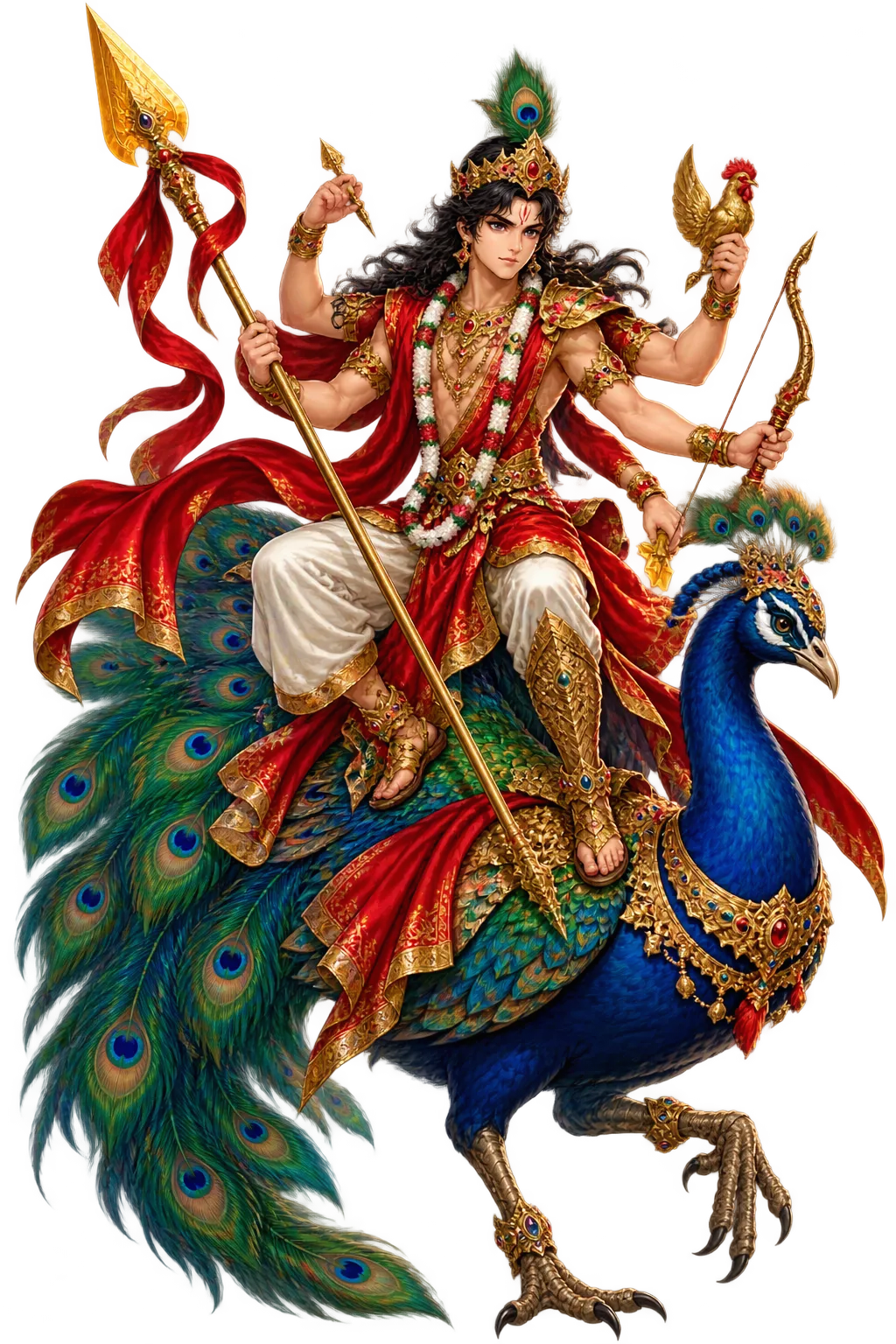
Sacred SymbolsThe Divine General, Born of the Third Eye, The Spear, Lord of the Six Abodes
02

Etymology & Word Family

From original script to Unicode restoration

Original Script स्कन्द Skanda — "‘The Attacker’ — a name of Kārttikeya, son of Śiva (or of Agni), the god of war who leads the divine hosts against the enemies of the gods."
Unicode Restoration Skanda Canonical scholarly spelling — ASCII-identical
Modern ASCII skanda Plain-ASCII fallback

The name Skanda reaches the modern world through scholarly transliteration of the sanskrit tradition. Because the conventional spelling uses only Latin letters, its Unicode and ASCII forms coincide — the tradition it carries is in the name itself, not in diacritics.

03

Unicode Character Breakdown

Character-by-character philological analysis

CharacterUnicodeNameBlockPhonetic Role
SU+0053Latin Capital Letter SBasic LatinSame, capitalized
kU+006BLatin Small Letter KBasic LatinSame
aU+0061Latin Small Letter ABasic LatinSame
nU+006ELatin Small Letter NBasic LatinSame
dU+0064Latin Small Letter DBasic LatinSame
aU+0061Latin Small Letter ABasic LatinSame

This restoration reflects fidelity to the attested tradition, not recovered diacritics: every character of Skanda already survives in ASCII. What the restoration preserves is the canonical spelling itself — the form scholarship standardised.

04

Cult & Worship

How the sacred was kept — rites, sanctuaries, remains

The Cult

The Kanda Ṣaṣṭhī festival — his birth-week and the war’s anniversary — is among the largest gatherings in the Tamil world, closing with the ritual breaking of the fast. His hill-shrines are walked on foot as pilgrimage; the kavadi-bearers’ dance is his cult’s most visible modern rite.

In the Earth

The six abodes (Ārupadaiveṭṭu) of Tamil Nadu are his living monuments; Gupta and Kushan sculpture give him his classical six-headed infant form. The Batu Caves of Malaysia, a modern Murugan shrine of cathedral scale, extend his geography into the diaspora.

05

Iconography

How Skanda was imaged across the ages

The Image

The beautiful youth, six heads arrayed as a peacock’s fan, the spear (vel) upright, riding the peacock whose spread tail is the god’s own flame; in Tamil images he stands alone with the vel, the weapon itself treated as the deity’s presence.

06

Reception & Transformation

The name after its own age — transmission, translation, survival

Afterlives

Comparative mythology pairs him with Ares, Mars, and the Chinese Erlang as the divine general; Tamil literature claims him as the grammar of Tamil devotion itself. The Batu Caves’ giant gold statue made him a global icon — the war-god who became a diaspora’s home.

Identifications Across Traditions

Skanda is the great pan-Indian convergence: Vedic Rudra’s son, Tamil Murugan, Buddhist Kārttikeya of the north, and the Graha of the week’s Tuesday. The Greeks of the Northwest compared him to Ares and Mars; the Kushan coins show him as Skanda-Kumāra beside the Buddha. His peacock entered Christian art’s immortality symbolism by the strangest of roads.

Modern Legacy

Murugan is Tamil country’s beloved god — the Kanda Ṣaṣṭhī festival at Tiruchendur draws millions, and the god’s hill-shrines anchor Tamil sacred geography. His six-headed infant image, the Kārttikeya of Gupta art, defined the war-god’s iconography for Asia; and the Ṣaṣṭhī vow is observed across the subcontinent by parents of sons.

07

The Meditation

What Skanda means — beyond the dictionary

Skanda: the war-name that means ‘the one who attacks’. In plain letters it reads like what it is — a battle-cry reduced to a name. The Tamil country still shouts it in festival; the lexicon keeps it here, at rest, its spear laid across the threshold of the temple.

08

Frequently Asked Questions

Common questions about Skanda, War, Commander, and Unicode restoration

01How do you pronounce Skanda?

In reconstructed pronunciation, Skanda is /ˈskʌndə/ — approximately “SKUN-duh”.

02What does Skanda mean?

Skanda means ‘The Attacker’ — a name of Kārttikeya, son of Śiva (or of Agni), the god of war who leads the divine hosts against the enemies of the gods. in the sanskrit tradition.

03What are the symbols of Skanda?

Skanda is associated with The Divine General (Commander of the gods’ armies — the deva-senāpati — before whom no asura line holds.), Born of the Third Eye (Six sparks from the gods’ wrath-eyes, fostered by the Kṛttikā — the Pleiades — as six infants, fused into one.), The Spear (Śakti, the lance his mother Umā gave him — one throw ended Tāraka, the boon-armed demon.), Lord of the Six Abodes (Murugan’s six mountain shrines from Tirupparankunram to Palani mark his Tamil country.).

04Why restore Skanda in Unicode?

Skanda is written entirely in ASCII letters, so its restoration is about canonical fidelity rather than recovered diacritics: the temple fixes the name in its scholarly standard spelling, attested in the source tradition, instead of leaving it to drift.

05What is the most important myth about Skanda?

“The Birth of Fire” — the Kumāra Cycle story that anchors the mythology of Skanda, told in full on the lore page.

09

Scholarly Sources

The philological foundations of this restoration

Every claim on this page is grounded in established scholarship. The orthographic restorations follow disciplinary convention. The etymological chain follows the best available reference works. This is not invention — it is resurrection through scholarship.

◈

Lexicography & Philology

  • MW
  • Puranas
◎

Primary Texts

  • Skanda Purāṇa (the senāpati theology)
◉

Archaeology & Art History

  • Material evidence — iconography, inscriptions, and temple archaeology — for Skanda and related cults.
✦

Religious Studies

  • Kumārasaṃbhava of Kālidāsa (the birth of the war-god)
  • Cilappatikāram & Tamil Murugan epics (Vaḷḷi cycle)
  • Kushan-period Skanda-Kumāra coinage
Return

The Surface Awaits

You have traced the name from its earliest attestation to its Unicode restoration. Now return to the myth. The story is where the name lives.

Back to Lore
Skanda mascot