
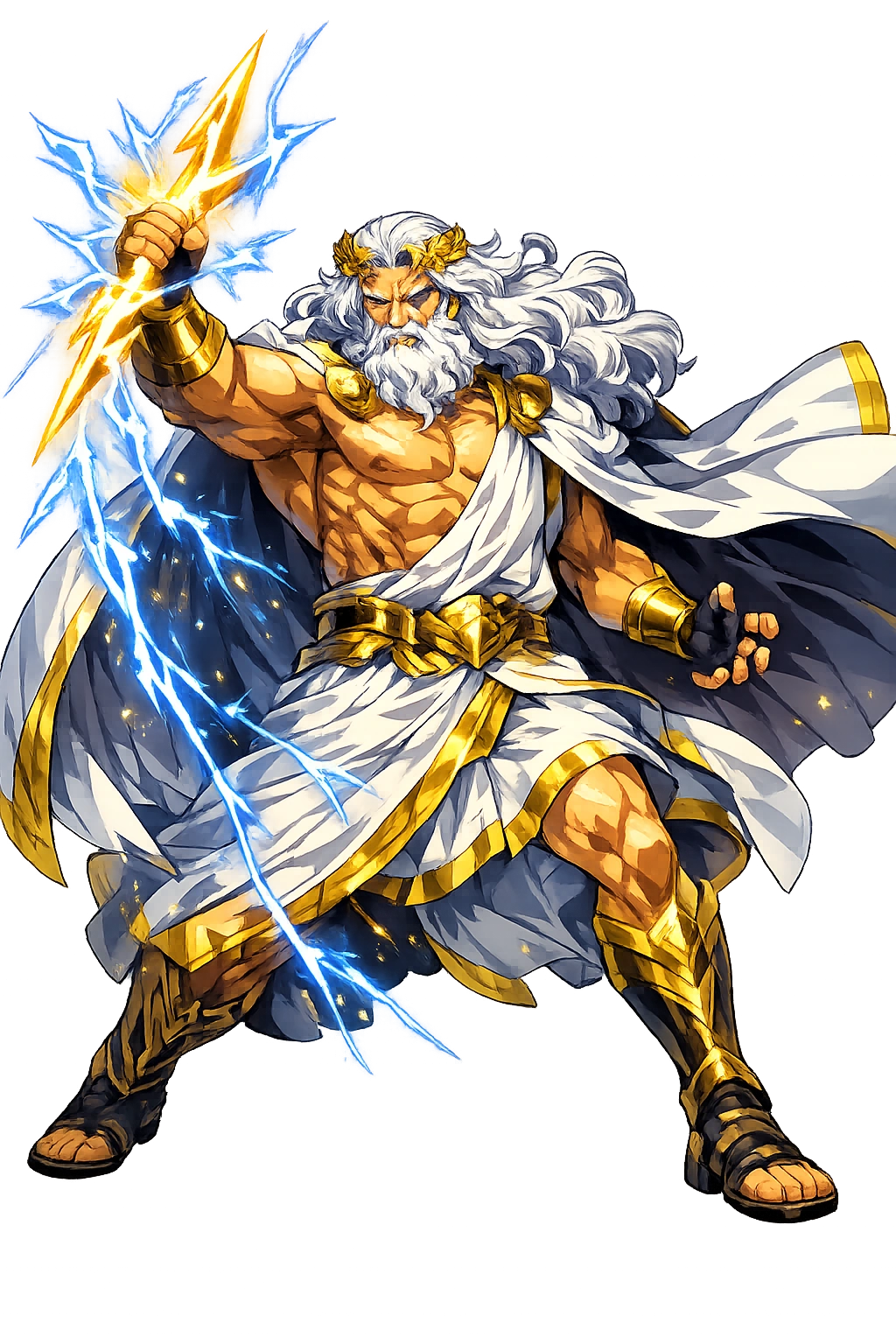
Why Zeús is spelled that way — and what it costs to get it right
There is a version of this name the early internet had to settle for: zeus. This is the file on how Zeús replaced it.
The mythology of Zeús is dominated by two great struggles: his overthrow of the Titans and his defense of cosmic order against every subsequent threat. He is the last son of Kronos, the only one not swallowed at birth.
At a Glance
- Restored name: Zeús
- ASCII form: zeus
- Meaning: "Bright, day (from Proto-Indo-European *dyēus)"
- Domain of influence: Sky, Thunder, King of Gods
- Pantheon: Greek
- Classification: Tier 1
- Original script: Ζεύς
- Series: The Restoration Files, No. 271 of 271
The Name Before the Marks
The name is attested as Ζεύς, as LSJ and Beekes record. On the evidence, it means "Bright, day (from Proto-Indo-European *dyēus)".
Strip Zeús to zeus and one piece of evidence vanishes:
- u → ú — Acute on upsilon: the stress position the ASCII form cannot show.
These are the small, provable things a restoration is made of: not taste, not branding — attestation.
Spoken, the name runs `/zděu̯s/` — 'ZDEWS' — one syllable, beginning with a buzzing 'zd' and ending in a sharp 's', like the sound of distant thunder compressed into a name.
The Temple That Stands Now
The restored name is not a plaque; it is an address. The temple of Zeús lives at /sites/zeus/, with its mythology in the lore halls, its peer-reviewed record in the Scholarly Edition, and its place in the pattern atlas on the patterns floor.
The restoration preserves more than the ASCII form can express — stress, length, or a letter the Latin keyboard lost — which places it, mechanically, in Tier-1.
Where the Name Stood First
Olympia: Temple of Zeus (ca. 470–456 BCE), chryselephantine statue by Phidias, one of the Seven Wonders; Olympic Games from 776 BCE. Dodona: oracle of Zeus in the oak grove. The temple on the web is the newest of these addresses — the first one that fits in a pocket.
The Archetype at Work
The pattern atlas seats this temple in 4 industries, each match argued and weighted: Leadership, Governance & Public Administration (king of gods; sovereignty with thunder behind it.); Meteorology & Weather Intelligence (the thunderbolt is his weapon and the sky his domain; every storm warning still reads his signature.); Aviation & Aerospace (the sky father whose domain every flight crosses.). The Resonance File reads those seats through the myths themselves.
In the Sacred Texts
The Greek tradition is not a vibe; it is a library. The Sacred Texts collection holds Theogony, Homeric Hymns, and Works and Days — the primary sources the temple's scholarship is built on. The temple is the argument; the texts are the evidence.
The File Continues
The temple's founding dispatch tells the name's story; its Resonance File reads the myths into the industries; the blog index holds the whole archive.
Continue the series — previous file: Yīnyáng (read it here).
The Restoration Files are written from the same canonical record as the temples themselves: the lexicon, the lore catalog, the pattern atlas, and the cited scholarly sources. If a file ever disagrees with its temple, the temple is right — tell us, and the file will be corrected.