The Authentic Orthography
Sky, Thunder, King of Gods · Bright, day (from Proto-Indo-European *dyēus)
Unicode restoration and ASCII comparison
Ζεύς
The name in its original Greek form. Zeús (Ζεύς) is attested in the source tradition — “Bright, day (from Proto-Indo-European *dyēus)”. Its diphthongs and acute accents carry the full phonetic and orthographic weight of the source tradition.
zeus
Reduced to plain zeus, the name loses everything that made it specific: diphthongs and acute accents. What remains is an ASCII string that machines can parse but that no longer speaks with its original voice.
Zeús
The Unicode restoration recovers what ASCII flattened. Zeús restores diphthongs and acute accents, returning the name to its original written dignity. The domain encodes to Punycode, but the browser displays the truth.
Zeús.com → xn--zes-9na.com
The non-ASCII characters in Zeús are encoded while the ASCII remains visible. To the DNS, it is Punycode. To humanity, it is Zeús.
How Zeús travels from ancient script to the modern URL
From Proto-Indo-European *dyēws 'sky, daylight, sky-god'. Cognates: Sanskrit Dyáuṣ Pitā, Latin Juppiter (*dyēws ph₂tḗr), Germanic *Tīwaz (English Tuesday).
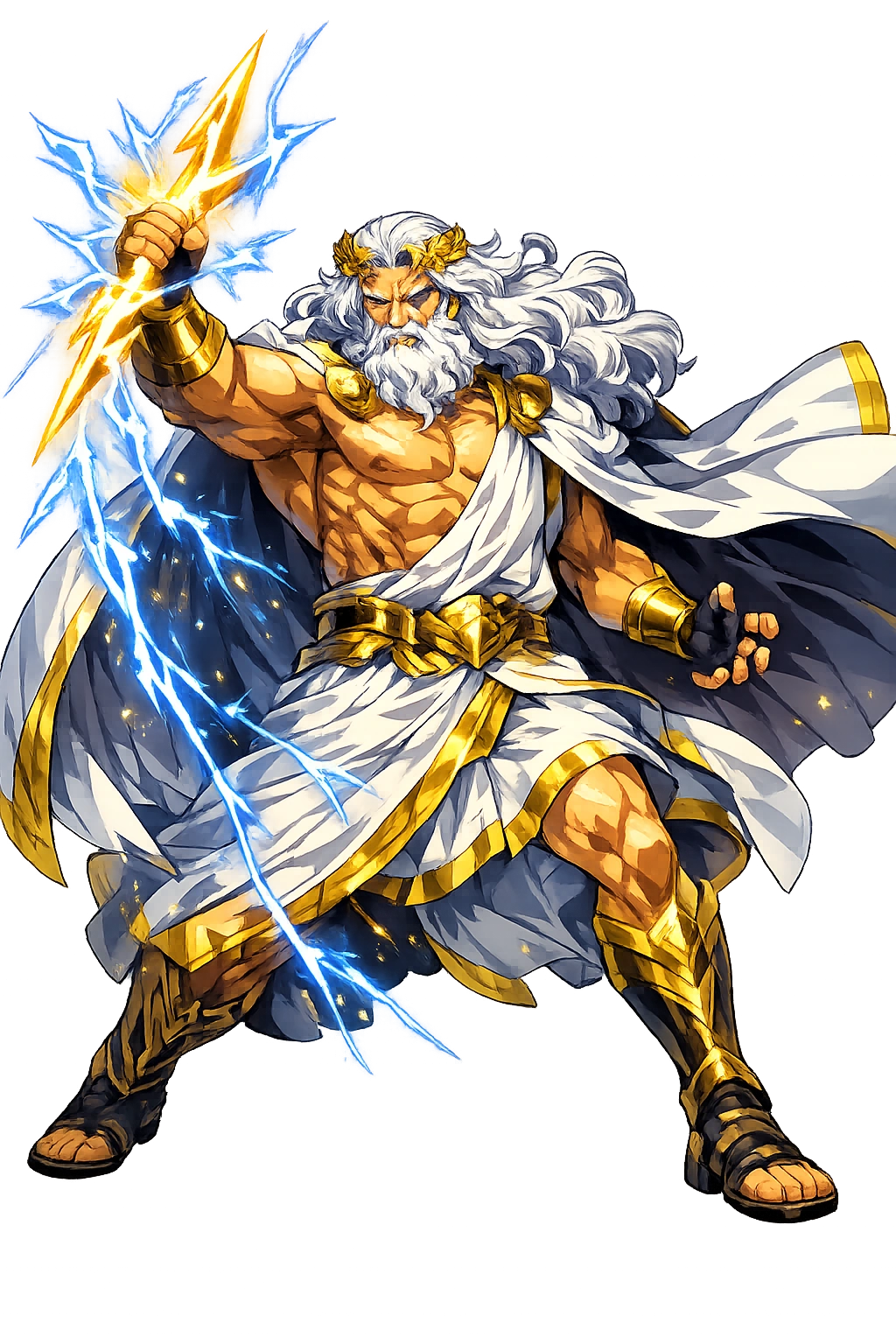
King of the Olympian gods; god of the sky, thunder, law, kingship, and cosmic order.
The Unicode restoration Zeús preserves the acute accent and long diphthong; the macron-only form Zeus is an accepted fallback. The domain encodes to Punycode while displaying the Greek-accented Latin form.
How Zeús was spoken
Kingship, Thunder, Oath, and Order
Zeús is not merely the king of the gods; he is the principle of cosmic and social order. His domain is the sky, his weapon the thunderbolt, his guarantee the oath. Every legitimate authority on earth — kingship, law, hospitality — traces its sanction to him.
Ruler of Olympus and arbiter of divine disputes; his will is fate's executive.
The weapon forged by the Cyclopes; it strikes oath-breakers, hubristic mortals, and Titans alike.
Protector of suppliants, guests, and kings; Themis and Díkē attend him.
Even Zeús cannot fully reverse Moira, but he directs its fulfillment through gods and oracles.
Stories of Zeús
The mythology of Zeús is dominated by two great struggles: his overthrow of the Titans and his defense of cosmic order against every subsequent threat. He is the last son of Kronos, the only one not swallowed at birth.
Rheia, weary of seeing her children devoured by Kronos, hid the infant Zeús in a cave on Crete — identified by different traditions as Mount Ida or Mount Dikte — and gave Kronos a stone wrapped in swaddling clothes. The Kouretes drowned the baby's cries with their clashing weapons. This substitution of stone for god is the primal image of how order survives by cunning.
When Zeús grew to strength, he freed his siblings from Kronos's belly and led them in a ten-year war against the Titans. The Cyclopes gave him thunder, the Hundred-Handers turned the tide, and the Titans were cast into Tartaros. Zeús then divided the cosmos with his brothers by lot: sky to Zeús, sea to Poseidôn, underworld to Hádês.
The monster Typhôn, born from Gaia's anger after the Titanomachy, challenged Zeús and briefly stripped him of his sinews. Zeús recovered and buried the monster under Mount Etna. The myth asserts that even the most chaotic rebellion cannot finally unseat the sky king.
When Zeús decided to destroy the Bronze Age race for its hubris, he sent a great flood. Only Deukalion and Pyrrha survived in an ark and, on the instructions of Themis, repopulated the earth by casting stones behind them — the 'bones of Gaia.' The myth gives Zeús both destructive and regenerative roles.
Zeús is the god who says 'enough.' Where other deities have passions, Zeús has authority. His mythology is almost devoid of the absurd or humiliating episodes that afflict other Olympians; even his erotic adventures are framed as cosmic necessities. This makes him remote, even cold — but also the necessary center without which the pantheon collapses into rival passions.
Enter Extended Lore