
Why Varuṇa is spelled that way — and what it costs to get it right
There is a version of this name the early internet had to settle for: varuna. This is the file on how Varuṇa replaced it.
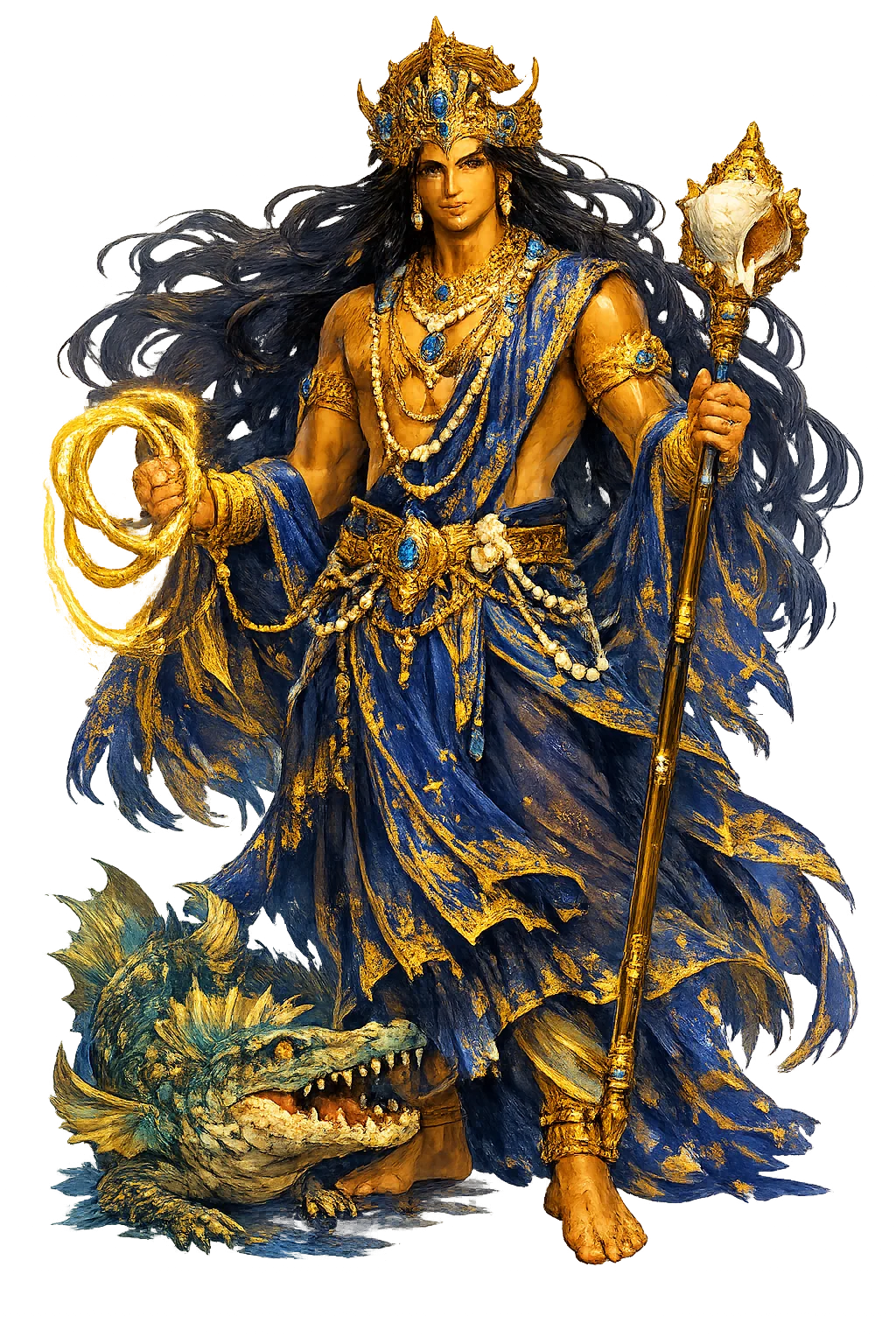
Varuṇa is the Vedic sovereign of the cosmic order (ṛta), the lord of waters, and the guardian of truth. He binds offenders with his noose (pāśa), sends a thousand spies to watch the world, and holds the night sky in his sway. To swear falsely before Varuṇa is to invite disease, disaster, and cosmic rupture.
At a Glance
- Restored name: Varuṇa
- ASCII form: varuna
- Meaning: "The All-Enveloping Sky — the Vedic Āditya of the waters and of ṛta, paired with Mitra"
- Domain of influence: Cosmic Order, Oceans, Law
- Pantheon: Sanskrit
- Classification: Tier 1
- Original script: वरुण
- Series: The Restoration Files, No. 258 of 271
The Name Before the Marks
Spoken, the name runs `/ˈʋɐ.ru.ɳɐ/` — 'VUH-roo-nah' — start with a soft 'v', keep the middle syllable light, and end with a tongue-tip-curled 'n' like an American 'r' pressed against the roof of the mouth.
The Temple That Stands Now
The restored name is not a plaque; it is an address. The temple of Varuṇa lives at /sites/varuna/, with its mythology in the lore halls, its peer-reviewed record in the Scholarly Edition, and its place in the pattern atlas on the patterns floor.
Tier-1 is not a compliment; it is a measurement. This restoration keeps something the ASCII form provably loses, and the measurement is repeatable.
Where the Name Stood First
The Indo-Iranian antiquity of Varuṇa is confirmed by the Mitanni treaty from Boğazköy (c. 1380 BCE), which invokes Mitravaruna in Hittite cuneiform. In India, the earliest visual references appear on Maurya-Sunga railing medallions at Bharhut and Sanchi, where a water-guardian with a noose may represent him. Gupta and medieval temples from Deogarh to Khajuraho include Varuṇa among the dikpālas, usually mounted on a makara. Coastal shrines and stepwells across Gujarat and Maharashtra preserve his association with waters. The temple on the web is the newest of these addresses — the first one that fits in a pocket.
The Archetype at Work
The pattern atlas seats this temple in 3 industries, each match argued and weighted: Freshwater & Hydrology (lord of all waters — rivers, seas, rain, and the underworld streams; the Vedic sovereign of the whole supply.); Legal, Justice & Compliance (the order that binds; law as cosmic covenant.); Maritime, Shipping & Ocean Industries (lord of the oceans and the order that governs them.). The Resonance File reads those seats through the myths themselves.
In the Sacred Texts
The Sanskrit tradition is not a vibe; it is a library. The Sacred Texts collection holds Rig Veda and Ramayana — the primary sources the temple's scholarship is built on. The temple is the argument; the texts are the evidence.
The File Continues
The temple's founding dispatch tells the name's story; its Resonance File reads the myths into the industries; the blog index holds the whole archive.
Continue the series — previous file: Váli (read it here) · next file: Viṣṇu (read it here).
The Restoration Files are written from the same canonical record as the temples themselves: the lexicon, the lore catalog, the pattern atlas, and the cited scholarly sources. If a file ever disagrees with its temple, the temple is right — tell us, and the file will be corrected.