
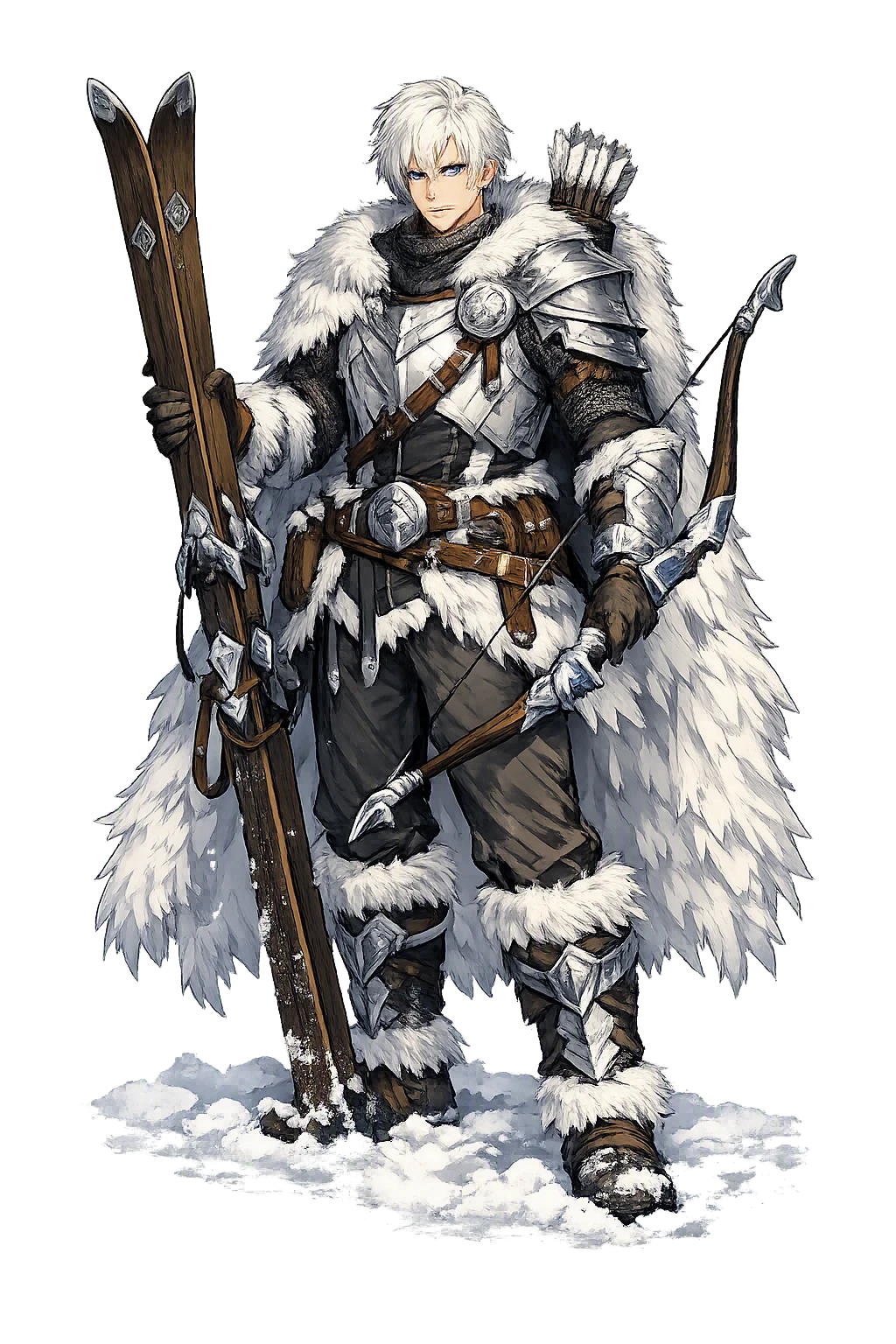
The canonical register: Ullr
Court is in session. In the matter of Ullr, the register hears the evidence — the attestation, the marks, and the forms that stand accused.
At a Glance
- Canonical form: Ullr
- Original script: ᚢᛚᛚᚱ
- Pantheon: Norse
- Convention: normalized Old Norse spelling — þ, ð, ǫ, æ and length marks preserved as the editions print them
- False forms on record: 1
- Contested forms: none attested
- Series: The Canonical Register, No. 370 of 397
The Charge
That the name Ullr is routinely written in forms that move, drop, or invent its marks — and that each such form teaches the reader a different, lesser name. The register's task is to separate the honest fallback from the outright false.
The Defense of the Canonical Form
The attested form is ᚢᛚᛚᚱ, from the tradition's own record. The canonical transliteration is Ullr.
No diacritics are required here: the canonical form is the exactness of the spelling itself, the form normalized Old Norse spelling — þ, ð, ǫ, æ and length marks preserved as the editions print them demands.
The Character Witness
The plain form ullr differs from the canonical Ullr only by convention of display — case, not content. It is acceptable everywhere: in legacy systems, in plain-text citation, in the DNS itself. What is not acceptable is what follows in the register: respellings that change the letters, not just their case.
Cross-Examination
The witness ulr
Where it comes from: the anglicized respelling — the name written the way English guesses it sounds. Why it cannot stand: rewrites attested consonant clusters to fit English spelling habits; every cluster simplified this way erases a letter the sources write.
Mitigating Circumstances
No alternate form of this name carries documented scholarly support in the lexicon's record. The convention here — normalized Old Norse spelling — þ, ð, ǫ, æ and length marks preserved as the editions print them — produces exactly one defensible transliteration: Ullr. Forms that differ from it are not contested; they are simply wrong.
The Convention's Own History
Old Norse orthography is a primary source in itself: þ (thorn) and ð (eth) are letters the language used natively, not transliteration marks — English once had them too, and lost them. ǫ (o with ogonek) is a nasal vowel with its own saga-era history, and normalized Old Norse spelling preserves it because the Eddas' editors do. To write th for þ or o for ǫ is not modernization; it is a different spelling of a different word. The Eddic poems survive in one manuscript tradition each — the register spells the names the way those manuscripts do.
Registration, Honestly
Three facts govern every domain this project registers. One: IDNA 2008 welcomes the marks — punycode encodes them legally and browsers show them faithfully. Two: welcome is not availability — registrars hold partial inventory, so the ideal form of a name may exist in the protocol yet not in the shop window today. Three: typeability is a separate virtue — a form no one can type on a phone is a form no one will visit, however canonical.
Hence the hierarchy the rulebook enforces: take the most complete form that is both attested and actually registrable, and never accept a wrong mark for the sake of availability. The wrong accent is not a rung on that ladder; it is off the ladder entirely.
The Verdict
So the register finds: Ullr, canonical; ullr, equally canonical; the contested forms, recorded with their support; the false forms, ruled against with their violations named. Every line of that finding cites its evidence, and the evidence is open to any reader — the register asks to be checked, not trusted. The temple keeps the canonical form at /sites/ullr/.
The docket for this ruling: 1 false form ruled against, ulr first on the docket; no contested forms attested; the attestation rests on 7 cited sources — Poetic Edda: Grímnismál 5 (Ýdalir, the hall Ullr made for himself) and 42 (Ullar hylli, the favor of Ullr invoked first among the gods); Atlakviða 30 (the oath sworn 'by the ring of Ullr'), trans. Carolyne Larrington, Snorri Sturluson, Prose Edda: Gylfaginning 31 (Ullr son of Sif, stepson of Thor; the bowman, the skier, the god of single combat); Skáldskaparmál (kennings: the Snowshoe God, the Bow God, the Hunting God, the Shield God; the shield as 'Ullr's ship'), trans. Anthony Faulkes, Saxo Grammaticus, Gesta Danorum, Book 3 (Ollerus rules in Othinus's place for ten years; the spell-marked bone; driven out and slain in Sweden), trans. Peter Fisher, ed. Hilda Ellis Davidson.
The Register Continues
This is one of 397 entries in the Canonical Register — the authoritative reference for every flagship temple. The temple's founding dispatch tells the name's story; its Restoration File details the marks; its Resonance File reads the archetype into the industries. The blog index holds the whole archive, and the Rulebook states the convention this register enforces.
Continue the register — previous entry: Týr (read it) · next entry: Uppsala (read it).
The Canonical Register is written from the same canonical record as the lexicon itself. If a false form is missing from this page, it is because the evidence does not support calling it false — or because we have not seen it yet. Show us, with a citation, and the register will answer.