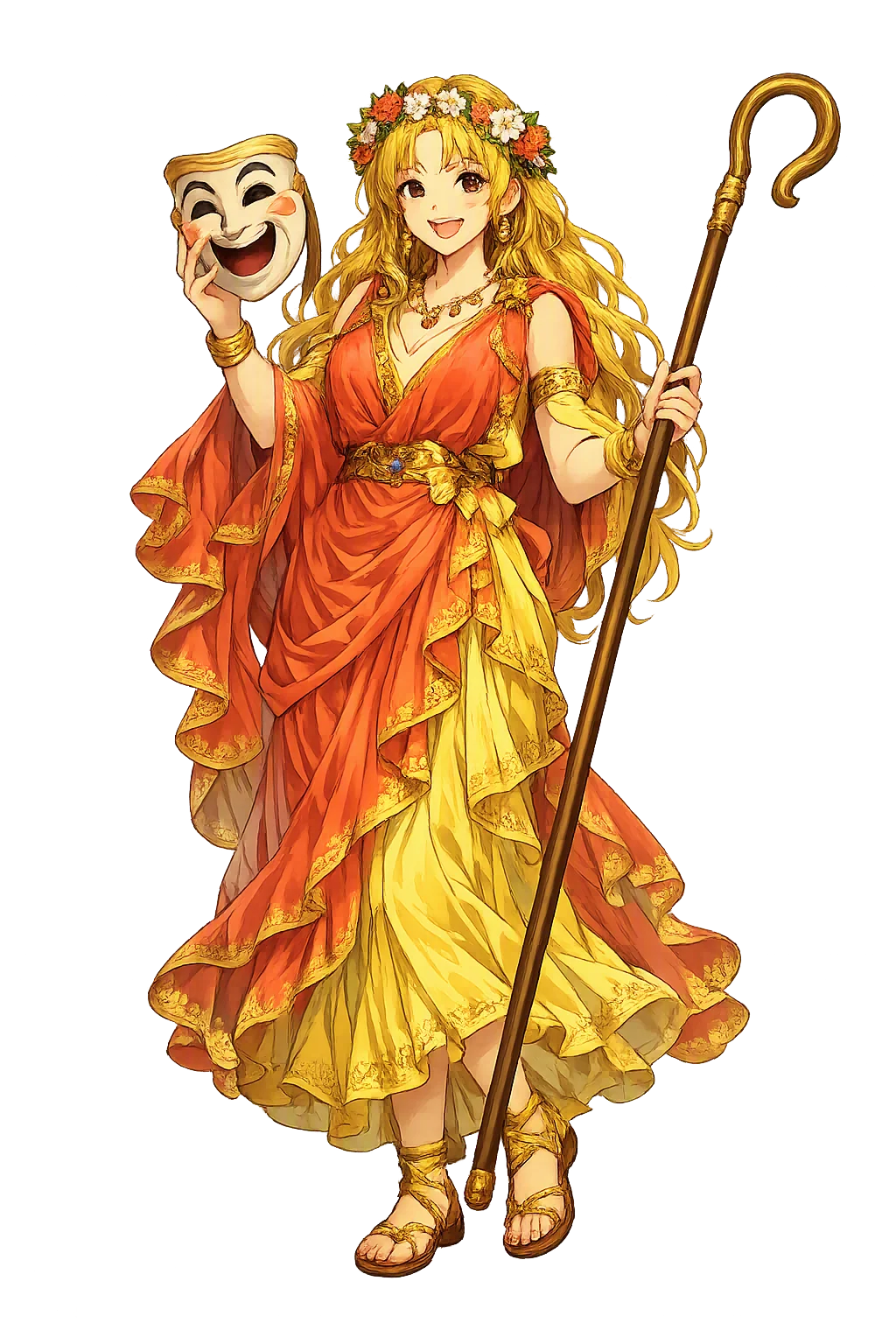
Tháleia through the eyes of sculptors, painters, and craftsmen across the ages

The Muses Sarcophagus — marble, first half of the 2nd century AD, found by the Via Ostiense (Louvre, Ma 475): Thaleia lifts the grinning comic mask, her attribute among the nine Muses and the oldest smile in the canon of comedy.

The Tivoli Thalia — Hadrianic marble (AD 117–138) from the Villa of Cassius near Tivoli, now in the Hall of the Muses, Museo Pio-Clementino: the Muse of comedy sits crowned in ivy, the theatre mask resting at her side.

The Vichten Mosaic — Roman floor mosaic, c. 240 AD (National Museum of History and Art, Luxembourg): among the nine Muses in their hexagonal panels, Thaleia appears with her comic mask, laughter set in stone for a Gallo-Roman villa.

The British Museum Thalia — Roman marble in chiton and himation (British Museum, London): the Muse stands with the pedum, the shepherd's crook of idyllic poetry, her drapery carved thin as laughter's disguise.

Denarius of Quintus Pomponius Musa — Rome, 56 BC: the moneyer's pun on his own name puts Thaleia on silver, standing in flowing peplos with the comic mask in hand — comedy's Muse minted into daily currency.

Goltzius's Thalia — Hendrick Goltzius, engraving, 1592 (Metropolitan Museum of Art): the Northern Mannerist burin gives the ancient Muse a Baroque swagger, mask and trumpet in hand, as comedy steps into the print culture of a new age.
