
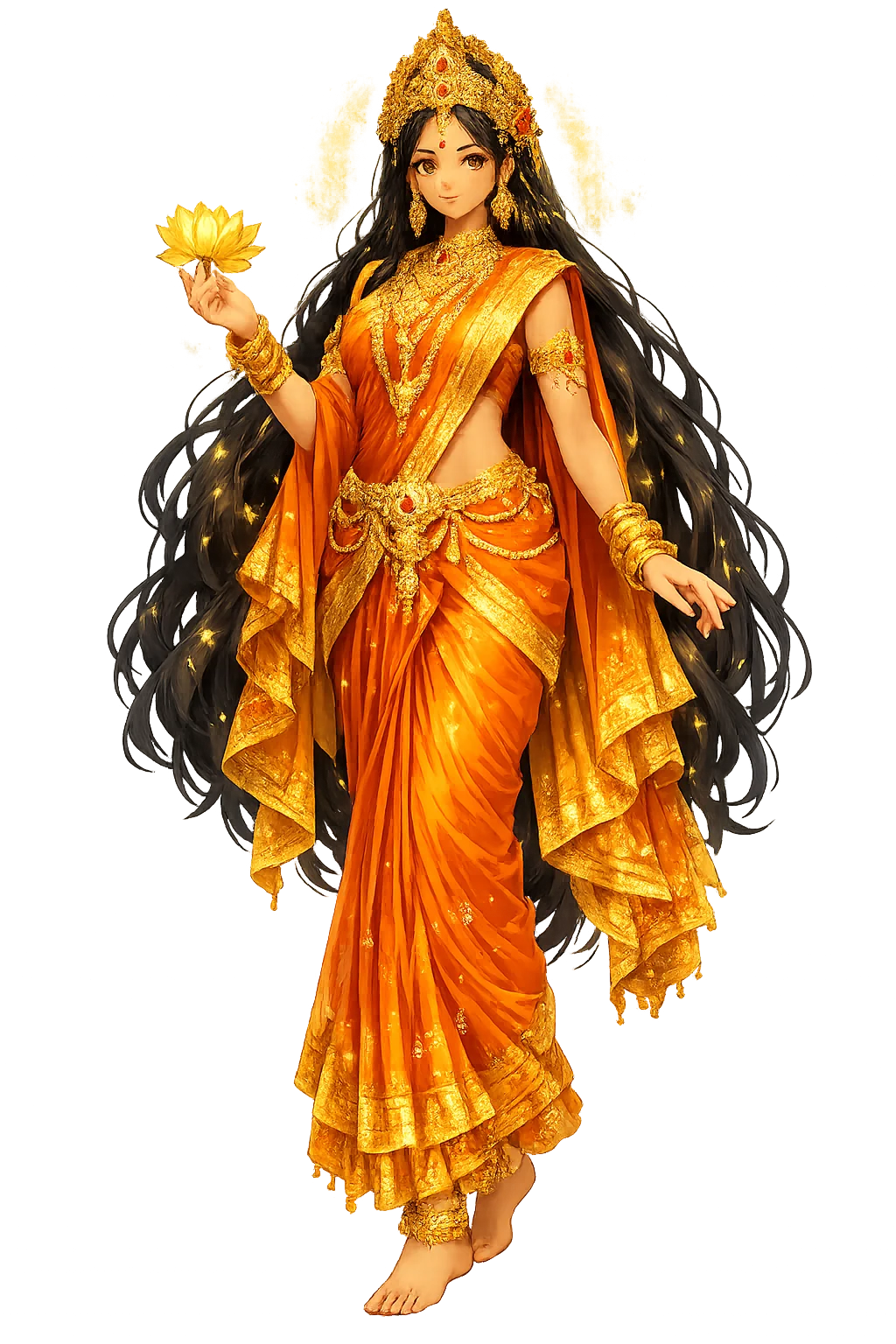
The appointments Sītā made — and who is keeping them
The mistake is reading myths as entertainment. Sītā's cycle reads more like a charter — each story assigning a duty the modern world still pays for.
At a Glance
- Temple: Sītā
- Pantheon: Sanskrit
- Domain of influence: Virtue, Devotion, Fertility
- Pattern seats: 5
- Sectors touched: Society & Spirit · Home & Lifestyle · Energy & Natural World · Commerce & Governance
- Strongest seat: Faith & Spiritual Organizations
- Series: The Resonance Files, No. 225 of 271
The Cycle, Read Forward
Faith & Spiritual Organizations — through Daughter of the Field
King Janaka of Mithilā, ploughing a sacrificial field, struck something that was not stone: an infant in the furrow, whom he named Sītā — "furrow" — and raised as his daughter. Earth-born, not womb-born, the texts insist: her mother is the field itself, and the Rāmāyaṇa's most beloved heroine begins as a gift of agriculture.
The atlas states the seat in one line: The furrow-born princess of the Rāmāyaṇa, worshipped beside Rāma as the measure of devotion — virtue enthroned in living temples. The story above is the long version of the same sentence. That is the cycle working: story becomes duty, duty becomes trade.
Wedding, Family & Maternity — through The Golden Deer
In the forest of Daṇḍaka, during the fourteen-year exile, the demon Mārīca became a golden deer to draw Rāma from her side, and Rāvaṇa came as a wandering ascetic. She crossed the line — the lakṣmaṇa-rekhā drawn for her protection — only to give alms, and was carried through the sky to Laṅkā.
The atlas states the seat in one line: The Rāmāyaṇa’s devoted wife, whose fidelity survived fire — the Hindu ideal of the marriage bond personified. The story above is the long version of the same sentence. That is the cycle working: story becomes duty, duty becomes trade.
Agriculture, Food & Harvest — through Agni-Parīkṣā
Rescued after the war, she was met not with embrace but with doubt, publicly, before the armies. Sītā's answer was the fire: she walked into the flames, and Agni himself bore her out unburned, declaring her purity to the three worlds.
The atlas states the seat in one line: Her name is the furrow; the Ṛgveda prays to her for crops. The story above is the long version of the same sentence. That is the cycle working: story becomes duty, duty becomes trade.
Education, Research & Knowledge — through The Earth Opens
Years later, crowned and pregnant, she was exiled again on a rumor — and raised her twin sons in Vālmīki's hermitage. When Rāma finally came for her and asked one more public proof, she asked the earth instead: "If I have been faithful, open for me.
The atlas states the seat in one line: The field-goddess of the Ṛgveda's ploughing hymns; patience as curriculum. The story above is the long version of the same sentence. Industries do not invent their archetypes; they inherit them and call them best practice.
The Theme That Runs the Cycle
The Rāmāyaṇa calls itself Rāma's story, but its moral engine is Sītā: every choice that matters is measured against her.
The Method, Stated Plainly
Skeptical? Good — the system is built for you. Every seat in this file carries its why-line and its weight, the full derivation is public at the methodology page, and the challenge process is part of the design. Falsifiable is not a posture here; it is the mechanism.
For the Ones Who Work There
If you work in faith & spiritual organizations, wedding, family & maternity, or any trade this temple holds a seat in, this is the honest version of what a placement means: your industry beside the story it has been re-telling all along — on the temple floor itself, before an audience that came specifically to read it. The patron tier and the advertising terms describe the mechanics; the resonance above describes the fit.
The File Continues
One of 271 Resonance Files — the series where the pantheon goes to work. Read the founding dispatch for the name, the Restoration File for the spelling, or the whole archive end to end.
Continue the series — previous: sjꜣ (read it) · next: Šəlōmōh (read it).
The Resonance Files are argued from the same canonical record as the pattern atlas itself: the lexicon, the lore catalog, and the cited sources. Every seat can be challenged at the methodology page — and the challenge is the point.