
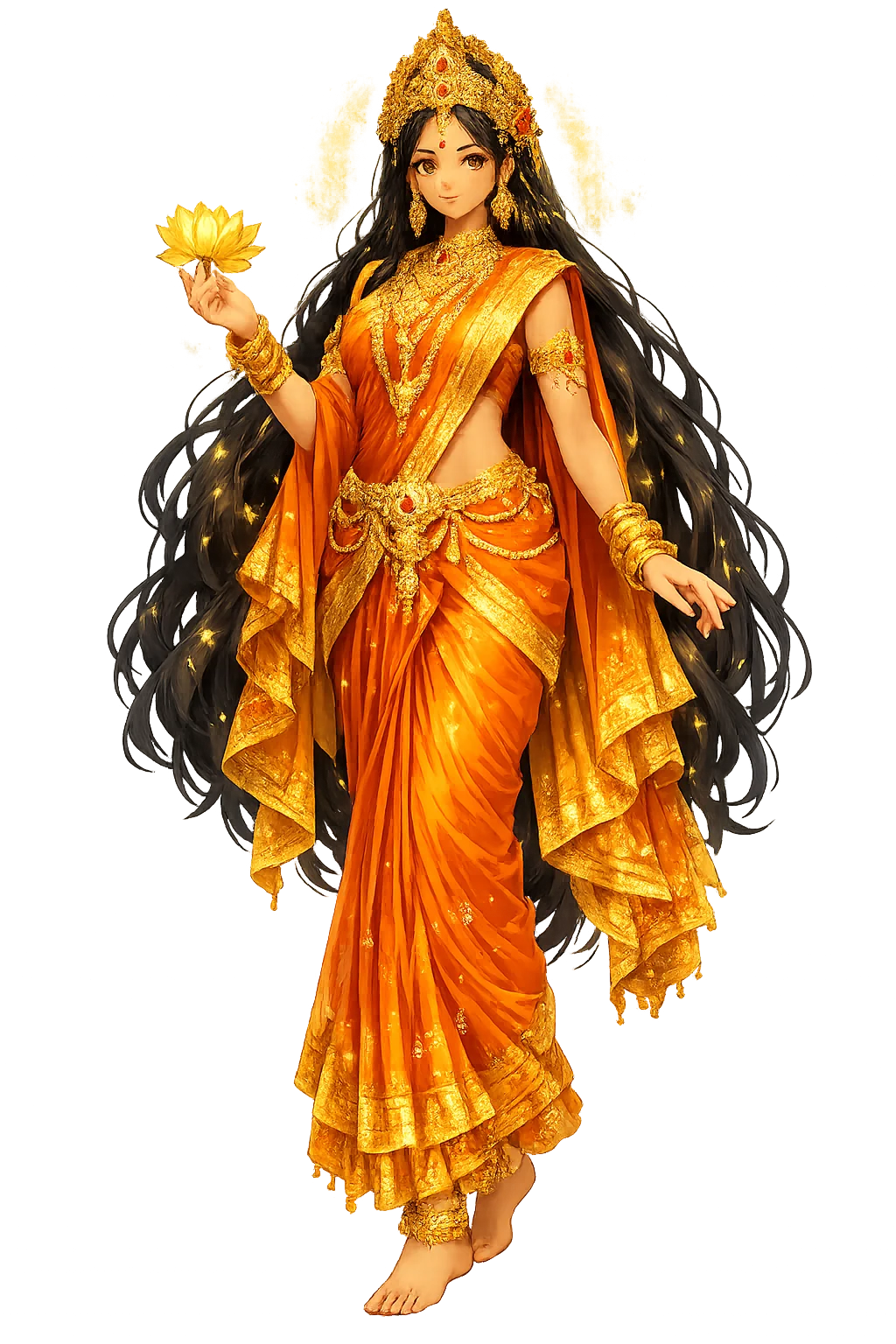
How Sītā was rebuilt, mark by mark
Bench notes, Sītā: what we found, what we rejected, and what we finally set down. Kept in the open, because a restoration you cannot audit is just a spelling with confidence.
What We Found
The attestation runs through the tradition's own sources: सीता. Meaning: "'Furrow' — the field-goddess, wife of Rāma and mother of his twin sons".
The figure behind the name: The Rāmāyaṇa calls itself Rāma's story, but its moral engine is Sītā: every choice that matters is measured against her.
What the Name Carried In
Daughter of the Field. King Janaka of Mithilā, ploughing a sacrificial field, struck something that was not stone: an infant in the furrow, whom he named Sītā — "furrow" — and raised as his daughter. Earth-born, not womb-born, the texts insist: her mother is the field itself, and the Rāmāyaṇa's most beloved heroine begins as a gift of agriculture.
The Golden Deer. In the forest of Daṇḍaka, during the fourteen-year exile, the demon Mārīca became a golden deer to draw Rāma from her side, and Rāvaṇa came as a wandering ascetic. She crossed the line — the lakṣmaṇa-rekhā drawn for her protection — only to give alms, and was carried through the sky to Laṅkā.
A spelling that has to carry stories like these is not a label. It is equipment.
Where It Stood Before Us
Janakpur in Nepal's Terai keeps her city: the Janaki Mandir (1911, on older foundations) marks the site tradition calls her birthplace-home, and the Ram-Janaki Vivāha festival re-enacts the wedding annually. Mithilā's painted tradition (Madhubani/Maithil art, from the kohbar wedding-chamber murals) is among the world's oldest continuously practiced narrative arts. The Rāmāyaṇa sites across India and Sri Lanka — the Aśoka Vatika candidates near Nuwara Eliya, the Sītā Amman temple there — form the epic's living pilgrimage map. The bench inherits all of it — the web temple is the newest site, not the first.
What We Kept
The evidence, mark by mark — 2 features the keyboard form sita cannot hold:
- i → ī — Macron: long i. Kept.
- a → ā — Macron: long a. Kept.
What We Rejected
Any form invented for availability. The rule on the bench: if the evidence does not carry it, the domain does not get it — whatever the registrar has in stock.
What We Set Down
Sītā — Tier-1 is not a compliment; it is a measurement. This restoration keeps something the ASCII form provably loses, and the measurement is repeatable.
For the voice: sEE-taa — both vowels long, even and open.
The temple stands at /sites/sita/ — the notes above are public in its Scholarly Edition, sources and all.
At a Glance
- Restored name: Sītā
- ASCII form: sita
- Meaning: "'Furrow' — the field-goddess, wife of Rāma and mother of his twin sons"
- Domain of influence: Virtue, Devotion, Fertility
- Pantheon: Sanskrit
- Classification: Tier 1
- Original script: सीता
- Series: The Restoration Files, No. 225 of 271
The File Continues
The temple's founding dispatch tells the name's story; its Resonance File reads the myths into the industries; the blog index holds the whole archive.
Continue the series — previous file: sjꜣ (read it here) · next file: Šəlōmōh (read it here).
The Restoration Files are written from the same canonical record as the temples themselves: the lexicon, the lore catalog, the pattern atlas, and the cited scholarly sources. If a file ever disagrees with its temple, the temple is right — tell us, and the file will be corrected.