
Sšꜣt in 2026: why scholars still care
In 2026, names are treated as data points. Sšꜣt is a reminder that they are also cultural artifacts — and that the difference matters for search engines, AI training corpora, and anyone who types the name of a Egyptian figure into a browser. Scholars never stopped caring about the difference between seshat and Sšꜣt; the web simply made that care actionable. What follows is the full scholarly picture — name, script, sound, myth, cult, and legacy — followed by the engineering compromise that lets a restored spelling live at a real address. The question is not whether the name is old. It is whether the digital world is old enough to hold it.
At a Glance
- Restored name: Sšꜣt
- ASCII form: seshat
- Meaning: "She who scrivens"
- Domain of influence: Writing, Architecture
- Pantheon: Egyptian
- Classification: Tier 2
- Original script: 𓋇𓏏𓁐 (Hieroglyphs)
- Live domain: sšꜣt.com
Overview
Ssḥt (seshat) — The Mistress of the Hall of Books — belongs to the Egyptian tradition, where it is catalogued under the domain "Writing, Architecture". The name means "She who scrivens".
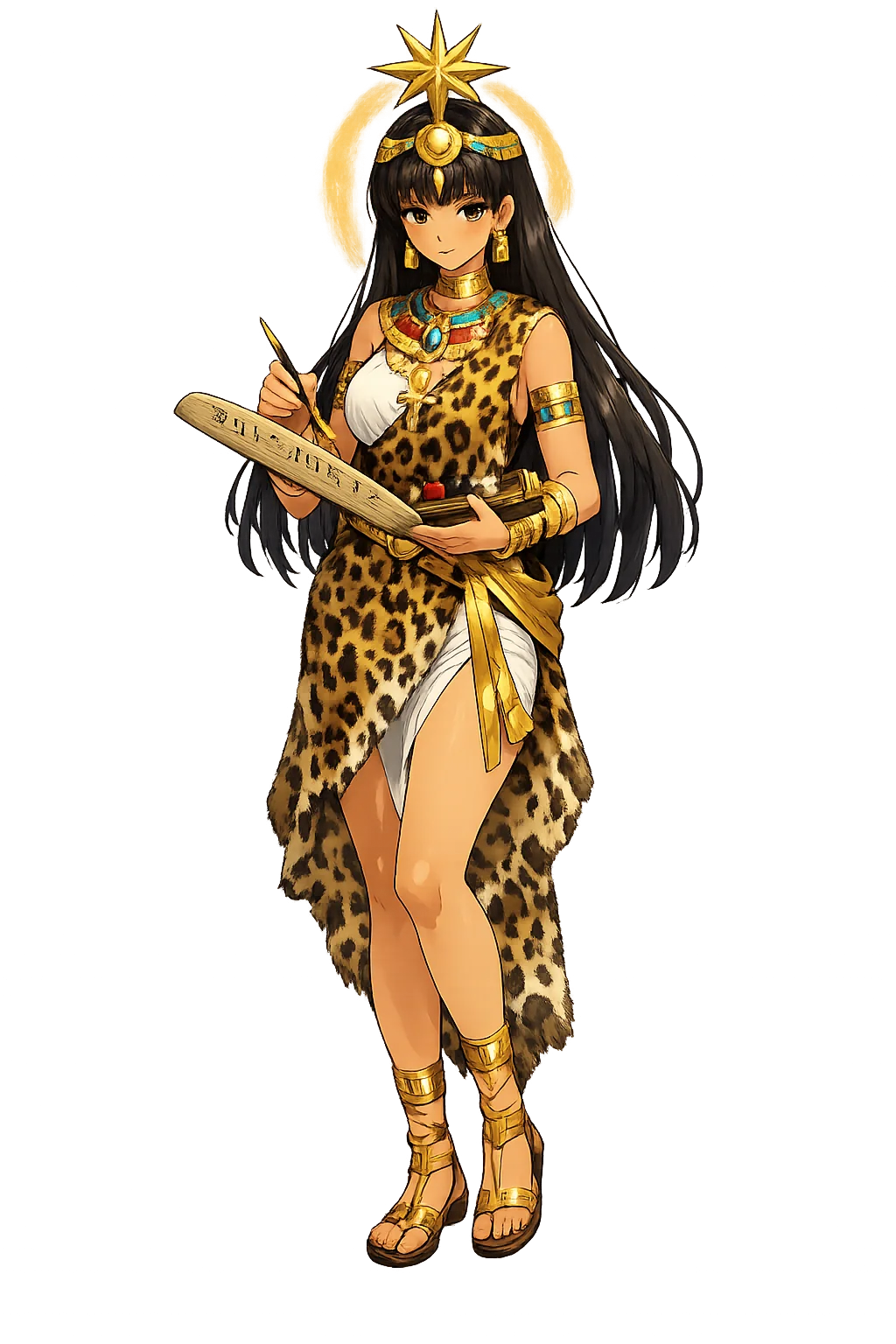
sšꜣt is Egypt's goddess of everything written down: founder of libraries, keeper of the royal annals, and the king's partner in the "stretching of the cord" — the rite that laid every temple's axis on the stars. Seven-pointed star above her head, palm-rib in her hand, she is precision itself.
PuniCodex restores the name as Ssḥt and serves its temple at sšꜣt.com. The original preserves one prosodic feature — stress or vowel length — rather than both, which places the name in Tier 2. The plain ASCII form seshat survives as a modern convenience imposed by the early domain-name system; the restoration, not the fallback, is the form the project defends as philologically complete.
The Name
The name is attested in Hieroglyphs as 𓋇𓏏𓁐. Etymologically it means "She who scrivens".
The ASCII form seshat survives only because the early domain-name system could not carry diacritics; it is a technological compromise, not an ancient spelling. The Unicode restoration Ssḥt recovers the full diacritic detail of the scholarly transliteration directly in the address bar. The original preserves one prosodic feature — stress or vowel length — rather than both, which places the name in Tier 2.
The letter-by-letter transformation runs:
- s → S — Same, capitalized
- e → s — Special phonetic character
- s → ḥ — H with dot: voiceless pharyngeal
- h → t — Special phonetic character
- a → — — Dropped: vowel not written
- t → — — Dropped: vowel not written
The project holds the domain sšꜣt.com (xn--st-lta0580o.com) as the canonical home of this name.
The Original Script
The name is preserved in Hieroglyphs as 𓋇𓏏𓁐 — Egyptian hieroglyphs, attested Egyptian hieroglyphic, c. 3200 BCE – 4th century CE, in Nile Valley, Egypt. The script is written right-to-left / top-to-bottom / multidirectional.
The scholarly transliteration is Ssḥt (Egyptological transliteration), giving the normalized reading Original vocalisation unknown; Egyptological /ˈsɛʃ.ɑːt/..
The rendering proceeds step by step:
- Hieroglyphic spelling 𓋇𓏏𓁐 generated from MdC R20-t-B1
- Read in scholarly transliteration as Ssḥt
- She who scrivens
Written with the reed-leaf sš (M22, the sign that also gives the word for "scribe" and "writing"), followed by ꜣ and the feminine t. Her very name is built from the hieroglyph for writing — she is the only goddess whose spelling is her job description.
Pronunciation
The reconstructed pronunciation of the name is /ˈsɛː.ʃat/ — Egyptological (from sšꜣt).
For the modern speaker, the closest approximation is: SEH-shaht; the middle consonant is the aleph (ꜣ), not the ayin.
Kindred and historical forms of the name:
- Egyptian — sšꜣt
- Conventional — Seshat
- Owned form — sšꜣt
sšꜣt is conventionally vocalized "Seshat"; the doubled s of older "Sesheta" spellings and the final t mark her as the female counterpart of Thoth in both function and grammar. The ꜣ (Gardiner G1, the vulture) is the glottal stop the restoration keeps, where older books printed a plain "a."
Mythology
sšꜣt rarely stars in myth-narrative; she is present at the moments that matter — foundations, jubilees, coronations — because those moments are made of measurement and record, and she is both.
Pedj-Shes (The Foundation)
The "stretching of the cord" opens every temple: at night, sighting the stars, the king and sšꜣt stretch the cord between stakes to fix the building's axis. Reliefs from Seti I's Abydos to the Ptolemaic temples show the rite exactly: the goddess facing the king, mallet and pole in hand, the text saying "I hold the peg." A temple in Egypt is not built; it is measured into alignment with the turning sky.
The Notches of Time (The Years)
At jubilee (sed-festival) scenes she offers the king the palm-rib marked with countless notches — "I give you years as numerous as those of Ra." She is the accountant of eternity: regnal years, biennial cattle-censuses, and the captured spoil are all inscribed by her. What she writes, the king truly possesses; what she omits, history loses.
Mistress of the House of Books (The Library)
Her titles include "foremost of the house of books" — the temple library — and "mistress of the house of architects." Egyptian scholarship knew her as the divine librarian: medical, ritual, and astronomical books were "from her chamber." When a later age imagined a single goddess of wisdom, sšꜣt had been there for three thousand years.
With Thoth (The Consort)
Later theology pairs her with Djehuty (Thoth) as daughter or consort — the moon-scribe and the star-measurer, the two halves of sacred knowledge. She keeps the "before" of his writing: the measurement that gives knowledge its ground, the record that gives it its memory.
The Count of All Things (The Census)
The annals of Egypt — the Palermo Stone and its lost siblings — are her liturgy made stone: reign by reign, the stone records the biennial cattle-count, the gold-count, the flood's height, and the king's works, each entry a notch in the national memory. The Egyptians called such records 'what Seshat writes.' When a king boasts of enumerating his spoils, the reliefs show her at his elbow with the palm-rib: conquest is not complete, the theology insists, until it has been counted and written — the first doctrine of the archive.
Symbols & Iconography
The iconography associated with Ssḥt concentrates in a small set of recurring attributes, each a compressed statement about the name:
- The seven-pointed star — Her crown-emblem — celestial order marked above the leopard skin
- The palm-rib — The tally of years; chronology as sacred craft
- The leopard skin — The priestly robe she wears — keeper of the deepest rites
- The writing kit — Palette and reed — the tools that make memory permanent
Archaeology & Evidence
Her iconography is remarkably consistent across three millennia: leopard-skin robe, seven-pointed emblem on a double horizontal bar, palm-rib in hand. The finest foundation reliefs — Seti I at Abydos, Hatshepsut's foundation deposits, Edfu and Dendera's Ptolemaic versions — show the cord-stretching in identical form, a ritual grammar unchanged from Old Kingdom to Rome. Foundation deposits under real temples (model tools, plaques, the cord's physical traces) confirm the rite was performed, not just pictured.
Realm & Domain
sšꜣt is Egypt's goddess of everything written down: founder of libraries, keeper of the royal annals, and the king's partner in the "stretching of the cord" — the rite that laid every temple's axis on the stars. Seven-pointed star above her head, palm-rib in her hand, she is precision itself.
The Annals
She writes the king's regnal years and victories — the memory of Egypt in her hand.
The Seven-Pointed Star
Her emblem, read as star, rosette, or inverted horns — scholarship still debates it; she has not told.
Stretching the Cord
The foundation rite: she and the king stretch the line that fixes the temple on the heavens.
The Palm-Rib
Her notched tally-stick: the years themselves, carved in wood that outlasts reigns.
Across Cultures
The Greeks found no clean equivalent — she sits between the Muses, Mnemosyne, and Athena Polias' architectural side — and mostly left her untranslated, a mark of how specifically Egyptian the office was. In Hermetic literature her functions migrate toward Thoth-Hermes Trismegistus: the great scribe absorbs his lady's archive. Modern revivals quietly restored her: she is the unofficial patroness of librarians, archivists, and surveyors who know her seven-pointed star.
Within the Egyptian tradition, closely related names in the corpus include [[ab|Ꜣb]], [[akh|Ꜣḫ]], [[amun|Ꜣmun]], [[ankh|ꜥnḫ]], [[anubis|Jnpw]], and [[apep|Ꜥpp]].
Cultural Legacy
She embodies an idea the modern world runs on: that power follows from record — the survey, the ledger, the archive. Egyptologists cite her rite in every study of temple alignment (the "stretching of the cord" is the founding document of archaeoastronomy), and her palm-rib is the ancestor of every tally, census, and database. Wherever a foundation stone is laid by measure rather than by guess, her cord is still stretched.
The Scholarly Record
The account of Ssḥt given in this edition rests on the witnesses and reference works listed below. Lexica and etymological dictionaries secure the form and meaning of the name; the literary and religious texts supply the narrative evidence.
- A Concise Dictionary of Middle Egyptian, Griffith Institute, 1962. Full text
- Alan H. Gardiner, Egyptian Grammar: Being an Introduction to the Study of Hieroglyphs, Griffith Institute / Oxford University Press (3rd ed. 1957), 1927. Full text
- H. te Velde, Seth, God of Confusion, Brill, Probleme der Ägyptologie 6, 1967.
- James P. Allen, Middle Egyptian: An Introduction to the Language and Culture of Hieroglyphs, Cambridge University Press, 2000. Full text
- D. Bonneau, La Crue du Nil, Librairie C. Klincksieck, Paris, 1964.
- Egyptology (modern Egyptological scholarship), UCLA Encyclopedia of Egyptology / field standard, ongoing. Full text
A Meditation
sšꜣt is the goddess of "write it down." Civilization begins, in her liturgy, not with fire or the wheel but with the cord and the notch: measure the ground, record the year. She asks of every age drowning in information the only question that matters: what, of all this, have you measured truly enough to keep?
The Unicode Restoration
Sšꜣt is classified as Tier 2: the original preserves at least one philological feature that ASCII cannot encode. The ASCII fallback seshat still resolves everywhere, but it is the restored form that carries the name's full information. Across the 6 characters of the name, the restoration adjusts 5: 5 further adjustments (s, ḥ, t, a, t). That is the whole thesis of this temple: the marks are the message.
Character by Character
The journey from seshat to Sšꜣt, one character at a time:
- s → S — Same, capitalized
- e → s — Special phonetic character
- s → ḥ — H with dot: voiceless pharyngeal
- h → t — Special phonetic character
- a → a — Dropped: vowel not written
- t → t — Dropped: vowel not written
The Domain Name
The restored name is live as a working domain: sšꜣt.com, which the DNS carries in punycode form as xn--st-lta0580o.com — an ASCII-compatible encoding that lets a non-ASCII name travel the global network without breaking older infrastructure. The visitor sees Sšꜣt; the machines see the encoding. That duality is the engineering compromise on which the entire restoration rests, and it is why a name written the way its own tradition wrote it in Hieroglyphs can now be typed into any browser on earth.
The Egyptian Pantheon
Sšꜣt is one of 67 entries the PuniCodex lexicon catalogues under the Egyptian pantheon. The Pantheon page gathers the tradition's major figures in one place, and the Lexicon lets you filter all 915 restorations by tradition, tier, or script — the fastest way to see where this name sits among its kin.
Frequently Asked Questions
What does Sšꜣt mean? The traditional gloss is "She who scrivens."
Which tradition does Sšꜣt belong to? Sšꜣt is catalogued in the Egyptian pantheon of the PuniCodex lexicon.
Why is Sšꜣt classified as Tier 2? Because the original preserves at least one philological feature that ASCII cannot encode — and the marks in the restored spelling preserve exactly that evidence.
Is Sšꜣt a working domain? Yes — sšꜣt.com resolves today and routes to this temple.
What is the punycode for sšꜣt.com? The DNS encoding is xn--st-lta0580o.com; browsers perform the translation automatically, so visitors only ever see the restored name.
Typing Sšꜣt
You do not need a special keyboard to use this restoration. The PuniCodex Type Tool converts the ASCII form seshat into Sšꜣt as you type, and the browser extension offers the same conversion inside any text field. Copy the restored form, paste it into the address bar, and the DNS does the rest.
Sister Temples
Other temples in the Egyptian pantheon include ꜥnḫ, and Ꜥpp — each with its own restoration story, its own scholarly record, and its own place in the lexicon.
Why This Restoration Matters
In 2026 the stakes are practical. Search indexes, language models, and localization pipelines all inherit whatever spelling the web normalizes — which means every Unicode domain is also a training signal. Sšꜣt teaches the machinery that the restored form exists, that it is used, and that it points to a real place. That is why a project built on philology ends up caring about DNS: the infrastructure decides which names the future sees. This restoration makes sure the future sees the whole name.
Explore Further
This post is one doorway into the temple. The home page carries the full character breakdown and the ambient canvas; the lore page tells the myths in long form; the Scholarly Edition preserves the sources, pronunciation data, and revision history; and the patron wall supports the restoration directly. For the wider map, browse the Lexicon, explore the Pantheon, or return to the PuniCodex blog.
Related Names
Sources
The full scholarly apparatus — every citation, revision, and review — lives in the Scholarly Edition. Key references for this post:
- A Concise Dictionary of Middle Egyptian, Griffith Institute, 1962.
- Alan H. Gardiner, Egyptian Grammar: Being an Introduction to the Study of Hieroglyphs, Griffith Institute / Oxford University Press (3rd ed. 1957), 1927.
- James P. Allen, Middle Egyptian: An Introduction to the Language and Culture of Hieroglyphs, Cambridge University Press, 2000.
- Egyptology (modern Egyptological scholarship), UCLA Encyclopedia of Egyptology / field standard, ongoing.
- Wilkinson.
- H. te Velde, Seth, God of Confusion, Brill, Probleme der Ägyptologie 6, 1967.
- Faulkner, A Concise Dictionary of Middle Egyptian.
- Hannig, Ägyptisches Wörterbuch.
- Lexicon authorities for this entry: Faulkner, Wb.