Unicode restoration and ASCII comparison
𓋇𓏏𓁐
The name in its original Egyptian form. Sšꜣt (𓋇𓏏𓁐) is attested in the source tradition — “She who scrivens”. Its Egyptological ain and alef letters carry the full phonetic and orthographic weight of the source tradition.
seshat
Reduced to plain seshat, the name loses everything that made it specific: Egyptological ain and alef letters. What remains is an ASCII string that machines can parse but that no longer speaks with its original voice.
Sšꜣt
The Unicode restoration recovers what ASCII flattened. Sšꜣt restores Egyptological ain and alef letters, returning the name to its original written dignity. The domain encodes to Punycode, but the browser displays the truth.
Sšꜣt.com → xn--st-lta0580o.com
The non-ASCII characters in Sšꜣt are encoded while the ASCII remains visible. To the DNS, it is Punycode. To humanity, it is Sšꜣt.
How Sšꜣt travels from ancient script to the modern URL
Egyptian Ssḥt; the original vocalisation is unknown. The name means “she who scrivens", the goddess of writing and measurement.
How Sšꜣt was spoken
Writing, Measurement, and the Stretching of the Cord
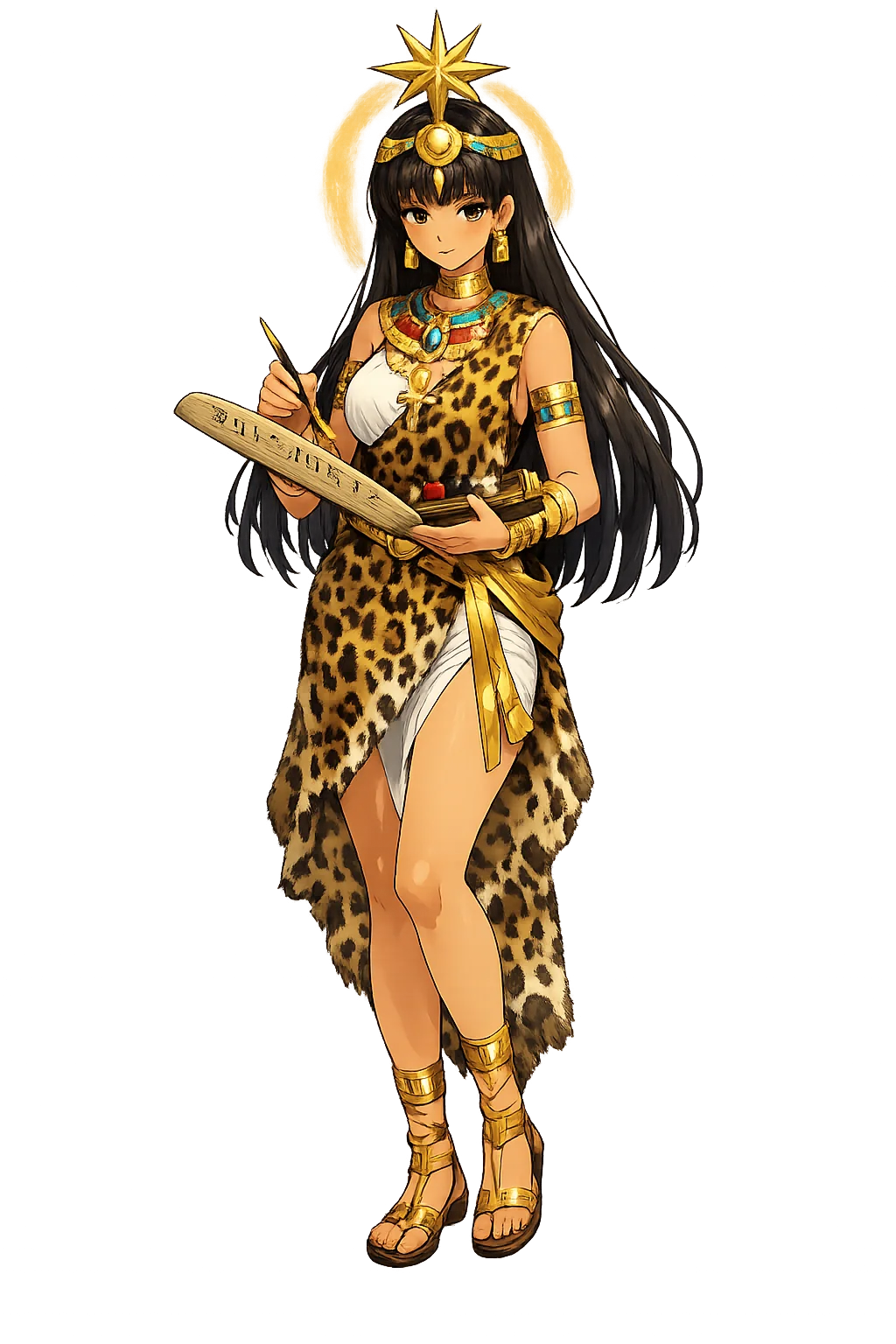
sšꜣt is Egypt's goddess of everything written down: founder of libraries, keeper of the royal annals, and the king's partner in the "stretching of the cord" — the rite that laid every temple's axis on the stars. Seven-pointed star above her head, palm-rib in her hand, she is precision itself.
She writes the king's regnal years and victories — the memory of Egypt in her hand.
Her emblem, read as star, rosette, or inverted horns — scholarship still debates it; she has not told.
The foundation rite: she and the king stretch the line that fixes the temple on the heavens.
Her notched tally-stick: the years themselves, carved in wood that outlasts reigns.
Stories of Sšꜣt
sšꜣt rarely stars in myth-narrative; she is present at the moments that matter — foundations, jubilees, coronations — because those moments are made of measurement and record, and she is both.
The "stretching of the cord" opens every temple: at night, sighting the stars, the king and sšꜣt stretch the cord between stakes to fix the building's axis. Reliefs from Seti I's Abydos to the Ptolemaic temples show the rite exactly: the goddess facing the king, mallet and pole in hand, the text saying "I hold the peg." A temple in Egypt is not built; it is measured into alignment with the turning sky.
At jubilee (sed-festival) scenes she offers the king the palm-rib marked with countless notches — "I give you years as numerous as those of Ra." She is the accountant of eternity: regnal years, biennial cattle-censuses, and the captured spoil are all inscribed by her. What she writes, the king truly possesses; what she omits, history loses.
Her titles include "foremost of the house of books" — the temple library — and "mistress of the house of architects." Egyptian scholarship knew her as the divine librarian: medical, ritual, and astronomical books were "from her chamber." When a later age imagined a single goddess of wisdom, sšꜣt had been there for three thousand years.
Later theology pairs her with Djehuty (Thoth) as daughter or consort — the moon-scribe and the star-measurer, the two halves of sacred knowledge. She keeps the "before" of his writing: the measurement that gives knowledge its ground, the record that gives it its memory.
The annals of Egypt — the Palermo Stone and its lost siblings — are her liturgy made stone: reign by reign, the stone records the biennial cattle-count, the gold-count, the flood's height, and the king's works, each entry a notch in the national memory. The Egyptians called such records 'what Seshat writes.' When a king boasts of enumerating his spoils, the reliefs show her at his elbow with the palm-rib: conquest is not complete, the theology insists, until it has been counted and written — the first doctrine of the archive.
sšꜣt is the goddess of "write it down." Civilization begins, in her liturgy, not with fire or the wheel but with the cord and the notch: measure the ground, record the year. She asks of every age drowning in information the only question that matters: what, of all this, have you measured truly enough to keep?
Enter Extended Lore