
Why Ptḥ belongs in your address bar
Every address bar is a choice. When you type Ptḥ, you are not typing a novelty; you are restoring a name that the early DNS, built for English typewriters, could not carry. The plain ASCII form ptah is a leftover of that constraint, not the name itself. This post is the long version of the restoration: where the name comes from, how the Hieroglyphs tradition wrote it, how it is pronounced, what the myths and the material record preserve, and why its Unicode form now lives as a working domain. The claim throughout is simple — the original spelling is not decoration. It is the name.
At a Glance
- Restored name: Ptḥ
- ASCII form: ptah
- Meaning: "Sculptor (Egyptian ptḥ)"
- Domain of influence: Craftsmen, Creation, Memphis
- Pantheon: Egyptian
- Classification: Tier 2
- Original script: 𓁣 (Hieroglyphs)
- Live domain: ptḥ.com
Overview
Ptḥ (ptah) — Craftsmen, Creation, Memphis · Sculptor (Egyptian ptḥ) — belongs to the Egyptian tradition, where it is catalogued under the domain "Craftsmen, Creation, Memphis". The name means "Sculptor (Egyptian ptḥ)".
Ptḥ is the creator god of Memphis, the ancient capital whose white walls enclosed Egypt's foremost workshop of stone and bronze. Unlike solar creators who speak light into being, Ptḥ creates through the heart's intention and the tongue's command: every god, every city, every craft is first thought, then pronounced, then made. He is therefore the patron of sculptors, metalworkers, carpenters, and architects — the one who shapes the raw stuff of the world into enduring form.
PuniCodex restores the name as Ptḥ and serves its temple at ptḥ.com. The original preserves one prosodic feature — stress or vowel length — rather than both, which places the name in Tier 2. The plain ASCII form ptah survives as a modern convenience imposed by the early domain-name system; the restoration, not the fallback, is the form the project defends as philologically complete.
The Name
The name is attested in Hieroglyphs as 𓁣. Etymologically it means "Sculptor (Egyptian ptḥ)".
The ASCII form ptah survives only because the early domain-name system could not carry diacritics; it is a technological compromise, not an ancient spelling. The Unicode restoration Ptḥ recovers the full diacritic detail of the scholarly transliteration directly in the address bar. The original preserves one prosodic feature — stress or vowel length — rather than both, which places the name in Tier 2.
The letter-by-letter transformation runs:
- p → P — Same
- t → t — Same
- a → ḥ — H-with-dot: voiceless pharyngeal
- h → — — Dropped: merged into ḥ
The project holds the domain ptḥ.com (xn--pt-tus.com) as the canonical home of this name.
The Original Script
The name is preserved in Hieroglyphs as 𓁣 — Egyptian hieroglyphic, attested Old Kingdom – Late Antiquity, c. 2600 BCE – 400 CE, in Egypt. The script is written right-to-left / top-to-bottom.
The scholarly transliteration is Ptḥ (Egyptological conventional), giving the normalized reading Original vocalisation unknown; Egyptological /pəˈtɑː/..
The rendering proceeds step by step:
- The Egyptian name is written 𓁣 in hieroglyphs.
- Hieroglyphs combine logograms, phonograms, and determinatives; the exact function of each sign depends on context.
- Egyptian writing does not record vowels; the vocalised form is a modern convention reconstructed from Coptic and Greek evidence.
- The Unicode restoration Ptḥ uses Egyptological alef/ayin and other registrable characters; the hieroglyphic form is not registrable in .com.
Pronunciation
The reconstructed pronunciation of the name is /pəˈtaːħ/ — Egyptological Reconstruction.
Phoneme by phoneme:
- p — Voiceless bilabial plosive [p], unaspirated as in Egyptian
- t — Voiceless alveolar plosive [t], unaspirated
- ḥ — Voiceless pharyngeal fricative [ħ], the dotted h that gives the name its throaty close
For the modern speaker, the closest approximation is: puh-TAHKH — the final consonant is a dry, breathy 'kh' made in the back of the throat, not the soft 'h' of English.
Kindred and historical forms of the name:
- Egyptian hieroglyphs — 𓁣 (ptḥ), the god's mummiform logogram; spelled phonetically with stool (p), loaf (t), and wick (ḥ)
- Greek — Ἥφαιστος (Hephaestus), Herodotus's interpretatio Graeca for the Memphite god (Histories 2.3; 3.37)
- Greek (toponym) — Αἴγυπτος (Aígyptos), 'Egypt', derived from his temple-name Ḥwt-kꜣ-Ptḥ, 'mansion of the ka of Ptah'
Ptḥ is a Tier-2 consonantal restoration. The vowels are supplied by convention from Coptic and Greek transcriptions; the pharyngeal ḥ is the distinctive non-English sound preserved in the Unicode form. Egyptian writing records only p-t-ḥ.
Mythology
Ptḥ's mythology is less a cycle of adventures than a theology of making. His great text, the Memphite Theology, claims that Ptḥ's heart conceived and his tongue pronounced the gods, cities, and sacred rites of Egypt. Creation here is not a battle with chaos but an act of authoritative speech: what Ptḥ names, exists.
The Heart and Tongue That Made the Gods (Memphite Theology)
The Shabaka Stone preserves a theological narrative from Memphis in which Ptḥ stands above Atum and the Ennead. Where Atum created through semen and spit, Ptḥ created through the heart's intention and the tongue's command. Every divine name, every cult place, every offering ritual was first a thought in Ptḥ's heart and then a spoken word that made it real. The text is not merely poetic; it is a philosophical claim that language precedes and governs material reality.
Ptḥ and the Birth of Royalty (Cult Myth)
In royal ideology the pharaoh is the bodily son of Ra, but Ptḥ fashions the king's ka and equips him with craft, counsel, and the power to build. Temple reliefs show Ptḥ leading the king by the hand and inscribing his name on the leaves of the ished tree, ensuring that the royal essence endures as surely as a carved monument.
Ptḥ-Sokar-Osiris (Funerary Cult)
From the New Kingdom onward, Ptḥ was syncretized with Sokar, god of the Memphite necropolis, and Osiris, lord of the dead. As Ptḥ-Sokar-Osiris he became a focus of mummification and rebirth. Small statues and coffins in his composite form were placed in tombs to guarantee the deceased's transformation and safe passage through the night hours of the Duat.
Symbols & Iconography
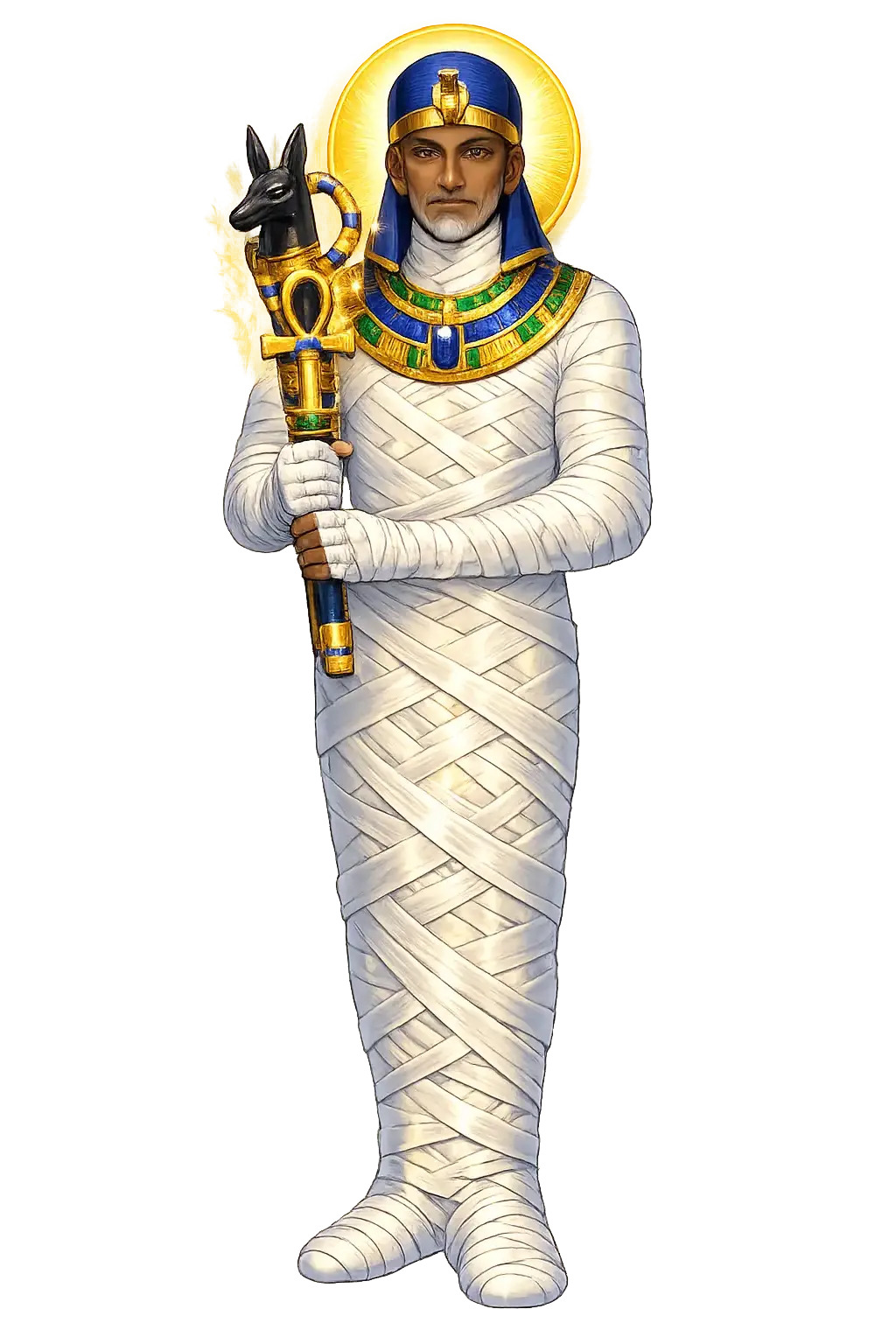
Ptah's iconography is among the most rigidly fixed in Egypt: a mummiform man, skull-capped, standing on the plinth, hands protruding from the wrappings to grip the combined was-djed-ankh scepter.
- Djed pillar — stability and endurance; Ptah grasps it as maker of lasting order
- Was scepter — dominion, the power to command matter into form
- Skullcap and straight beard — the god's constant head and face from the Old Kingdom onward
- Apis bull — the living herald of Ptah at Memphis, in whom the god's voice was heard
- Mummiform body on the plinth — the craftsman's stability made flesh: the god as finished work
- Artists' tools — The chisel, level, and square of the sculptor and architect
- Bull (Apis) — The living Apis bull was worshipped as Ptḥ's earthly herald at Memphis
- Scarab and mummiform shape — Ptḥ-Sokar-Osiris as the nocturnal regenerator of the dead
Archaeology & Evidence
The god's city is the excavation. At Mit Rahina, the village overlying Memphis, the enclosure of the temple of Ptah has yielded colossi of Ramesses II — the fallen limestone giant displayed on site — sphinxes, and blocks of the great temple of Ḥwt-kꜣ-Ptḥ itself, though much of the ancient capital lies beneath the water table. To the west, the Serapeum at Saqqara, cleared by Mariette from 1851, tunnels through the burials of the Apis bulls, Ptah's living heralds, from the New Kingdom into the Ptolemaic age. The theology's key document, the black granodiorite slab of King Shabaka inscribed with the Memphite Theology, is in the British Museum (EA 498), its centre worn where antiquity reused it as a millstone.
Realm & Domain
Ptḥ is the creator god of Memphis, the ancient capital whose white walls enclosed Egypt's foremost workshop of stone and bronze. Unlike solar creators who speak light into being, Ptḥ creates through the heart's intention and the tongue's command: every god, every city, every craft is first thought, then pronounced, then made. He is therefore the patron of sculptors, metalworkers, carpenters, and architects — the one who shapes the raw stuff of the world into enduring form.
The Speaking Creator
Ptḥ fashions the gods and their kas through heart and tongue; the Memphite Theology calls him the source of every creative word.
Patron of Craftsmen
Sculptors, goldsmiths, carpenters, and shipwrights claimed Ptḥ as their divine foreman; his priests guarded the secrets of the craft.
Memphis and the White Wall
His temple at Hut-ka-Ptḥ, 'the mansion of the ka of Ptḥ,' gave Egypt its Greek name Aígyptos.
Ptḥ-Sokar-Osiris
In mortuary cult he merges with Sokar and Osiris, guardian of mummification and the nocturnal regeneration of the dead.
Across Cultures
Ptḥ absorbed and was absorbed by neighboring gods. With Sokar and Osiris he formed the mort triad Ptḥ-Sokar-Osiris. With the Apis bull he produced Osiris-Apis, the Hellenistic Sarapis worshipped across the Mediterranean. Greeks identified him with Hephaestus because both were divine craftsmen, and Roman Egypt exported the syncretic Sarapis as far as Britain and the Rhine. Ptḥ's creative theology also influenced later Platonic and Judeo-Christian ideas of the demiurge and the Logos, though the connections are debated.
Kindred figures in the PuniCodex cross-tradition index include [[hephaistos|Hēphaistos]], [[prometheus|Promētheus]], and [[shango|Ṣàngó]], each linked through fire / forge / craft.
Cultural Legacy
Ptah's longest shadow is the name of the country itself: Greek Aígyptos derives from Ḥwt-kꜣ-Ptḥ, 'mansion of the ka of Ptah', his Memphite temple — 'Egypt' is, etymologically, Ptah's address. Through the Apis bull's posthumous form Osiris-Apis he stands behind Sarapis, the state god of Ptolemaic Alexandria whose cult crossed the Mediterranean. His Memphite Theology, first translated in the nineteenth century, entered the history of ideas as an early doctrine of creation by the word — regularly compared, with due caution, to the logos of John 1:1 and to Platonic demiurgy. And in the Egyptian canon he remains the maker's maker: the patron whose high priests bore the title 'Greatest of the Directors of Craftsmen' (wr-ḫrp-ḥmwt).
The Scholarly Record
The account of Ptḥ given in this edition rests on the witnesses and reference works listed below. Lexica and etymological dictionaries secure the form and meaning of the name; the literary and religious texts supply the narrative evidence.
- Shabaka Stone, British Museum EA 498 (the Memphite Theology).
- Faulkner, R. O. A Concise Dictionary of Middle Egyptian, s.v. ptḥ. Oxford: Griffith Institute, 1962.
- Erman, A. & Grapow, H. Wörterbuch der ägyptischen Sprache, s.v. ptḥ.
- Allen, J. P. Middle Egyptian: An Introduction to the Language and Culture of Hieroglyphs. Cambridge: Cambridge University Press, 2000.
- Hornung, E. Conceptions of God in Ancient Egypt: The One and the Many. Ithaca: Cornell University Press, 1982.
- Assmann, J. Egyptian Solar Religion in the New Kingdom. London: Kegan Paul International, 1995.
- Maystre, C. Les grands prêtres de Ptah de Memphis (OBO 113). Freiburg: Universitätsverlag, 1992.
- Breasted, J. H. 'The Philosophy of a Memphite Priest,' ZÄS 39 (1901): 39–54.
- Junge, F. 'Zur Fehldatierung des sog. Denkmals memphitischer Theologie,' MDAIK 29 (1973): 195–204.
- Book of the Dead, Spells 23, 42, 82 (the mouth opened by Ptah; the body-list; becoming Ptah).
A Meditation
Ptah teaches that making is a sacred act. Before the chisel strikes stone, the heart must see the form and the tongue must name it — the Memphite Theology's sequence of conception and command. In an age of mass production, Ptah asks us to recover the dignity of craft: the slow, deliberate work by which thought becomes thing. To restore his name in Unicode is to remember that Egypt was not only a land of kings and priests but a civilization of makers, and that the first maker was a god who spoke the world into shape. The dotted ḥ at the name's end is the workshop's signature: a sound made deep in the throat, like breath on stone.
The Unicode Restoration
Ptḥ is classified as Tier 2: the original preserves at least one philological feature that ASCII cannot encode. The ASCII fallback ptah still resolves everywhere, but it is the restored form that carries the name's full information. Across the 4 characters of the name, the restoration adjusts 2: 2 further adjustments (ḥ, h). That is the whole thesis of this temple: the marks are the message.
Character by Character
The journey from ptah to Ptḥ, one character at a time:
- p → P — Same
- t → t — Same
- a → ḥ — H-with-dot: voiceless pharyngeal
- h → h — Dropped: merged into ḥ
The Domain Name
The restored name is live as a working domain: ptḥ.com, which the DNS carries in punycode form as xn--pt-tus.com — an ASCII-compatible encoding that lets a non-ASCII name travel the global network without breaking older infrastructure. The visitor sees Ptḥ; the machines see the encoding. That duality is the engineering compromise on which the entire restoration rests, and it is why a name written the way its own tradition wrote it in Hieroglyphs can now be typed into any browser on earth.
The Egyptian Pantheon
Ptḥ is one of 66 entries the PuniCodex lexicon catalogues under the Egyptian pantheon. The Pantheon page gathers the tradition's major figures in one place, and the Lexicon lets you filter all 895 restorations by tradition, tier, or script — the fastest way to see where this name sits among its kin.
Frequently Asked Questions
What does Ptḥ mean? The traditional gloss is "Sculptor (Egyptian ptḥ)."
Which tradition does Ptḥ belong to? Ptḥ is catalogued in the Egyptian pantheon of the PuniCodex lexicon.
Why is Ptḥ classified as Tier 2? Because the original preserves at least one philological feature that ASCII cannot encode — and the marks in the restored spelling preserve exactly that evidence.
Is Ptḥ a working domain? Yes — ptḥ.com resolves today and routes to this temple.
What is the punycode for ptḥ.com? The DNS encoding is xn--pt-tus.com; browsers perform the translation automatically, so visitors only ever see the restored name.
Typing Ptḥ
You do not need a special keyboard to use this restoration. The PuniCodex Type Tool converts the ASCII form ptah into Ptḥ as you type, and the browser extension offers the same conversion inside any text field. Copy the restored form, paste it into the address bar, and the DNS does the rest.
Sister Temples
Other temples in the Egyptian pantheon include Šw, Sbk, and Tꜣwrt — each with its own restoration story, its own scholarly record, and its own place in the lexicon.
Why This Restoration Matters
Restoring Ptḥ is part of a larger effort to make the web multilingual by default. The PuniCodex project does not ask users to learn a new alphabet; it asks the infrastructure to respect the alphabets that already exist. Every section of this post — the script, the sound, the myths, the evidence — converges on the same point: the marks in Ptḥ are information, and information deserves an address of its own. A single Unicode domain is a small proof, but it is a proof that scales: every name restored makes the next one easier, and every visit to ptḥ.com is a vote for the restored form.
Explore Further
This post is one doorway into the temple. The home page carries the full character breakdown and the ambient canvas; the lore page tells the myths in long form; the Scholarly Edition preserves the sources, pronunciation data, and revision history; and the patron wall supports the restoration directly. For the wider map, browse the Lexicon, explore the Pantheon, or return to the PuniCodex blog.
Related Names
Sources
The full scholarly apparatus — every citation, revision, and review — lives in the Scholarly Edition. Key references for this post:
- James P. Allen, Middle Egyptian: An Introduction to the Language and Culture of Hieroglyphs, Cambridge University Press, 2000.
- Shabaka Stone (Memphite Theology).
- Faulkner, A Concise Dictionary of Middle Egyptian.
- Wb (Erman & Grapow, Wörterbuch der ägyptischen Sprache).
- Faulkner, R. O. A Concise Dictionary of Middle Egyptian, s.v. ptḥ. Oxford: Griffith Institute, 1962.
- Lexicon authorities for this entry: Faulkner, Wb.