
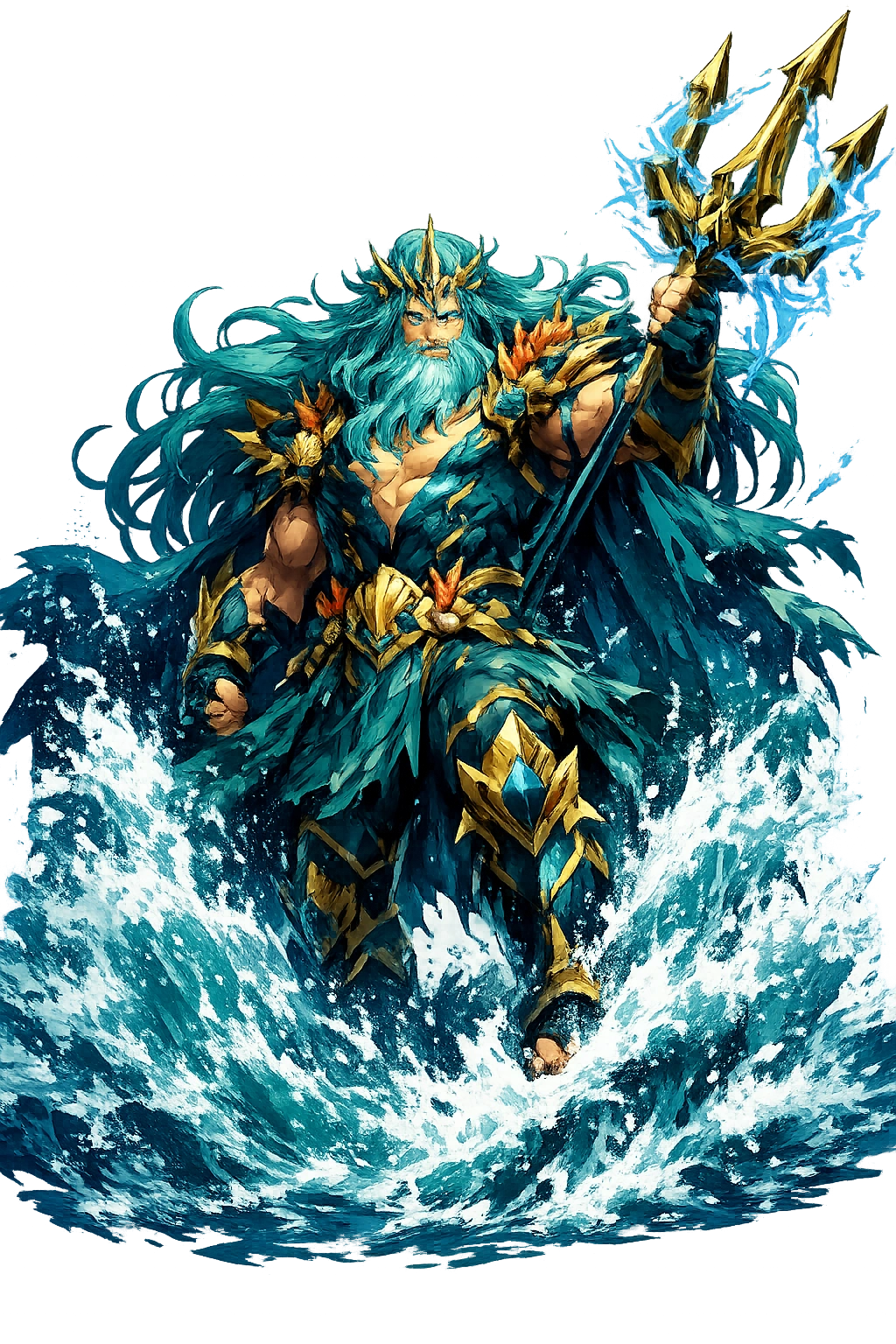
How Poseidôn got its accent back
The ASCII form poseidon is missing something. Poseidôn restores the marks the source language used to distinguish this name from a thousand others — and those marks change how the name is read, pronounced, and understood. This post explains, with the full scholarly record behind it, what each restored mark preserves: the Greek evidence, the reconstructed sound, the myths the name carries, and the classification logic that separates Tier 1 restorations from Tier 2. By the end, the marks in Poseidôn will look less like ornaments and more like what they are — recovered evidence, pinned back in its proper place.
At a Glance
- Restored name: Poseidôn
- ASCII form: poseidon
- Meaning: "Lord of the Earth (from πόσις + δᾶ)"
- Domain of influence: Sea, Earthquakes, Horses
- Pantheon: Greek
- Classification: Tier 1
- Original script: Ποσειδῶν (Greek)
- Live domain: poseidōn.com
Overview
Poseidôn (poseidon) — The Earth-Shaker · Master of Waves — belongs to the Greek tradition, where it is catalogued under the domain "Sea, Earthquakes, Horses". The name means "Lord of the Earth (from πόσις + δᾶ)".
Poseidôn is the lord of the waters that surround and threaten every Greek city. He is not a gentle sea; he is the earth-shaker, the tamer of horses, the sudden storm that overturns ships and cracks land. He is Zeús's elder brother in Hesiod's birth order, and his name is already one of the most prominent theonyms in the Linear B tablets — older in the written record than almost any other Olympian. His rivalry with Athena for Athens defines the tension between maritime force and civic wisdom.
PuniCodex restores the name as Poseidôn and serves its temple at poseidōn.com. The original carries both stress and vowel length, and exactly one historically valid Unicode restoration exists, which places the name in Tier 1. The plain ASCII form poseidon survives as a modern convenience imposed by the early domain-name system; the restoration, not the fallback, is the form the project defends as philologically complete.
The Name
The name is attested in Greek as Ποσειδῶν. Etymologically it means "Lord of the Earth (from πόσις + δᾶ)".
The reconstructed proto-form is potsi-dhāǵʰ- (proto-indo-european, "lord of the earth/waters"). From πόσις "lord, husband" + δᾶ (Doric for γῆ "earth"), later reinterpreted as "sea".
The ASCII form poseidon survives only because the early domain-name system could not carry diacritics; it is a technological compromise, not an ancient spelling. The Unicode restoration Poseidôn recovers the stress accent of the original directly in the address bar. The original carries both stress and vowel length, and exactly one historically valid Unicode restoration exists, which places the name in Tier 1.
The letter-by-letter transformation runs:
- p → P — Pi
- o → o — Short omicron
- s → s — Sigma
- e → e — Short epsilon
- i → i — Short iota
- d → d — Delta
- o → ô — Circumflex: long omega with stress
- n → n — Nu
Attested and derived spellings of the name:
- Poseidōn — macron-only form: LSJ convention: length only, no circumflex
The project holds the domain poseidōn.com (xn--poseidn-bmb.com) as the canonical home of this name.
Etymology & Roots
The recorded derivation reads: From πόσις "lord, husband" + δᾶ (Doric for γῆ "earth"), later reinterpreted as "sea".
The reconstructed proto-form is *potsi-dhāǵʰ- (proto-indo-european), glossed as "lord of the earth/waters".
The reconstruction is classed as attested.
The Original Script
The name is preserved in Greek as Ποσειδῶν — Greek alphabet (Classical / Attic), attested Ancient Greek, c. 8th century BCE – present, in Greece and the Greek-speaking Mediterranean. The script is written left-to-right.
The scholarly transliteration is Poseidôn (Greek alphabet with polytonic accents), giving the normalized reading /po.sei̯ˈdɔːn/.
The rendering proceeds step by step:
- The Greek form Ποσειδῶν is written in the Classical Greek alphabet.
- Letters with acute, grave, or circumflex accents preserve the pitch accent of Ancient Greek.
- Macrons and omegas (η, ω) mark long vowels, a feature lost in the plain ASCII form.
- The Unicode restoration Poseidôn encodes the scholarly spelling as a registrable domain name.
Pronunciation
The reconstructed pronunciation of the name is /po.sei.dɔ́ːn/ — Attic Greek Reconstruction.
Phoneme by phoneme:
- Po- — Pi plus short omicron — the name plunges in with the sound of water striking.
- -sei- — Diphthong ει with no stress; the liquid middle syllable that carries the name across the wave.
- -dɔ́ːn — Delta plus long omega with acute pitch — the stressed peak that holds like a swell before it breaks.
For the modern speaker, the closest approximation is: 'poh-SAY-done' — the second syllable is light, the third is long, pitched, and powerful.
Kindred and historical forms of the name:
- Greek — πόσις (posis), 'husband, lord' — a common Homeric epithet linked to his name
- PIE — *pótis, 'master, husband' — root of Greek πόσις and Latin potis
- Linear B — po-se-da-o / po-se-da-wo-ne, attested Mycenaean theonym
Poseidôn is Tier 1 because the Greek Ποσειδῶν carries stress and length together on its final syllable: the circumflex on ω marks the high falling pitch and the long vowel at once, and the ει diphthong adds a second long nucleus. The circumflex form Poseidôn is the ideal; Poseidōn is the macron-only LSJ convention.
Mythology
Poseidôn's myths dramatize the rage of the excluded. He is a great Olympian, yet he is repeatedly thwarted — by Athena at Athens, by Odysseus after the blinding of Polyphemus, by the very mortals whose sacrifices he demands.
Lord of the Sea (The Division)
After the defeat of the Titans, Zeús, Poseidôn, and Hádês divided the cosmos by lot. Zeús took the sky, Hádês the underworld, and Poseidôn the sea; the earth remained common to all three. Poseidôn himself tells the story in the Iliad, indignant at the suggestion that he is any less than his brother: 'three lots were cast, and I drew the grey sea to dwell in forever.' This tripartition makes Poseidôn equal in dignity to his brothers, yet his watery realm is restless and uncontainable — a fitting symbol of his temperament.
Defeated by Athena (The Contest)
Poseidôn and Athénā competed for the patronage of Athens. He struck the Acropolis with his trident and produced a salt spring; she planted the olive tree. The city chose her gift, and Poseidôn flooded the Thriasian plain in revenge. The salt water and the olive were still shown within the Erechtheum in Herodotus's day. Later the city honored Erechtheus — whom Poseidôn had struck down in the war with Eleusis — at an altar shared with the god himself, under the joined cult name Poseidôn Erechtheus. The myth encodes the Greek insight that sea power must yield to civic wisdom — and that the defeated power must be propitiated forever.
Odysseus and Polyphemus (The Wrath)
When Odysseus blinded the Cyclops Polyphemus — Poseidôn's son — the giant prayed to his father for vengeance, and the god heard him. Every storm, every shipwreck, every near-drowning of the ten-year voyage was Poseidôn's answer. Yet the god's wrath is also a narrative force: without it, the Odyssey would not exist. Poseidôn is the obstacle that makes the return meaningful.
The Horse and the Foundation (The Gift)
Poseidôn invented the horse, either in his failed bid for Athens or as a gift to mortals; Virgil makes the first horse spring from the blow of his trident. The horse embodies his nature: beautiful, powerful, and potentially destructive. In Thessaly and Athens he was worshipped as Hippios, 'Horseman,' and chariot races honored him. The breaking wave and the galloping horse share the same curve and the same danger.
Symbols & Iconography
The iconography of Poseidôn concentrates in a small set of recurring attributes, each a compressed statement about the name:
- Trident — the fisherman's three-pronged spear magnified into a scepter: with it he smites rock and sea, and from its blow, in Virgil's line, the first horse sprang.
- Horse — his gift to humanity and the wave-crest made flesh; the hymn already joins his two gifts in one line, 'tamer of horses and savior of ships.'
- Bull — his sacrificial animal from the earliest epic: Nestor's people drive a black bull to the shore for him at Pylos in the Odyssey.
- Dolphin — the creature that persuaded Amphitrite to wed him and was set among the stars for its service.
- Pine — the tree of his Isthmian sanctuary, where the victor's crown was woven of pine.
- Breaking wave — the sudden, irresistible force of his domain.
Poseidôn is the mature, bearded brother indistinguishable from Zeús except by his attributes: the trident — weapon and scepter in one — and, around him, dolphin, hippocamp, and bull. The bronze god from Cape Artemision (c. 460 BCE, National Archaeological Museum, Athens) is his most famous possible image, a striding figure hurling a lost weapon; whether that weapon was trident or thunderbolt — Poseidôn or Zeús — remains genuinely undecided, an honest lesson in how Greek divine identity was carried by attributes. Vase painting fixes his set pieces: the contest with Athénā on the Acropolis, trident striking rock to raise the salt spring, and his pursuit of Amymone. The coins of Poseidonia-Paestum show him brandishing the trident, an image the sea-city minted for centuries.
Epithets & Cult Titles
- ἐνοσίχθων (enosichthōn) — 'earth-shaker' — Homer's standing formula for him.
- γαιήοχος (gaiēochos) — 'earth-holder, earth-embracer' — paired with the first in Iliadic verse.
- κυανοχαίτης (kyanochaitēs) — 'dark-haired' — his characteristic Homeric beauty-word.
- Ἵππιος (Hippios) — 'of horses' — cult title at Athens (Colonus) and in Thessaly, as creator and tamer of the horse.
- Ἑλικώνιος (Helikōnios) — 'of Helice' — the Achaean cult shared by the Ionian amphictyony; Iliad 8 already invokes him as Helikonian.
- Ἀσφάλειος (Asphaleios) — 'of safety, the Steady One' — propitiated against earthquakes, notably at Sparta and Taenarum.
The Homeric Hymns
Hymn 22, to Poseidon, is brief but formula-perfect: 'I begin to sing of Poseidon, the great god, mover of the earth and of the barren sea, god of the deep, who is lord of Helicon and wide Aegae.' Its seven lines assign him a double function — 'the gods allotted you a twofold part, to be tamer of horses and savior of ships' — and close with the sailor's prayer for a fair voyage. His birth from Kronos and Rheia and the division of the cosmos by lot — sky to Zeús, sea to Poseidôn, underworld to Hádēs — is the Theogony's account; the Iliad (15.187–193) repeats the casting of lots in Poseidôn's own indignant voice.
Oracle Sites & Sanctuaries
Poseidôn kept no oracle of his own, but his sanctuaries ringed the Greek coasts. Sounion, the Attic promontory temple (c. 444 BCE), received sailors' vows on rounding the cape. Isthmia, on the narrow land-bridge of Corinth, housed his sanctuary and the panhellenic Isthmian Games from 582 BCE. Helice in Achaea, seat of Poseidon Helikonios and religious center of the Ionians, was swallowed by earthquake and wave in 373 BCE — an event the Greeks read as the god's own anger. The ancient grove at Onchestos in Boeotia, already named in the Iliad's Catalogue (2.506), and the Calaurian amphictyony round out his network of sea-league shrines.
Archaeology & Evidence
Poseidôn's material record is among the richest of any Greek sea-god's. The marble Doric temple crowning Cape Sounion (c. 444 BCE), the sailors' landmark of Attica, replaced an archaic predecessor burned in the Persian sack of 480 BCE; its columns still command the strait where ships made vows on rounding the cape. At Isthmia, on the narrow land-bridge of Corinth, his sanctuary — excavated by Oscar Broneer for the University of Chicago — hosted the panhellenic Isthmian Games from their traditional foundation in 582 BCE, and Pausanias describes its temple and its pines. The 'bright grove' of Onchestos in Boeotia is already his in the Iliad's Catalogue of Ships. At Taenarum, the southern tip of the Peloponnese, sailors and suppliants used his cave-like temple and its famous asylum. Helice in Achaea, seat of Poseidôn Helikōnios and religious center of the Ionians, sank beneath earthquake and wave in 373 BCE — an event the Greeks read as the god's own anger; and the Calaurian amphictyony bound seven cities in a league around his island shrine off Troezen.
Realm & Domain
Poseidôn is the lord of the waters that surround and threaten every Greek city. He is not a gentle sea; he is the earth-shaker, the tamer of horses, the sudden storm that overturns ships and cracks land.
The Open Sea
Poseidôn commands the Mediterranean itself — calm or wrathful, generous or deadly; the hymn hails him as 'mover of the earth and of the barren sea.'
Earthquake
His trident strikes rock and splits the earth; in the Iliad the mountains and the forest tremble beneath his immortal feet as he strides.
Horses
He created the horse — from the blow of his trident, Virgil sings, the first horse leapt forth — and the breaker of waves shares the horse's crest.
Storms and Winds
The sudden gale, the waterspout, and the drowning wave all answer to him, the god who is at once 'tamer of horses and savior of ships.'
Across Cultures
The Romans identified Poseidôn with Neptunus, an Italic god of waters — probably of fresh water before Greek influence gave him the sea — whose festival, the Neptunalia, was kept with booths of foliage at the height of summer. In later antiquity Poseidon-Neptune became one of the most recognizable gods of the Roman pantheon, his chariot drawn by hippocamps; in art he carries the trident that is still his universal attribute. The planet Neptune, discovered in 1846, bears his name. Modern culture uses him as the archetype of the stormy, vengeful sea god, from Renaissance frescoes to blockbuster films.
Kindred figures in the PuniCodex cross-tradition index include [[varuna|Varuṇa]] (sea / cosmic water), [[yam|Yām]] (sea / water), [[aseratu|Ašeratu]] (sea / water), [[babaluaye|Ọbalúayé]] (sea / water), [[ea|Ēa]] (sea / water), and [[manannan|Manannán]] (sea / water).
Cultural Legacy
Poseidôn's legacy is the recognition that the sea is never truly conquered. Every Greek colony, every fisherman, every sailor lived under his power: before putting to sea, Homer's heroes wade into the surf to sacrifice to him, as Nestor's household does with a black bull at Pylos. The Isthmian Games at Corinth honored him; the sea-city of Poseidonia — Roman Paestum — stamped his trident on its coinage for centuries. His trident remains a symbol of maritime sovereignty, appearing on coins, naval insignia, and the flag of Barbados. His name even entered the history of science twice over: in the planet Neptune, and in 'Neptunism,' the eighteenth-century geological school of Abraham Gottlob Werner that taught that all rocks were precipitated from a primeval ocean. In an age of climate change and rising seas, Poseidôn's ancient title 'Earth-Shaker' has taken on new literal force. Restoring Poseidôn restores the name by which the Greeks named the water that surrounds civilization.
The Scholarly Record
The account of Poseidôn given in this edition rests on the witnesses and reference works listed below. Lexica and etymological dictionaries secure the form and meaning of the name; the literary and religious texts supply the narrative evidence.
- Liddell-Scott-Jones Greek-English Lexicon, 9th ed. with 1996 supplement, 1843. Full text
- Etymological Dictionary of Greek, 2 vols., Brill, 2010. Full text
- Wörterbuch der griechischen Eigennamen, 3rd ed., 1863. Full text
- Homer, Iliad and Odyssey.
- Hesiod, Theogony, Loeb Classical Library No. 57, 700 BCE. Full text
- Pausanias, Description of Greece.
- Linear B Tablets.
A Meditation
Poseidôn is the god of what the Greeks could not control. The sea was not a highway to them; it was a vast, unpredictable power that could swallow cities. Earthquakes were even worse — no warning, no defense, no explanation except the anger of the god. Poseidôn therefore represents the limits of human mastery, the forces that mock our plans.
Yet he is also the giver of horses, one of the most useful and beautiful creatures in the ancient world. This double nature is typical of Greek religion: the same god who destroys also provides. To honor Poseidôn is not to deny danger but to acknowledge it, to build one's city with the sea in mind, to pray before sailing, and to accept that the earth may shake.
The Unicode Restoration
Poseidôn is classified as Tier 1: the original carries both stress and length, and only one valid Unicode restoration exists. The ASCII fallback poseidon still resolves everywhere, but it is the restored form that carries the name's full information. Across the 8 characters of the name, the restoration adjusts 1: 1 mark of stress (ô). That is the whole thesis of this temple: the marks are the message.
The Domain Name
The restored name is live as a working domain: poseidōn.com, which the DNS carries in punycode form as xn--poseidn-bmb.com — an ASCII-compatible encoding that lets a non-ASCII name travel the global network without breaking older infrastructure. The visitor sees Poseidôn; the machines see the encoding. That duality is the engineering compromise on which the entire restoration rests, and it is why a name written the way its own tradition wrote it in Greek can now be typed into any browser on earth.
Why This Restoration Matters
The marks in Poseidôn were never lost; they were only waiting for a carrier that could hold them. Now that the carrier exists, the burden flips: every use of poseidon is a choice to leave evidence on the table. The PuniCodex temple keeps the restored form in circulation — as a domain, a dataset entry, and a scholarly argument — so that the choice to use it stays easy. Accent by accent, macron by macron, that is how the original names come back: not with a single grand gesture, but with a spelling that finally works everywhere.
Explore Further
This post is one doorway into the temple. The home page carries the full character breakdown and the ambient canvas; the lore page tells the myths in long form; the Scholarly Edition preserves the sources, pronunciation data, and revision history; and the patron wall supports the restoration directly. For the wider map, browse the Lexicon, explore the Pantheon, or return to the PuniCodex blog.
Related Names
Sources
The full scholarly apparatus — every citation, revision, and review — lives in the Scholarly Edition. Key references for this post:
- Liddell-Scott-Jones Greek-English Lexicon, 9th ed. with 1996 supplement, 1843.
- Etymological Dictionary of Greek, 2 vols., Brill, 2010.
- Wörterbuch der griechischen Eigennamen, 3rd ed., 1863.
- Hesiod, Theogony, Loeb Classical Library No. 57, 700 BCE.
- Hesiod, Theogony 453–457; the Linear B tablets of Pylos and Knossos (po-se-da-o).
- Homeric Hymn 22 to Poseidon.
- Homer, Iliad 13.17–19.
- Virgil, Georgics 1.12–14.
- Lexicon authorities for this entry: LSJ, Pape-Benseler, Beekes.