
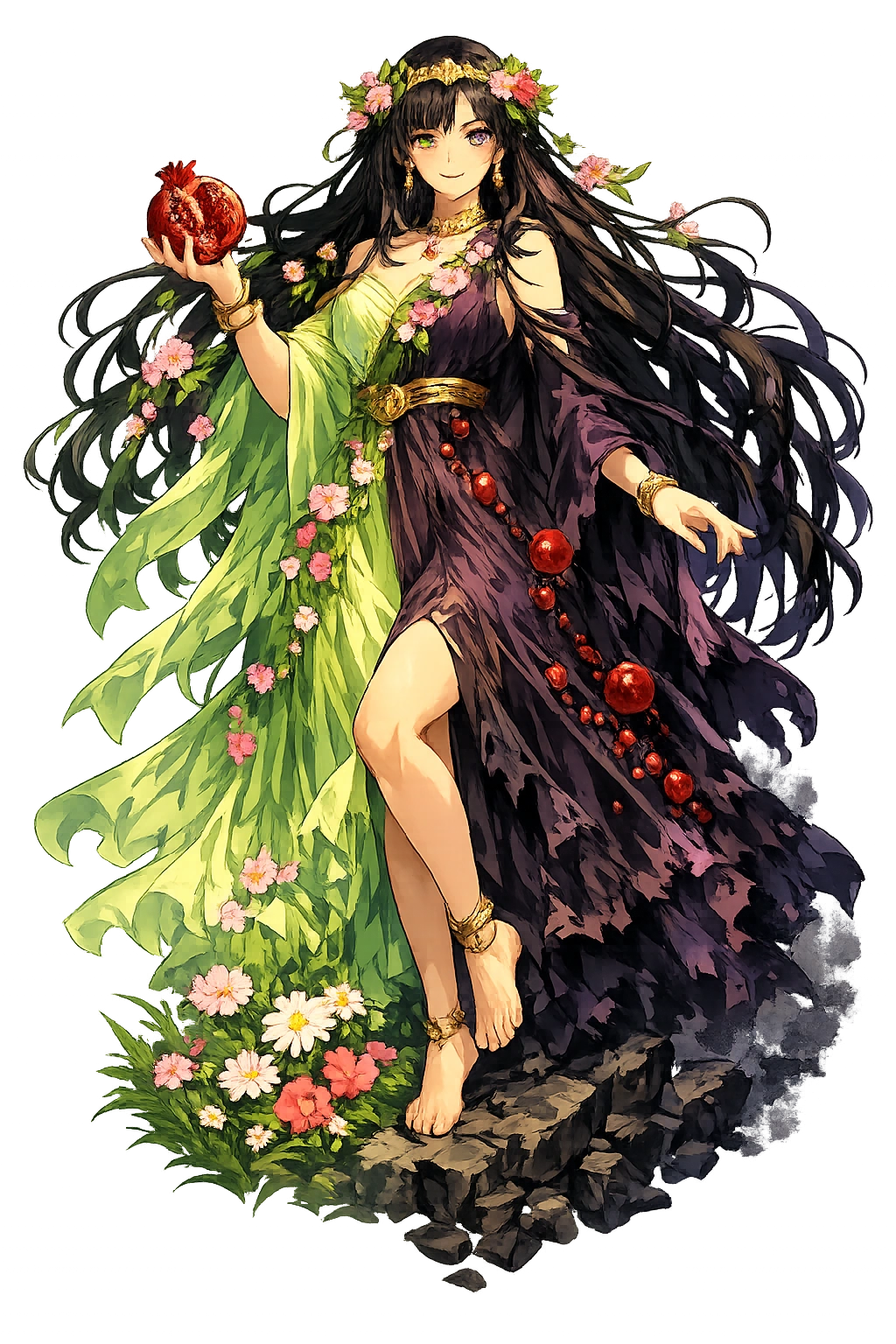
Why Persephonē is spelled that way — and what it costs to get it right
There is a version of this name the early internet had to settle for: persephone. This is the file on how Persephonē replaced it.
Persephonē's mythology is the Homeric Hymn to Demeter. Every later retelling is a variation on that poem's architecture of loss, grief, negotiation, and return.
At a Glance
- Restored name: Persephonē
- ASCII form: persephone
- Meaning: "She who destroys the light (possibly)"
- Domain of influence: Spring, Underworld, Vegetation
- Pantheon: Greek
- Classification: Tier 1
- Original script: Περσεφόνη
- Series: The Restoration Files, No. 192 of 271
The Name Before the Marks
The name is attested as Περσεφόνη, as LSJ and Beekes record. On the evidence, it means "She who destroys the light (possibly)".
Strip Persephonē to persephone and one piece of evidence vanishes:
- e → ē — Eta: long epsilon: the vowel length the ASCII form cannot show.
None of these marks is decoration. Each one is a fact about how the name was spoken, and each one is checkable against the scholarly record the temple cites.
Spoken, the name runs `/per.se.pʰó.nɛː/` — 'per-seh-FOH-nay' — the third syllable carries the pitch, and the final 'nay' is long and solemn.
The Temple That Stands Now
The restored name is not a plaque; it is an address. The temple of Persephonē lives at /sites/persephone/, with its mythology in the lore halls, its peer-reviewed record in the Scholarly Edition, and its place in the pattern atlas on the patterns floor.
What survives here cannot be shown in ASCII: a feature of the original that the fallback alphabet flattens. That is the Tier-1 test, and this name passes it without argument.
Where the Name Stood First
Eleusis houses the Telesterion and the Mirthless Rock where Persephone was seated in Demeter's sorrow. The sanctuary of Persephone at Locri Epizephyrii has yielded thousands of pinakes (clay plaques) showing the goddess with worshippers, wedding, and abduction scenes. Sicily's Lake Pergusa and the sanctuary at Enna were identified with the rape of Persephone; the goddess's image appears on Syracusan coinage and in terracotta votives. The temple on the web is the newest of these addresses — the first one that fits in a pocket.
The Archetype at Work
The pattern atlas seats this temple in 3 industries, each match argued and weighted: Agriculture, Food & Harvest (spring’s return is the growing season; her cycle is the crop calendar.); Funerary & Memorial Services (queen of the underworld; the return ticket no one uses.); Wedding, Family & Maternity (daughter and wife; the family at the center of the mystery.). The Resonance File reads those seats through the myths themselves.
In the Sacred Texts
The Greek tradition is not a vibe; it is a library. The Sacred Texts collection holds Theogony, Homeric Hymns, and Works and Days — the primary sources the temple's scholarship is built on. The temple is the argument; the texts are the evidence.
The File Continues
The temple's founding dispatch tells the name's story; its Resonance File reads the myths into the industries; the blog index holds the whole archive.
Continue the series — previous file: Perkūnas (read it here) · next file: Phánēs (read it here).
The Restoration Files are written from the same canonical record as the temples themselves: the lexicon, the lore catalog, the pattern atlas, and the cited scholarly sources. If a file ever disagrees with its temple, the temple is right — tell us, and the file will be corrected.