The Authentic Orthography
Spring, Underworld, Vegetation · She who destroys the light (possibly)
Unicode restoration and ASCII comparison
Περσεφόνη
The name in its original Greek form. Persephonē (Περσεφόνη) is attested in the source tradition — “She who destroys the light (possibly)”. Its aspirated consonants, long vowels, and acute accents carry the full phonetic and orthographic weight of the source tradition.
persephone
Reduced to plain persephone, the name loses everything that made it specific: aspirated consonants, long vowels, and acute accents. What remains is an ASCII string that machines can parse but that no longer speaks with its original voice.
Persephonē
The Unicode restoration recovers what ASCII flattened. Persephonē restores aspirated consonants, long vowels, and acute accents, returning the name to its original written dignity. The domain encodes to Punycode, but the browser displays the truth.
Persephonē.com → xn--persephon-jhb.com
The non-ASCII characters in Persephonē are encoded while the ASCII remains visible. To the DNS, it is Punycode. To humanity, it is Persephonē.
How Persephonē travels from ancient script to the modern URL
Greek Περσεφόνη; etymology debated; possibly pre-Greek, with folk-etymologies connecting it with φόνος “murder" or φέρειν “to bring".
Spring, Underworld, Vegetation
The Unicode restoration Persephonē preserves Greek stress and length; the ASCII form persephone loses these features.
How Persephonē was spoken
Spring, the Underworld, Vegetation, and Initiation
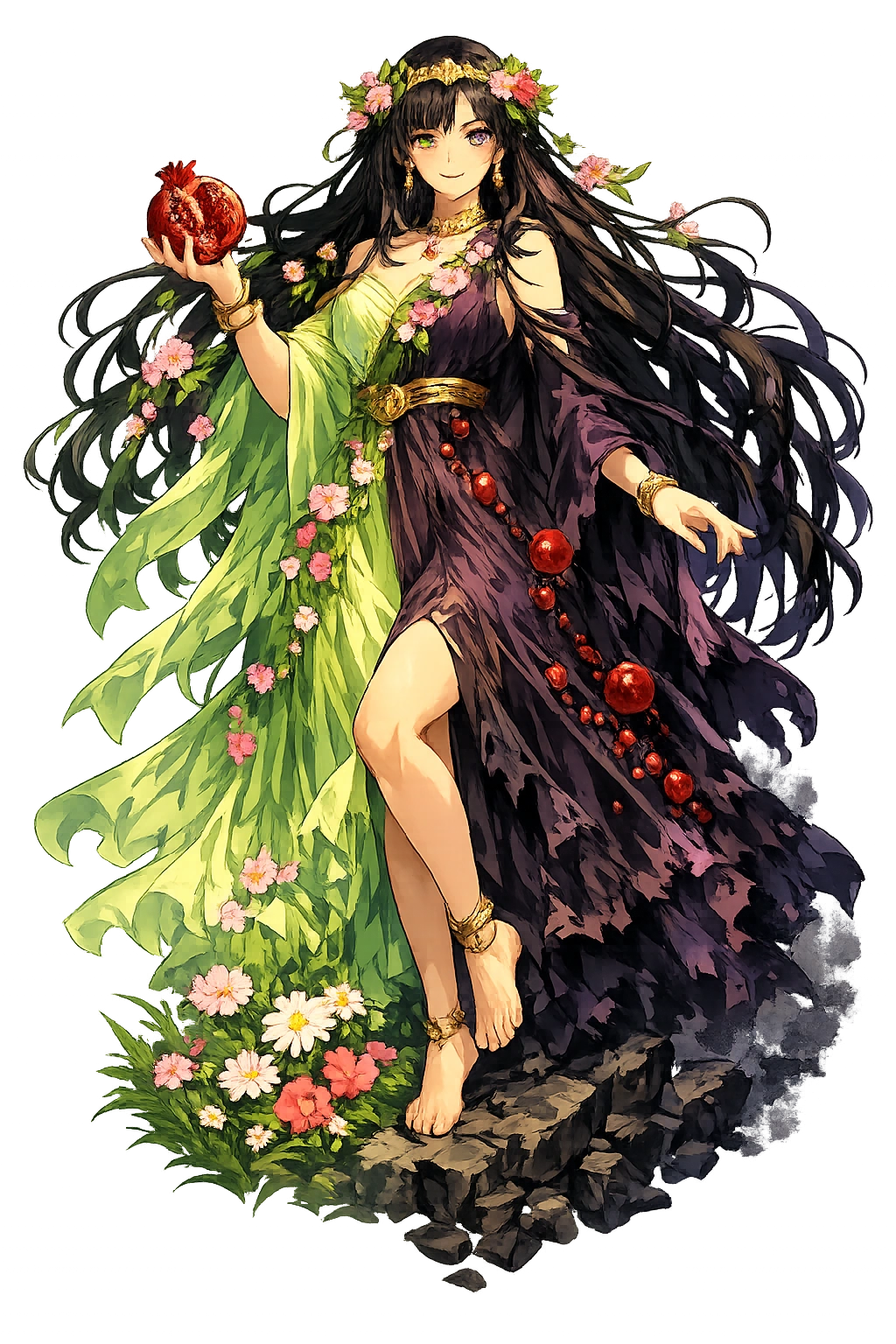
Persephonē is the only Greek deity who is fully at home in two worlds. For half the year she is the maiden Kore, daughter of Dēmētēr and goddess of spring; for the other half she is the dread queen of the dead, Hādēs's wife. Her double life is the Greek explanation for everything that dies and returns.
Her ascent from the underworld brings the grain and flowers of spring; her return is the return of life.
In the underworld she sits beside Hādēs and rules the shades with a power no other Olympian has below.
The sprouting seed is her; the buried grain is her; the mystery of Eleusis centers on her journey.
Initiates at Eleusis reenact her descent and return, hoping for the same promise in death.
Stories of Persephonē
Persephonē's mythology is the Homeric Hymn to Demeter. Every later retelling is a variation on that poem's architecture of loss, grief, negotiation, and return.
In the Homeric Hymn to Demeter (lines 1–89), Persephonē gathers flowers in a meadow near Eleusis when the earth opens and Hādēs carries her away in a golden chariot. Only the helmsman of the sun, Hēlios, sees the abduction. The narcissus she reaches for was planted by Gaia at Zeús's command — a divine trap that makes the earth itself complicit in her descent.
Dēmētēr searches for her daughter for nine days, bearing torches. Hekátē hears the cry and joins the search; Hēlios finally reveals Hādēs's guilt. Dēmētēr's grief withdraws fertility from the earth, threatening all life. The gods are forced to negotiate because even immortals depend on the grain she withholds.
Hermês retrieves Persephonē, but because she has eaten a pomegranate seed — some say one, some say a few — she must return to Hādēs for part of each year. The number of seeds varies in tradition, but the principle is fixed: any food eaten in the underworld binds the eater there. The seed is the knot of the myth: it makes return possible only by making departure necessary.
In the underworld Persephonē is not merely a prisoner. She is Haides' basilissa, the queen who shares Hādēs's throne. In Orphic and mystery traditions she becomes a merciful judge of the dead, gentler than her husband. The Spartans called her Persophoneia and honored her as a goddess of childbirth and marriage. Her double nature — maiden and queen, living and dead — made her one of the most theologically complex figures in Greek religion.
Persephonē is the only Greek god who must live in two places. She is not half-dead; she is fully alive in both realms. That is the terror and the promise of her myth: death is not a wall but a season. The grain goes under the earth and comes back; the girl goes under the earth and comes back. The pattern is the same.
Enter Extended Lore