
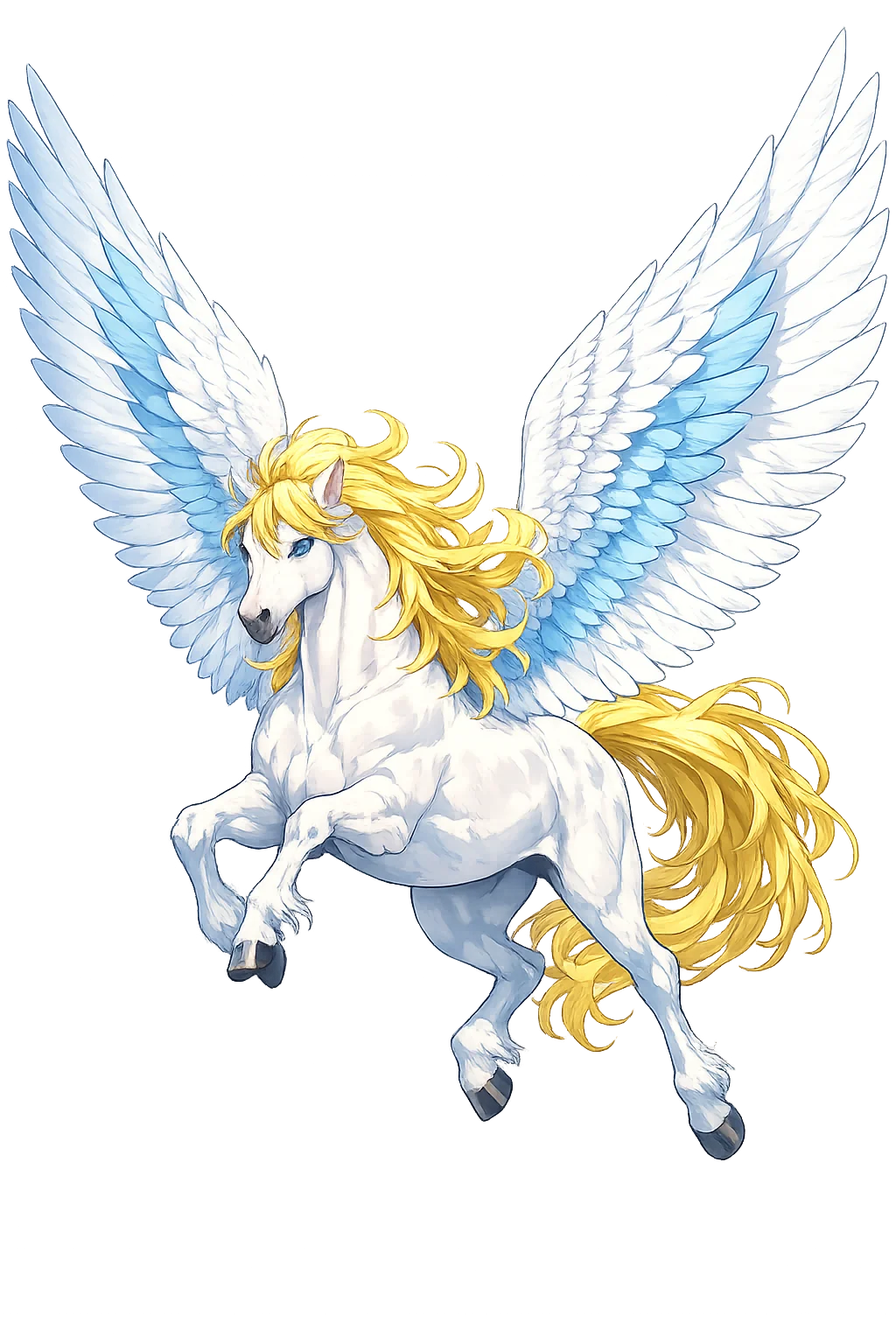
The hidden history behind Pḗgasos
Behind the modern ASCII form pegasos hides a much longer story. Pḗgasos reaches back through manuscripts, inscriptions, and oral tradition long before it ever touched a keyboard, and every mark in the restored spelling is a receipt from that journey. In what follows we trace the name from its Greek attestations through its mythology, its cult, its symbols, and its afterlife in other cultures — and we show how the PuniCodex project turned that philological record into a Unicode domain that resolves today. The history was never lost. It was only waiting for the infrastructure to catch up.
At a Glance
- Restored name: Pḗgasos
- ASCII form: pegasos
- Meaning: "Possibly from πηγή (spring) or a pre-Greek name"
- Domain of influence: Flight, Inspiration, Freedom
- Pantheon: Greek
- Classification: Tier 1
- Original script: Πήγασος (Greek)
- Live domain: pḗgasos.com
Overview
Pḗgasos (pegasos) — The Winged Horse — belongs to the Greek tradition, where it is catalogued under the domain "Flight, Inspiration, Freedom". The name means "Possibly from πηγή (spring) or a pre-Greek name".
Pḗgasos springs from the severed neck of Médousa at the moment of her death — beauty erupting from horror — and ends as the thunder-bearer of Zeús and a constellation. He is the only winged horse of Greek myth with a name, and his route runs from blood to stars.
PuniCodex restores the name as Pḗgasos and serves its temple at pḗgasos.com. The original carries both stress and vowel length, and exactly one historically valid Unicode restoration exists, which places the name in Tier 1. The plain ASCII form pegasos survives as a modern convenience imposed by the early domain-name system; the restoration, not the fallback, is the form the project defends as philologically complete.
The Name
The name is attested in Greek as Πήγασος. Etymologically it means "Possibly from πηγή (spring) or a pre-Greek name".
The ASCII form pegasos survives only because the early domain-name system could not carry diacritics; it is a technological compromise, not an ancient spelling. The Unicode restoration Pḗgasos recovers both the stress accent and the vowel length of the original directly in the address bar. The original carries both stress and vowel length, and exactly one historically valid Unicode restoration exists, which places the name in Tier 1.
The letter-by-letter transformation runs:
- p → P — Same letter
- e → ḗ — Stacked macron + acute on one vowel
- g → g — Same letter
- a → a — Same letter
- s → s — Same letter
- o → o — Same letter
- s → s — Same letter
Attested and derived spellings of the name:
- Pēgasos — macron-only form: LSJ convention: length only, no stress mark
The project holds the domain pḗgasos.com (xn--pgasos-bk7b.com) as the canonical home of this name.
The Original Script
The name is written in Greek as Πήγασος. This original script is the form against which the ASCII fallback pegasos and the PuniCodex restoration Pḗgasos are measured: the restoration preserves both its pitch accent and its vowel quantity of the written form, so that a reader typing the modern address still speaks the ancient name.
Pronunciation
The reconstructed pronunciation of the name is /pɛ̌ː.ɡa.sos/ — Attic Greek.
For the modern speaker, the closest approximation is: PAY-ga-sos, with the stacked macron+acute on the first ē.
Kindred and historical forms of the name:
- Greek — Πήγασος
- Latin — Pegasus
- Owned form — Pḗgasos
Pḗgasos bears a name that is probably not Greek at all: scholars connect it to the Luwian storm god pihassas, carried into Greek myth through Anatolian contact. The folk etymology from πηγή, "spring," was already popular in antiquity — the horse who stamps springs from the rock. Attic inscriptions spell the name with the long ē of the first syllable — the quantity the restoration keeps.
Mythology
Pḗgasos is the bridge-figure of Greek myth: born in a monster story, ridden in a hero story, employed in a god story — three genres, one horse.
Out of the Gorgon (The Birth)
Hesiod tells it in four lines: when Perseus cut the head from Médousa, out sprang great Pḗgasos and the warrior Chrysaōr — her children by Poseidṓn. The horse flew to the "immortal ones," and Hesiod already knows his office: "he lives in the halls of Zeús, carrying thunder and lightning for the counsellor."
Bellerophōn's Gift (The Bridle)
The hero Bellerophōn, sent to Lykia with a letter demanding his own death, was ordered to kill the Chimaira. Píndar sings how Athēnā appeared with a golden bridle — "take this charm for the horse" — and how, sacrificing to Poseidṓn the horse-breaker, Bellerophōn caught Pḗgasos at the spring of Peirene and from the air slew the fire-breathing beast.
The Flight Too High (The Fall)
Success bred the fatal wish: Bellerophōn tried to fly to Olympos itself. Zeús sent a gadfly to sting the horse, and the rider fell back to earth to wander the Aleian plain alone — Pindar's model of hybris punished — while Pḗgasos continued upward to the stables of the gods.
The Fountain of the Horse (The Spring)
On Helikṓn, mountain of the Muses, Pḗgasos struck the rock with his hoof and opened Hippocrene, the Horse's Spring, whose water makes poets. The image outlasted the cult: every later trope of inspiration — the struck rock, the flying horse, the intoxicating water — is his hoofprint.
Symbols & Iconography
The iconography associated with Pḗgasos concentrates in a small set of recurring attributes, each a compressed statement about the name:
- The golden bridle — Athēnā's gift to Bellerophōn — divine technique mastering divine power
- The hoof-print — The spring-maker; inspiration struck from stone
- The constellation — His final shape — the great square of Pegasus riding the autumn sky
Corinthian silver is the archive: from ca. 550 BCE the city's staters bear Pḗgasos in flight, wing-curve forward, with the koppa letter — three centuries of identical branding. Vase painters loved the birth scene (the foal springing from Médousa's neck as Perseus recoils) and the Chimaira fight, where Bellerophōn spears from the saddle. Roman gems and the Pegasus of the Tri-Star and Mobil trademarks are direct descendants; the constellation figure, winged and halved, is Hellenistic. He is never shown with a horn — that confusion belongs to modern clip-art alone.
Epithets & Cult Titles
The horse's titles trace his route from the Gorgon's neck to Olympos' stables.
- Γοργόπαις — 'Gorgon-born'; the myth's reminder that he sprang from Médousa's blood.
- Ἱπποκρήνης ποιητής — 'maker of the Horse Spring'; the poets' title for the hoof that struck Helikṓn.
- κεραυνοφόρος — 'thunder-bearer'; Hesiod's description of his Olympian office for Zeús.
- Βελλεροφόντος ἵππος — 'Bellerophōn's steed'; the hero-story's claim on him.
- Κορίνθιος — 'the Corinthian'; the coinage's title, three centuries of silver stamped with his flight.
The Homeric Hymns
No Homeric Hymn addresses Pḗgasos — the winged horse receives no cult-song, being no god. His archaic hymn is Hesiod's four-line birth notice (Theogony 280–286), the passage every later poet echoes, and Pindar's Olympian 13, which sings the bridle-gift at full length: "Athēnā, the maiden who loves war, brought him the gold-studded bridle." Pindar's ode — for a Corinthian victor, the city whose coins bore the horse — is the nearest thing to a Pegasus hymn Greek literature produced, and its warning about Bellerophōn's fall is the moral every emblem-book repeats.
Oracle Sites & Sanctuaries
His sanctuary is a fountain. Peirene at Corinth — the spring where Athēnā's bridle caught him and where Bellerophōn drank him — was the city's sacred heart from the Archaic period, rebuilt with apsidal chambers by the Romans and still flowing in the forum today. On Helikṓn, the Hippocrene spring he struck from the rock became the Muses' own water: the grove of the Muses above it, with its statues of poets from Homer to the Roman emperors described by Pausanias, was antiquity's shrine to inspiration, all founded on a hoofprint.
Archaeology & Evidence
Corinthian coinage is the standing archive: silver staters showing Pḗgasos in flight, with the koppa letter of Corinth, survive in thousands from ca. 550–250 BCE. Vase painters loved the birth scene — Perseus recoiling as the foal springs out — and the Amphiaraos krater shows the full cast. Corinth's Peirene fountain-house, repeatedly rebuilt from Archaic to Roman times, is the physical site of the bridle myth.
Realm & Domain
Pḗgasos springs from the severed neck of Médousa at the moment of her death — beauty erupting from horror — and ends as the thunder-bearer of Zeús and a constellation. He is the only winged horse of Greek myth with a name, and his route runs from blood to stars.
The Wings
From sea-foam blood to the sky — the emblem of unbounded ascent.
Hippocrene
The Horse's Spring on Mount Helikṓn, struck open by his hoof — the poets' fountain of inspiration.
The Chimaira
Bellerophōn's fire-breathing foe, fought from the saddle of the flying horse.
Bearer of Thunder
Hesiod gives him Olympus's strangest job: carrying Zeús' thunder and lightning.
Across Cultures
His name is the syncretism: Luwian pihassas, a storm-god honoured in Cilicia, meets the Greek horse — which explains why an earth-and-sea creature serves the sky god's bolts. Rome made him a cavalry emblem and a favourite of coinage; Corinth stamped him on her silver for three centuries as the city's own beast, since Bellerophōn's Corinthian Peirene was his watering place.
Within the Greek tradition, closely related names in the corpus include [[acheron|Achérōn]], [[achilleus|Achilleús]], [[adamas|Adámas]], [[aer|Aḗr]], [[aither|Aithḗr]], and [[ananke|Anánkē]].
Cultural Legacy
Pḗgasos became the western shorthand for poetic flight — from the Renaissance "hobby-horse of the Muses" to Pope's mock-epic. His silhouette is arguably the most commercially licensed image from Greek myth: the red Pegasus of Mobil Oil flew over filling stations across the planet, and the TriStar Pictures logo opens thousands of films. Astronomy keeps his body nightly; literature keeps his spring.
The Scholarly Record
The account of Pḗgasos given in this edition rests on the witnesses and reference works listed below. Lexica and etymological dictionaries secure the form and meaning of the name; the literary and religious texts supply the narrative evidence.
- Hesiod, Theogony, Loeb Classical Library No. 57, 700 BCE. Full text
- Pindar, Victory Odes (Olympian, Pythian, Nemean, Isthmian), Loeb Classical Library, 438 BCE. Full text
- Homer, Iliad, Oxford Classical Texts (Monro & Allen); Loeb, 750 BCE. Full text
- Apollodorus, Bibliotheca, Loeb Classical Library (Frazer), 150.
- Liddell-Scott-Jones Greek-English Lexicon, 9th ed. with 1996 supplement, 1843. Full text
- Etymological Dictionary of Greek, 2 vols., Brill, 2010. Full text
A Meditation
Pḗgasos proves that origin is not destiny. Born of blood and salt and horror, he ends as pure ascent — the horse of storms who chooses the sky. He is the emblem of every act of imagination that takes off from wreckage: the spring in the stone, the poem in the wound.
And he remains the honest emblem of inspiration because the myth hides none of it: the gift is caught, not earned — a bridle in a dream, a spring in a stone — and it throws the rider who mistakes it for his own wings. Every artist who has flown on something they did not make, and every one who has been dropped for flying too high on it, knows exactly whose back they were on.
The Unicode Restoration
Pḗgasos is classified as Tier 1: the original carries both stress and length, and only one valid Unicode restoration exists. The ASCII fallback pegasos still resolves everywhere, but it is the restored form that carries the name's full information. Across the 7 characters of the name, the restoration adjusts 1: 1 further adjustment (ḗ). That is the whole thesis of this temple: the marks are the message.
Name Variations
The lexicon records 1 additional form of the name:
- Pēgasos (macron-only) — LSJ convention: length only, no stress mark
The temple uses Pḗgasos as the primary form: it is the spelling that best balances philological accuracy with the practical limits of DNS.
Character by Character
The journey from pegasos to Pḗgasos, one character at a time:
- p → P — Same letter
- e → ḗ — Stacked macron + acute on one vowel
- g → g — Same letter
- a → a — Same letter
- s → s — Same letter
- o → o — Same letter
- s → s — Same letter
The Domain Name
The restored name is live as a working domain: pḗgasos.com, which the DNS carries in punycode form as xn--pgasos-bk7b.com — an ASCII-compatible encoding that lets a non-ASCII name travel the global network without breaking older infrastructure. The visitor sees Pḗgasos; the machines see the encoding. That duality is the engineering compromise on which the entire restoration rests, and it is why a name written the way its own tradition wrote it in Greek can now be typed into any browser on earth.
The Greek Pantheon
Pḗgasos is one of 268 entries the PuniCodex lexicon catalogues under the Greek pantheon. The Pantheon page gathers the tradition's major figures in one place, and the Lexicon lets you filter all 915 restorations by tradition, tier, or script — the fastest way to see where this name sits among its kin.
Frequently Asked Questions
What does Pḗgasos mean? The traditional gloss is "Possibly from πηγή (spring) or a pre-Greek name."
Which tradition does Pḗgasos belong to? Pḗgasos is catalogued in the Greek pantheon of the PuniCodex lexicon.
Why is Pḗgasos classified as Tier 1? Because the original carries both stress and length, and only one valid Unicode restoration exists — and the marks in the restored spelling preserve exactly that evidence.
Is Pḗgasos a working domain? Yes — pḗgasos.com resolves today and routes to this temple.
What is the punycode for pḗgasos.com? The DNS encoding is xn--pgasos-bk7b.com; browsers perform the translation automatically, so visitors only ever see the restored name.
Typing Pḗgasos
You do not need a special keyboard to use this restoration. The PuniCodex Type Tool converts the ASCII form pegasos into Pḗgasos as you type, and the browser extension offers the same conversion inside any text field. Copy the restored form, paste it into the address bar, and the DNS does the rest.
Sister Temples
Other temples in the Greek pantheon include Thánatos, Theōría, and Thétis — each with its own restoration story, its own scholarly record, and its own place in the lexicon.
Why This Restoration Matters
The story of Pḗgasos did not end in antiquity; it changed medium. Names that survive for millennia do so because each generation finds a new carrier for them — clay, papyrus, print, and now DNS. The PuniCodex restoration simply makes the carrier honest: the spelling that resolves is the spelling the evidence supports. If this post showed anything, it is that pegasos and Pḗgasos are not the same name with different styling. They are a summary and the text it summarizes. The web can now serve the text.
Explore Further
This post is one doorway into the temple. The home page carries the full character breakdown and the ambient canvas; the lore page tells the myths in long form; the Scholarly Edition preserves the sources, pronunciation data, and revision history; and the patron wall supports the restoration directly. For the wider map, browse the Lexicon, explore the Pantheon, or return to the PuniCodex blog.
Related Names
Sources
The full scholarly apparatus — every citation, revision, and review — lives in the Scholarly Edition. Key references for this post:
- Hesiod, Theogony / Works and Days / Shield, Loeb Classical Library No. 57, 700 BCE.
- Pindar, Victory Odes (Olympian, Pythian, Nemean, Isthmian), Loeb Classical Library, 438 BCE.
- Hesiod, Theogony, Loeb Classical Library No. 57, 700 BCE.
- Homer, Iliad, Oxford Classical Texts (Monro & Allen); Loeb, 750 BCE.
- Liddell-Scott-Jones Greek-English Lexicon, 9th ed. with 1996 supplement, 1843.
- Etymological Dictionary of Greek, 2 vols., Brill, 2010.
- Apollodorus, Bibliotheca, Loeb Classical Library (Frazer), 150.
- Hesiod, Theogony 280–286; Pindar, Olympian 13.
- Pausanias 2.31 (Peirene), 9.31 (Helikon).
- Hesiod, Theogony 280–286; Pindar, Olympian 13.63–92.
- Lexicon authorities for this entry: LSJ, Hesiod, Pindar.