The Authentic Orthography
Flight, Inspiration, Freedom · The Winged Horse
Unicode restoration and ASCII comparison
Πήγασος
The name in its original Greek form. Pḗgasos (Πήγασος) is attested in the source tradition — “Possibly from πηγή (spring) or a pre-Greek name”. Its long vowels and acute accents carry the full phonetic and orthographic weight of the source tradition.
pegasos
Reduced to plain pegasos, the name loses everything that made it specific: long vowels and acute accents. What remains is an ASCII string that machines can parse but that no longer speaks with its original voice.
Pḗgasos
The Unicode restoration recovers what ASCII flattened. Pḗgasos restores long vowels and acute accents, returning the name to its original written dignity. The domain encodes to Punycode, but the browser displays the truth.
Pḗgasos.com → xn--pgasos-bk7b.com
The non-ASCII characters in Pḗgasos are encoded while the ASCII remains visible. To the DNS, it is Punycode. To humanity, it is Pḗgasos.
How Pḗgasos is preserved in writing
A bespoke provenance study for Pḗgasos is being prepared by the PUNICODEX scholarly team.
Contribute scholarly provenance →How Pḗgasos was spoken
Springs, Lightning, and the Flight to Olympos
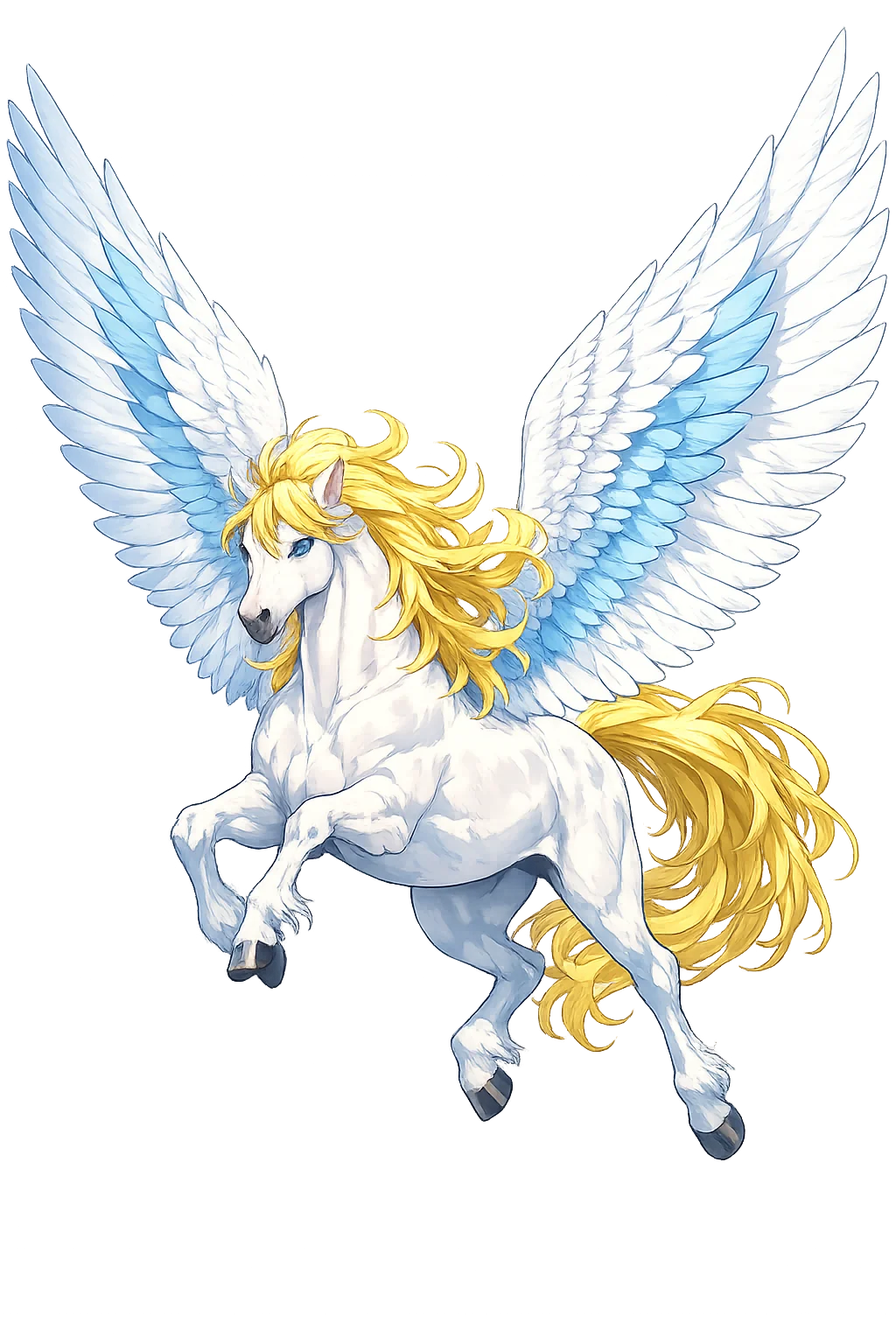
Pḗgasos springs from the severed neck of Médousa at the moment of her death — beauty erupting from horror — and ends as the thunder-bearer of Zeús and a constellation. He is the only winged horse of Greek myth with a name, and his route runs from blood to stars.
From sea-foam blood to the sky — the emblem of unbounded ascent.
The Horse's Spring on Mount Helikṓn, struck open by his hoof — the poets' fountain of inspiration.
Bellerophōn's fire-breathing foe, fought from the saddle of the flying horse.
Hesiod gives him Olympus's strangest job: carrying Zeús' thunder and lightning.
Stories of Pḗgasos
Pḗgasos is the bridge-figure of Greek myth: born in a monster story, ridden in a hero story, employed in a god story — three genres, one horse.
Hesiod tells it in four lines: when Perseus cut the head from Médousa, out sprang great Pḗgasos and the warrior Chrysaōr — her children by Poseidṓn. The horse flew to the "immortal ones," and Hesiod already knows his office: "he lives in the halls of Zeús, carrying thunder and lightning for the counsellor."
The hero Bellerophōn, sent to Lykia with a letter demanding his own death, was ordered to kill the Chimaira. Píndar sings how Athēnā appeared with a golden bridle — "take this charm for the horse" — and how, sacrificing to Poseidṓn the horse-breaker, Bellerophōn caught Pḗgasos at the spring of Peirene and from the air slew the fire-breathing beast.
Success bred the fatal wish: Bellerophōn tried to fly to Olympos itself. Zeús sent a gadfly to sting the horse, and the rider fell back to earth to wander the Aleian plain alone — Pindar's model of hybris punished — while Pḗgasos continued upward to the stables of the gods.
On Helikṓn, mountain of the Muses, Pḗgasos struck the rock with his hoof and opened Hippocrene, the Horse's Spring, whose water makes poets. The image outlasted the cult: every later trope of inspiration — the struck rock, the flying horse, the intoxicating water — is his hoofprint.
Pḗgasos proves that origin is not destiny. Born of blood and salt and horror, he ends as pure ascent — the horse of storms who chooses the sky. He is the emblem of every act of imagination that takes off from wreckage: the spring in the stone, the poem in the wound.
Enter Extended Lore