
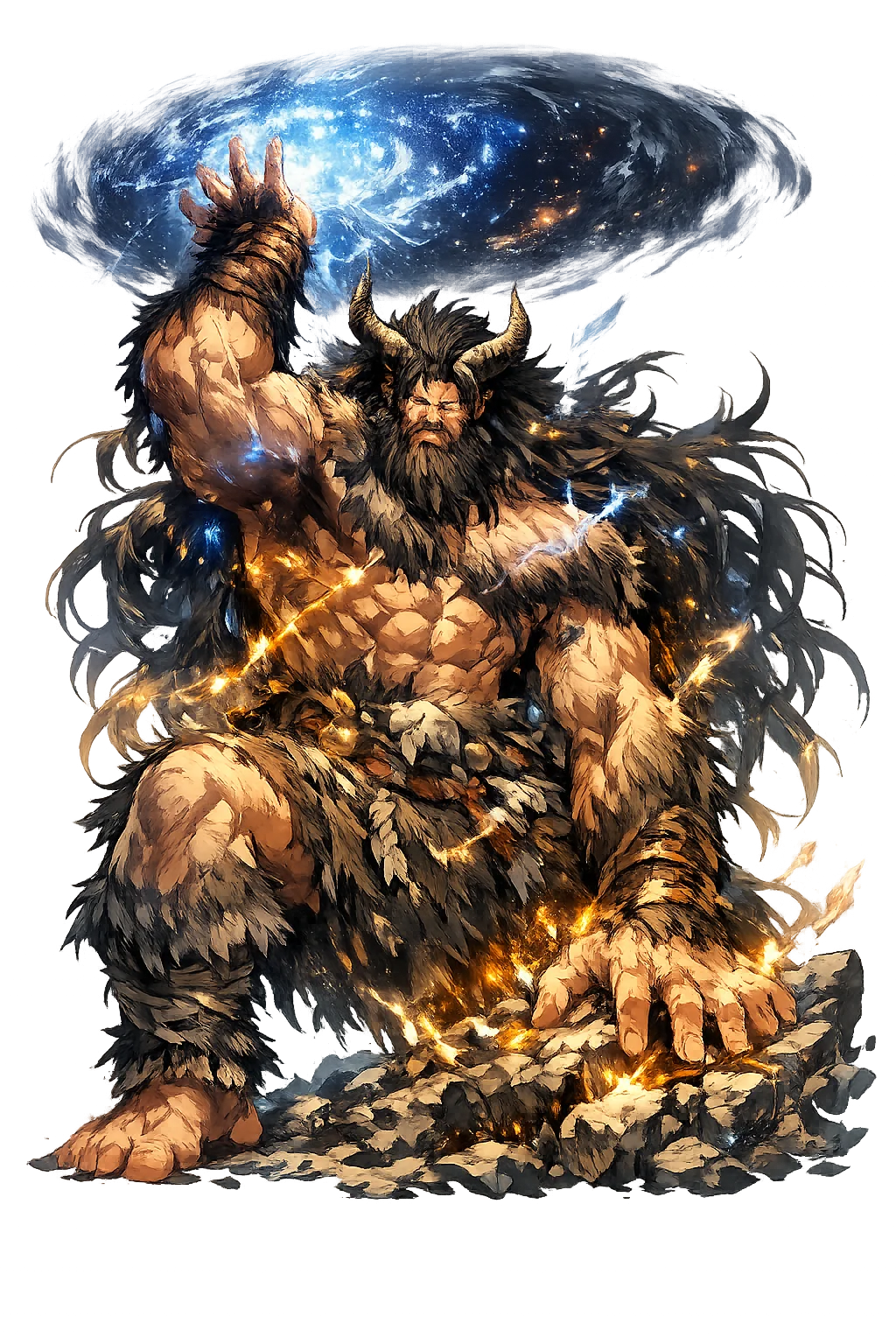
How Pángǔ got its accent back
The ASCII form pangu is missing something. Pángǔ restores the marks the source language used to distinguish this name from a thousand others — and those marks change how the name is read, pronounced, and understood. This post explains, with the full scholarly record behind it, what each restored mark preserves: the Chinese characters evidence, the reconstructed sound, the myths the name carries, and the classification logic that separates Tier 1 restorations from Tier 2. By the end, the marks in Pángǔ will look less like ornaments and more like what they are — recovered evidence, pinned back in its proper place.
At a Glance
- Restored name: Pángǔ
- ASCII form: pangu
- Meaning: "'Coiled antiquity' (盤古), the giant who split heaven from earth"
- Domain of influence: Creation, Separation, Foundation
- Pantheon: Chinese
- Classification: Tier 2
- Live domain: pángǔ.com
Overview
Pángǔ (pangu) — The Giant Between Heaven and Earth — belongs to the Chinese tradition, where it is catalogued under the domain "Creation, Separation, Foundation". The name means "'Coiled antiquity' (盤古), the giant who split heaven from earth".
Pángǔ is China's creation made flesh: the giant who grew for eighteen thousand years inside the cosmic egg, pushed heaven and earth apart with his own body, and — dying at last — became the world itself: his eyes the sun and moon, his breath the wind, his voice the thunder.
PuniCodex restores the name as Pángǔ and serves its temple at pángǔ.com. The original preserves one prosodic feature — stress or vowel length — rather than both, which places the name in Tier 2. The plain ASCII form pangu survives as a modern convenience imposed by the early domain-name system; the restoration, not the fallback, is the form the project defends as philologically complete.
The Name
No indigenous written attestation survives for this name; Pángǔ is a scholarly transliteration of the reconstructed spoken form. Etymologically the name means "'Coiled antiquity' (盤古), the giant who split heaven from earth".
The ASCII form pangu survives only because the early domain-name system could not carry diacritics; it is a technological compromise, not an ancient spelling. The Unicode restoration Pángǔ recovers the stress accent of the original directly in the address bar. The original preserves one prosodic feature — stress or vowel length — rather than both, which places the name in Tier 2.
The letter-by-letter transformation runs:
- p → P — Same letter
- a → á — Stress mark (acute/tone)
- n → n — Same letter
- g → g — Same letter
- u → ǔ — same
The project holds the domain pángǔ.com (xn--png-ela13j.com) as the canonical home of this name.
The Original Script
The original script for this chinese name has not yet been added to PUNICODEX. The form shown is a scholarly transliteration.
The form Pángǔ is therefore a scholarly transliteration rather than an attested ancient spelling; it encodes the reconstructed sound of the name for modern use, and no mark in it is decorative.
Written 盘古 (盤古 traditional): pán (coil, tray, the great basin) plus gǔ (ancient). The graphs describe him exactly — the coiled giant of antiquity, curled inside the cosmic egg before there was a world to be ancient in.
Pronunciation
The reconstructed pronunciation of the name is /pʰa˧˥ ku˨˩˦/ — Mandarin (Hanyu Pinyin with tones).
For the modern speaker, the closest approximation is: pahng-goo, rising tone on Pang, low-dipping on Gu.
Kindred and historical forms of the name:
- Chinese — 盤古
- Owned form — Pángǔ
Pángǔ 盘古 carries the rising tone on páng and the dipping third tone on gǔ ("antiquity"); the name pairs "coiling" with "ancient" — the coiled one of the primordial egg. Written 盤古 in traditional characters, it is Chinese myth's youngest great name: the giant is attested only from the 3rd century CE.
Mythology
Pángǔ's myth exists in two sentences of immense consequence, recorded by Xú Zhěng in the 3rd century CE — and expanded by a civilization into its canonical account of how the world began.
Three-Five Calendar Record (The Egg)
Xú Zhěng's Sānwǔ lìjì gives the founding text: "Heaven and earth were chaos like a hen's egg, and Pángǔ was born within it. After eighteen thousand years, heaven and earth opened: the bright, light qì rose to become heaven; the dark, heavy qì sank to become earth. Pángǔ stood between them, changing nine times daily — heaven rising ten feet a day, earth thickening ten feet, and Pángǔ growing ten feet — for eighteen thousand years more."
The Body Becomes the World (The Death)
When the separation was fixed, Pángǔ died — and the transformation began: his breath became wind and cloud, his voice thunder, his left eye the sun and his right the moon, his four limbs the four sacred mountains, his blood the rivers, his veins the roads, his flesh the soil, his hair the stars, his skin and body-hair grass and trees, his sweat rain — and, in the most anthropologically piquant line, his fleas and lice, quickened by the wind, became the black-haired people.
China's Youngest Creator (The Late Arrival)
The myth's strangest fact is its date: no pre-Han text mentions Pángǔ, and scholars trace his entry through southern traditions — the Yao and Miao genealogies of the dog-ancestor Pán Hù, phonetically adjacent — absorbed and cosmicized in the Wei-Jin centuries. China's canonical creation is thus a relative newcomer, adopted so completely that every schoolchild now learns it as the oldest story.
Symbols & Iconography
The iconography associated with Pángǔ concentrates in a small set of recurring attributes, each a compressed statement about the name:
- The egg — Chaos as potential — the undivided whole that must crack to become a world
- The horns — His folk-iconography — the shaggy, horned giant of the first morning
- The pillars of his limbs — The four limbs as the four sacred mountains — the body as geography
Archaeology & Evidence
No cult-temple of Pángǔ predates the myth's literary arrival, but his material afterlife is real: the Pángǔ temples of Tongbai (Henan) and the southern shrines of Guangdong and Guangxi mark the festival of his "birth" in the tenth lunar month. The textual archaeology is exact — Xú Zhěng's Sānwǔ lìjì and the Wǔyùn lìnián jì (both 3rd century, preserved in encyclopedias) are the two struts of the whole tradition, and the history of their quotation is the history of the myth itself.
His cult is young, like his myth: the Pángǔ temple of Tongbai county (Henan) anchors the tradition's claimed birthplace, with his festival in the tenth lunar month drawing the county's pilgrimage. In the south — Guangdong and Guangxi, where scholars trace the myth's Yao and Miao ancestry — village shrines to Pángǔ dàrén, 'the great man Pangu,' predate the literary fame. The Museum of Chinese creation mythology tradition apart, his monuments are the mountains themselves: the myth names them his limbs, and the pilgrim reads the landscape as the giant's body, which is the oldest way of reading it.
Realm & Domain
Pángǔ is China's creation made flesh: the giant who grew for eighteen thousand years inside the cosmic egg, pushed heaven and earth apart with his own body, and — dying at last — became the world itself: his eyes the sun and moon, his breath the wind, his voice the thunder.
The Cosmic Egg
Chaos like a hen's egg — and Pángǔ born within it, the first form in the formless.
The Separation
Heaven rose ten feet daily, earth thickened ten feet, and he grew between them — 18,000 years of pushing.
The Transformation
His body becomes the world: eyes to sun and moon, limbs to mountains, blood to rivers.
The Chisel and Axe
Folk art arms him with the tools of separation — the first worker, carving sky from stone.
Across Cultures
The Pángǔ–Pán Hù debate is one of Chinese mythology's famous problems: the southern dog-ancestor of the Yao and She peoples and the cosmic giant share a syllable and a region, and scholars from the Republican era onward have argued transmission in both directions. Comparative mythology places him with the dismembered primordial beings — Vedic Púruṣa, Norse Ymir — whose bodies become worlds: China's version is distinctive for making the giant's death not a murder but a completion.
Within the Chinese tradition, closely related names in the corpus include [[bagua|Bāguà]], [[fuxi|Fúxī]], [[guanyin|Guānyīn]], [[long|Lóng]], [[mengpo|Méngpó]], and [[nuwa|Nǚwā]].
Cultural Legacy
"Since Pángǔ separated heaven and earth" is the standard Chinese formula for "since the beginning of time," and his myth opens every children's account of Chinese prehistory. The transformation — body to landscape — gave Chinese poetry one of its deepest image-families, the mountain-as-body. UNESCO-listed school textbooks, animated films, and the giant's statues across southern China (Henan's Tongbai county claims his birthplace) keep the youngest creator as the most familiar.
The Scholarly Record
The account of Pángǔ given in this edition rests on the witnesses and reference works listed below. Lexica and etymological dictionaries secure the form and meaning of the name; the literary and religious texts supply the narrative evidence.
- Xu Zheng, Sanwu Liji (Historical Records of the Three Sovereigns and Five Emperors), as preserved in later encyclopedias (Taiping Yulan), 260.
- Anne Birrell, Chinese Mythology: An Introduction, Johns Hopkins University Press, 1993.
- Shiji (Records of the Grand Historian), Sima Qian; Chinese Text Project, 91 BCE. Full text
- Chinese classical texts, Chinese Text Project, 500 BCE. Full text
- Chinese folklore, Oral and compiled folk tales, various.
- Shan Hai Jing (Classic of Mountains and Seas), Chinese Text Project, 400 BCE. Full text
A Meditation
Pángǔ is the god of the long work: eighteen thousand years of pushing, unnoticed, until the sky stayed up on its own. He never saw the world he made — he became it. He asks of everyone engaged in slow, unglamorous creation: what are you growing between the heaven and the earth of your time — and will it stand when you are done?
The flea-born people of the oldest version keep the myth honest: humanity is not the giant's masterpiece but his smallest parasite, quickened by the wind. It is the humblest creation-line in world mythology — and somehow the most accurate: we are the detail, not the design, and the world was not made for us but of something that once stood up and held it apart.
The Unicode Restoration
Pángǔ is classified as Tier 2: the original preserves at least one philological feature that ASCII cannot encode. The ASCII fallback pangu still resolves everywhere, but it is the restored form that carries the name's full information. Across the 5 characters of the name, the restoration adjusts 1: 1 mark of stress (á). That is the whole thesis of this temple: the marks are the message.
Character by Character
The journey from pangu to Pángǔ, one character at a time:
- p → P — Same letter
- a → á — Stress mark (acute/tone)
- n → n — Same letter
- g → g — Same letter
- u → ǔ
The Domain Name
The restored name is live as a working domain: pángǔ.com, which the DNS carries in punycode form as xn--png-ela13j.com — an ASCII-compatible encoding that lets a non-ASCII name travel the global network without breaking older infrastructure. The visitor sees Pángǔ; the machines see the encoding. That duality is the engineering compromise on which the entire restoration rests, and it is why a name written the way its own tradition wrote it in Chinese characters can now be typed into any browser on earth.
The Chinese Pantheon
Pángǔ is one of 46 entries the PuniCodex lexicon catalogues under the Chinese pantheon. The Pantheon page gathers the tradition's major figures in one place, and the Lexicon lets you filter all 915 restorations by tradition, tier, or script — the fastest way to see where this name sits among its kin.
Frequently Asked Questions
What does Pángǔ mean? The traditional gloss is "'Coiled antiquity' (盤古), the giant who split heaven from earth."
Which tradition does Pángǔ belong to? Pángǔ is catalogued in the Chinese pantheon of the PuniCodex lexicon.
Why is Pángǔ classified as Tier 2? Because the original preserves at least one philological feature that ASCII cannot encode — and the marks in the restored spelling preserve exactly that evidence.
Is Pángǔ a working domain? Yes — pángǔ.com resolves today and routes to this temple.
What is the punycode for pángǔ.com? The DNS encoding is xn--png-ela13j.com; browsers perform the translation automatically, so visitors only ever see the restored name.
Typing Pángǔ
You do not need a special keyboard to use this restoration. The PuniCodex Type Tool converts the ASCII form pangu into Pángǔ as you type, and the browser extension offers the same conversion inside any text field. Copy the restored form, paste it into the address bar, and the DNS does the rest.
Sister Temples
Other temples in the Chinese pantheon include Sānzàng, Tiān, and Wǔxíng — each with its own restoration story, its own scholarly record, and its own place in the lexicon.
Why This Restoration Matters
The marks in Pángǔ were never lost; they were only waiting for a carrier that could hold them. Now that the carrier exists, the burden flips: every use of pangu is a choice to leave evidence on the table. The PuniCodex temple keeps the restored form in circulation — as a domain, a dataset entry, and a scholarly argument — so that the choice to use it stays easy. Accent by accent, macron by macron, that is how the original names come back: not with a single grand gesture, but with a spelling that finally works everywhere.
Explore Further
This post is one doorway into the temple. The home page carries the full character breakdown and the ambient canvas; the lore page tells the myths in long form; the Scholarly Edition preserves the sources, pronunciation data, and revision history; and the patron wall supports the restoration directly. For the wider map, browse the Lexicon, explore the Pantheon, or return to the PuniCodex blog.
Related Names
Sources
The full scholarly apparatus — every citation, revision, and review — lives in the Scholarly Edition. Key references for this post:
- Shiji (Records of the Grand Historian), Sima Qian; Chinese Text Project, 91 BCE.
- Chinese classical texts, Chinese Text Project, 500 BCE.
- Shan Hai Jing (Classic of Mountains and Seas), Chinese Text Project, 400 BCE.
- Chen Shou, Sanguozhi (Records of the Three Kingdoms), Zhonghua Shuju critical edition, 289.
- Xu Zheng, Sanwu Liji (Historical Records of the Three Sovereigns and Five Emperors), as preserved in later encyclopedias (Taiping Yulan), 260.
- Anne Birrell, Chinese Mythology: An Introduction, Johns Hopkins University Press, 1993.
- Birrell, Chinese Mythology; the Tongbai temple records.
- Lexicon authorities for this entry: Sanguozhi, Xu Zheng, Birrell.