
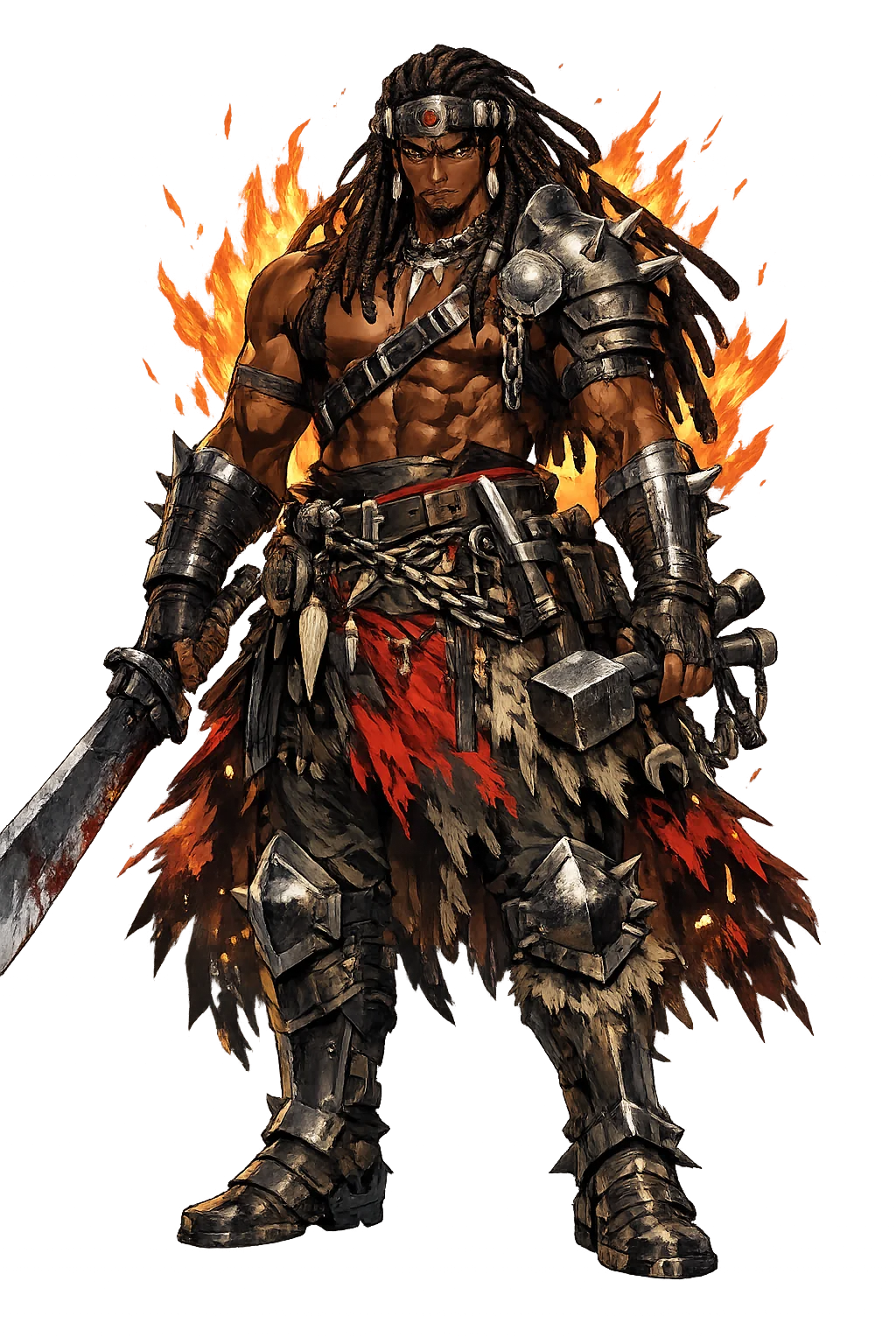
How Ògún got its accent back
The ASCII form ogun is missing something. Ògún restores the marks the source language used to distinguish this name from a thousand others — and those marks change how the name is read, pronounced, and understood. This post explains, with the full scholarly record behind it, what each restored mark preserves: the Yoruba transcription evidence, the reconstructed sound, the myths the name carries, and the classification logic that separates Tier 1 restorations from Tier 2. By the end, the marks in Ògún will look less like ornaments and more like what they are — recovered evidence, pinned back in its proper place.
At a Glance
- Restored name: Ògún
- ASCII form: ogun
- Meaning: "God of iron"
- Domain of influence: Iron, War, Labour
- Pantheon: Yoruba
- Classification: Tier 2
- Live domain: ògún.com
Overview
Ogun (ogun) — The Master of Iron — belongs to the Yoruba tradition, where it is catalogued under the domain "Iron, War, Labour". The name means "God of iron".
Ògún is the orisha of iron and of every road iron opens: the hunter who cleared the primordial forest so the gods could descend, the smith who arms the farmer and the warrior alike, and the patron of every worker who makes a living by metal — from the blacksmith to the surgeon to the driver.
PuniCodex restores the name as Ogun and serves its temple at ògún.com. The original preserves one prosodic feature — stress or vowel length — rather than both, which places the name in Tier 2. The plain ASCII form ogun survives as a modern convenience imposed by the early domain-name system; the restoration, not the fallback, is the form the project defends as philologically complete.
The Name
No indigenous written attestation survives for this name; Ogun is a scholarly transliteration of the reconstructed spoken form. Etymologically the name means "God of iron".
The ASCII form ogun survives only because the early domain-name system could not carry diacritics; it is a technological compromise, not an ancient spelling. The Unicode restoration Ogun recovers the full diacritic detail of the scholarly transliteration directly in the address bar. The original preserves one prosodic feature — stress or vowel length — rather than both, which places the name in Tier 2.
The letter-by-letter transformation runs:
- o → O — Same
- g → g — Same
- u → u — Same
- n → n — Same
The project holds the domain ògún.com (xn--gn-1ja7a.com) as the canonical home of this name.
The Original Script
No indigenous writing system is securely attested for individual yoruba names. The form shown is a modern scholarly transliteration.
The form Ogun is therefore a scholarly transliteration rather than an attested ancient spelling; it encodes the reconstructed sound of the name for modern use, and no mark in it is decorative.
Yoruba is written in Latin letters with tone marks — the orthography the restoration preserves: Ò (low tone) and ú (high tone) are the name as spoken. In the Ifá divination corpus his signs live in the odù Ogunda, "Ogun creates," one of the sixteen principal odù: the god written into the divination system itself.
Pronunciation
The reconstructed pronunciation of the name is /ò.gṹ/ — Yoruba.
For the modern speaker, the closest approximation is: aw-GOON, low tone on the first syllable, high on the last.
Kindred and historical forms of the name:
- Yoruba — Ògún
- Brazil — Ogun / São Jorge
- Haiti — Ogou Feray
- Owned form — Ògún
Ògún carries Yoruba's tonal low-high melody: ò with the grave (low tone), gún with the acute (high) — the tones are phonemic, and the restoration keeps both exactly as the language requires. The name is bound to the word for iron (irin) in his praise-names: "Ogun, master of iron, the one who clears the road."
Mythology
Ògún's myths are the Yoruba meditation on power: the strength that clears the way for everyone, and the rage that, unmastered, turns on its own town.
The First Road (The Descent)
When the orisha first sought to descend to the earth, the primordial forest stood unbroken and none could pass — not Orunmila with his wisdom, not any god with any tool. Ògún took his cutlass and cut the road through, and the gods followed him down; for this he is saluted first in every rite, the opener of the way. Creation, in Yoruba thought, required not a word but a blade.
The King of Ire (The Retreat)
Made king of the town of Ire, Ògún came one festival day to find the people silent — they did not greet him with the honours he was owed. In his rage he cut down his own people with the sword until his son stood in the way; coming to himself, he declared he would go no more among men, and sank into the earth — remaining, as his praise-songs say, in the iron itself. Every Ògún festival at Ire replays the king's coming and going.
Master of the Forest (The Hunter)
Before he was king or smith, Ògún was the supreme hunter: lord of the deep forest where no farm grows, guide of the hunters' guilds whose odu-ifá praise-songs call him "the one who has water but bathes in blood." Hunters still chant his oríkì at the forest's edge: the road-opener is also the one who knows the road's dangers better than any god.
Symbols & Iconography
The iconography associated with Ogun concentrates in a small set of recurring attributes, each a compressed statement about the name:
- The cutlass — The path-making blade — technology as the opener of ways
- The anvil — The forge's heart, where his power is hammered into tools
- The palm wine — His drink — offered by hunters and smiths for coolness and courage
Archaeology & Evidence
Yorubaland is one of Africa's oldest iron-working regions: the smelting furnaces of the Nsukka plateau (Lejja) date the craft back over two thousand years, and the guild-smithies of the forest belt kept the ritual side — the first iron of a furnace smelted with prayers to Ògún. His shrines are often the anvil itself; the great festivals of Ire and of Ọndó preserve the masquerades and the dog-sacrifice described in the earliest ethnographies, and the odù Ogunda verses are still divined daily by babaláwo across the Yoruba world.
Realm & Domain
Ògún is the orisha of iron and of every road iron opens: the hunter who cleared the primordial forest so the gods could descend, the smith who arms the farmer and the warrior alike, and the patron of every worker who makes a living by metal — from the blacksmith to the surgeon to the driver.
The Cutlass
His tool and emblem: the blade that clears the forest path — creation by cutting.
The Forge
The smith's fire: iron is his body, and every smithy his shrine.
The First Road
He hacked the road through the primal forest that let the orisha reach the earth.
The Dog
His companion and sacrifice — the hunter's faithful one, honoured at his festivals.
Across Cultures
The Middle Passage carried him across the Atlantic, where the iron god found new irons: in Cuban Santería he is Oggún, syncretized with Saint Peter (keeper of the keys — the metal of heaven's gate) or Saint George; in Brazilian Candomblé, Ògún is Saint George of the dragon-slaying spear; in Haitian Vodou he is Ogou Feray, the warrior-loa of the forge and the soldier's flag. The saints changed the face; the iron, the road, and the dog kept the god.
Kindred figures in the PuniCodex cross-tradition index include [[anat|ꜥAnat]], [[ares|Árēs]], [[ashur|Aššur]], [[athena|Athénā]], [[durga|Durgā]], and [[huitzilopochtli|Huitzilopōchtli]], each linked through war / battle.
Cultural Legacy
Nigeria's Nobel laureate Wole Soyinka is his most famous devotee: Ògún is the patron of Soyinka's art — the road-maker who is also the destroyer — and the essay "The Fourth Stage" and the novel The Road are his modern liturgy. Ògún state in Nigeria bears his name; his praise-names echo in the foundries and mechanics' yards of every Yoruba city, where a splash of palm wine on the anvil still opens the working day.
The Scholarly Record
The account of Ogun given in this edition rests on the witnesses and reference works listed below. Lexica and etymological dictionaries secure the form and meaning of the name; the literary and religious texts supply the narrative evidence.
- E. Bolaji Idowu, Olódùmarè: God in Yoruba Belief, Longmans, Green & Co., 1962.
- William Bascom, Ifa Divination: Communication Between Gods and Men in West Africa, Indiana University Press, 1969.
- Abraham (biblical patriarch / Genesis narrative), Book of Genesis, 1000 BCE.
- Folklore (traditional oral narrative), Oral traditions, various.
- Cambridge Ancient History, Multiple volumes, 1970. Full text
- Oxford Classical Dictionary, 4th ed., Oxford University Press, 2012. Full text
A Meditation
Ògún is the god of the tool in the hand. Every technology is his: the blade that clears the road and the blade that clears the town are the same iron, and only the wielder's self-command decides which road it opens. He asks the maker's question, which is also the warrior's and the surgeon's: what does your strength serve — and who stands in the way when it slips?
Every driver who splashes gin on a bumper in Lagos, every mechanic who taps the anvil before the first weld, is keeping his liturgy without needing its name: tools are moral — they open roads or open wounds — and the hand must be steadier than the blade. Ògún's myth admits what no other war-god's does: that the rage is his own. The road-opener who cut down his own town is the honest patron of a technological age: the strength is real, the forest is real, and so is the apology owed when the blade turns.
Soyinka, his greatest modern devotee, calls him the god of the road and of transition — the patron of everyone who makes a path where none existed, and the warning that every path is cut through something. In the diaspora's forge-altars the lesson survives translation: iron does not apologize, but it must be answered for. The road-opener asks of every builder, coder, and driver the same question his own myth could not escape: when the forest is cleared, what will you plant — and whom did the clearing cost?
The anvil rings, the day's first iron is cut, and the road — his road — opens another meter. The forest always grows back; that is why the clearing is a daily act, and why the god of the cutlass is worshipped not once but every working morning.
The Unicode Restoration
Ògún is classified as Tier 2: the original preserves at least one philological feature that ASCII cannot encode. The ASCII fallback ogun still resolves everywhere, but it is the restored form that carries the name's full information. That is the whole thesis of this temple: the marks are the message.
Character by Character
The journey from ogun to Ògún, one character at a time:
- o → O — Same
- g → g — Same
- u → u — Same
- n → n — Same
The Domain Name
The restored name is live as a working domain: ògún.com, which the DNS carries in punycode form as xn--gn-1ja7a.com — an ASCII-compatible encoding that lets a non-ASCII name travel the global network without breaking older infrastructure. The visitor sees Ògún; the machines see the encoding. That duality is the engineering compromise on which the entire restoration rests, and it is why a name written the way its own tradition wrote it in Yoruba transcription can now be typed into any browser on earth.
The Yoruba Pantheon
Ògún is one of 30 entries the PuniCodex lexicon catalogues under the Yoruba pantheon. The Pantheon page gathers the tradition's major figures in one place, and the Lexicon lets you filter all 915 restorations by tradition, tier, or script — the fastest way to see where this name sits among its kin.
Frequently Asked Questions
What does Ògún mean? The traditional gloss is "God of iron."
Which tradition does Ògún belong to? Ògún is catalogued in the Yoruba pantheon of the PuniCodex lexicon.
Why is Ògún classified as Tier 2? Because the original preserves at least one philological feature that ASCII cannot encode — and the marks in the restored spelling preserve exactly that evidence.
Is Ògún a working domain? Yes — ògún.com resolves today and routes to this temple.
What is the punycode for ògún.com? The DNS encoding is xn--gn-1ja7a.com; browsers perform the translation automatically, so visitors only ever see the restored name.
Typing Ògún
You do not need a special keyboard to use this restoration. The PuniCodex Type Tool converts the ASCII form ogun into Ògún as you type, and the browser extension offers the same conversion inside any text field. Copy the restored form, paste it into the address bar, and the DNS does the rest.
Sister Temples
Other temples in the Yoruba pantheon include Aganjú, Ajé, and Altjira — each with its own restoration story, its own scholarly record, and its own place in the lexicon.
Why This Restoration Matters
The marks in Ògún were never lost; they were only waiting for a carrier that could hold them. Now that the carrier exists, the burden flips: every use of ogun is a choice to leave evidence on the table. The PuniCodex temple keeps the restored form in circulation — as a domain, a dataset entry, and a scholarly argument — so that the choice to use it stays easy. Accent by accent, macron by macron, that is how the original names come back: not with a single grand gesture, but with a spelling that finally works everywhere.
Explore Further
This post is one doorway into the temple. The home page carries the full character breakdown and the ambient canvas; the lore page tells the myths in long form; the Scholarly Edition preserves the sources, pronunciation data, and revision history; and the patron wall supports the restoration directly. For the wider map, browse the Lexicon, explore the Pantheon, or return to the PuniCodex blog.
Related Names
Sources
The full scholarly apparatus — every citation, revision, and review — lives in the Scholarly Edition. Key references for this post:
- Cambridge Ancient History, Multiple volumes, 1970.
- Oxford Classical Dictionary, 4th ed., Oxford University Press, 2012.
- Abimbola.
- E. Bolaji Idowu, Olódùmarè: God in Yoruba Belief, Longmans, Green & Co., 1962.
- William Bascom, Ifa Divination: Communication Between Gods and Men in West Africa, Indiana University Press, 1969.
- Abraham (biblical patriarch / Genesis narrative), Book of Genesis, 1000 BCE.
- Lexicon authorities for this entry: Abraham.