
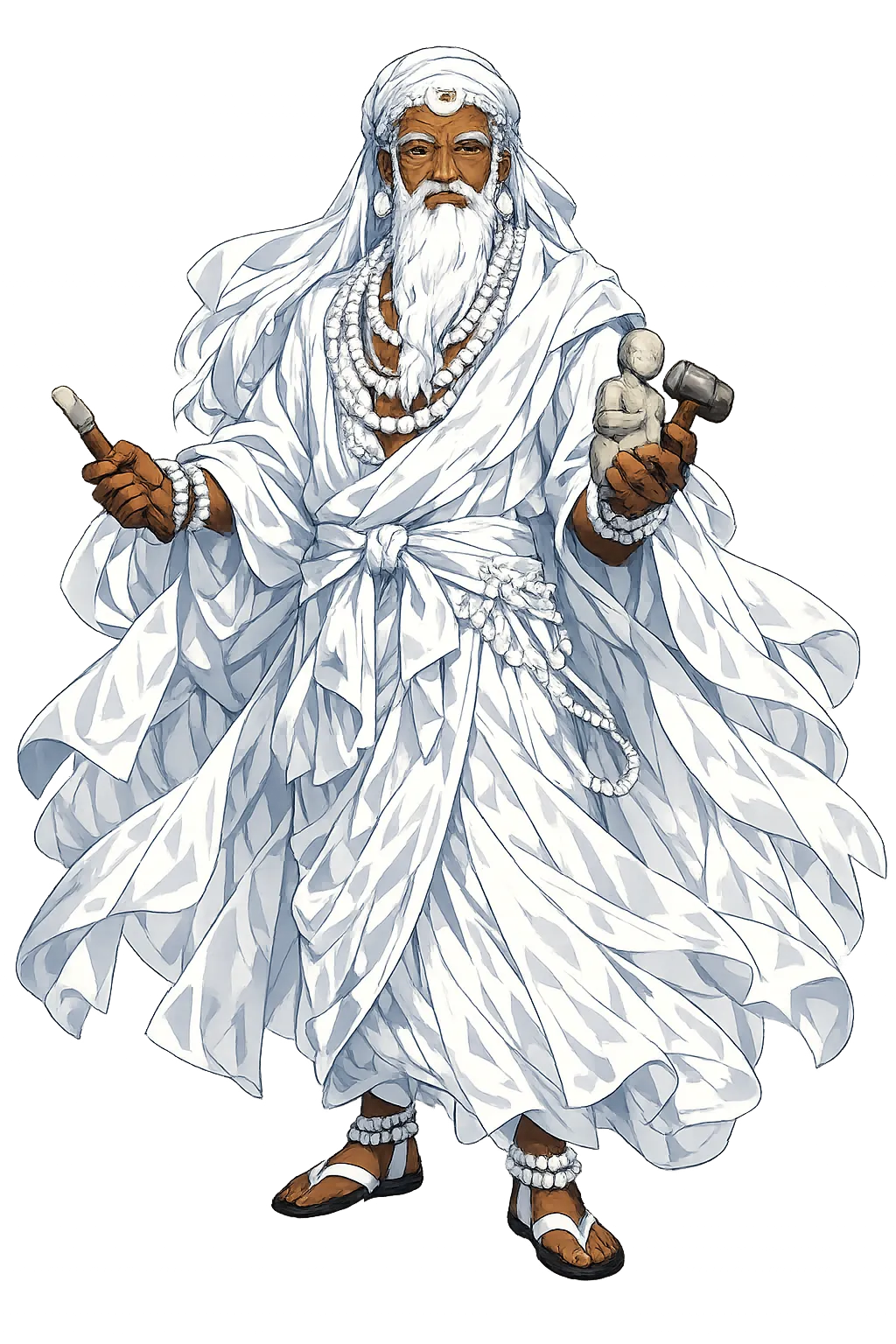
The many faces of Ọbatálá
No important name has only one face. Ọbatálá appears as a figure of myth, a scholarly reconstruction, a piece of material culture, a memory carried across languages, and — most recently — a Unicode domain. This post looks at each face in turn: the name and its roots, the Yoruba transcription original, the reconstructed pronunciation, the mythological record, the symbols and sanctuaries, the cross-cultural afterlife, and the engineering that lets the restored spelling resolve in a browser. Taken together, those faces explain why obatala was never going to be enough — and why the restored form is worth a domain of its own.
At a Glance
- Restored name: Ọbatálá
- ASCII form: obatala
- Meaning: "King of the white cloth"
- Domain of influence: Creation, Purity, Peace
- Pantheon: Yoruba
- Classification: Tier 2
- Live domain: ọbatálá.com
Overview
Ọbatálá (obatala) — Creation, Purity, Peace · King of the white cloth — belongs to the Yoruba tradition, where it is catalogued under the domain "Creation, Purity, Peace". The name means "King of the white cloth".
Ọbatalá is the orixá who shapes humanity. While Olódùmarè breathes the soul into the body, Ọbatalá is the sculptor who moulds the limbs, the one whose hands first pressed cool clay into human form. He is the eldest of the orishas in many accounts, the patron of white cloth, purity, peace, and the aged. His voice is soft, his judgments slow, and his anger terrible precisely because it is so rare.
He is also the guardian of those whom the world calls imperfect: the disabled, the deformed, the albino. In Yoruba thought, these are not mistakes; they are Ọbatalá's own children, marked by his hand.
PuniCodex restores the name as Ọbatálá and serves its temple at ọbatálá.com. The original preserves one prosodic feature — stress or vowel length — rather than both, which places the name in Tier 2. The plain ASCII form obatala survives as a modern convenience imposed by the early domain-name system; the restoration, not the fallback, is the form the project defends as philologically complete.
The Name
No indigenous written attestation survives for this name; Ọbatálá is a scholarly transliteration of the reconstructed spoken form. Etymologically the name means "King of the white cloth".
The ASCII form obatala survives only because the early domain-name system could not carry diacritics; it is a technological compromise, not an ancient spelling. The Unicode restoration Ọbatálá recovers the stress accent of the original directly in the address bar. The original preserves one prosodic feature — stress or vowel length — rather than both, which places the name in Tier 2.
The letter-by-letter transformation runs:
- o → Ọ — O with dot below
- b → b — Same
- a → a — Same
- t → t — Same
- a → á — Acute on a
- l → l — Same
- a → á — Acute on a
The project holds the domain ọbatálá.com (xn--batl-7nab8274c.com) as the canonical home of this name.
The Original Script
No indigenous writing system is securely attested for Yoruba before the nineteenth century: the tradition was carried in speech, praise poetry, and the memorised verses of Ifá. Muslim Yoruba scholars maintained an Ajami literature in Arabic script, and the modern Latin orthography was developed by Church Missionary Society workers in the 1840s–1850s, codified in Samuel Ajayi Crowther's Yoruba grammar of 1852 and his Bible translation.
The form Ọbatálá is therefore a scholarly transliteration rather than an attested ancient spelling, and no mark in it is decorative. Its Ọ carries the dot below that distinguishes open /ɔ/ from close /o/ in the standard orthography, and the two acute accents record the high tones of the reconstructed /ɔ̀.bà.tá.lá/ — low, low, high, high. The name is a compressed sentence-name which the tradition itself analyses as ọba tí ó ní àlà, 'king who owns the white cloth', the etymology behind the gloss 'king of the white cloth'. Everyday Yoruba print omits tone marks, and the DNS root zone cannot carry them; the restoration keeps both high tones and the open vowel because each encodes a distinction of sound, not ornament.
Pronunciation
The reconstructed pronunciation of the name is /ɔ̀.bà.tá.lá/ — Yoruba Reconstruction.
Phoneme by phoneme:
- Ọ- — Open-mid back rounded vowel [ɔ] with low tone, written with a dot below in standard Yoruba orthography.
- -bà- — Voiced bilabial stop [b] followed by open [a] with low tone.
- -tá- — Voiceless alveolar stop [t] followed by open [a] with high tone.
- -lá — Voiced alveolar lateral approximant [l] followed by open [a] with high tone.
For the modern speaker, the closest approximation is: aw-bah-TAH-LAH — low on 'aw-bah', then high on 'TAH-LAH'.
Kindred and historical forms of the name:
- Yoruba — Ọbatalá, 'King of the White Cloth,' creator of human bodies and patron of purity.
- Brazilian Candomblé — Oxalá, the highest orixá, syncretised with Jesus Christ and the dove.
- Cuban Santería — Obatalá, father of clarity and peace, associated with white beads and white cloth.
Ọbatalá is Tier 2: the acute accents on the final two syllables preserve high tones, but tone is not registrable as vowel length. The dot below ọ marks the open [ɔ] vowel, a phonemic distinction essential to Yoruba.
Mythology
Ọbatalá's mythology turns on creation, sobriety, and the cost of pride. He is the elder who knows that making life is more difficult than destroying it.
The Moulding of Humanity (Creation)
When Olódùmarè decided to populate the earth, he sent Ọbatalá down with a lump of clay. Ọbatalá shaped the first human bodies with care, but one day he drank too much palm wine and some of his figures came out twisted or incomplete. Olódùmarè breathed life into them anyway, and ever since Ọbatalá has forbidden palm wine to his devotees and taken the deformed as his own special children.
The Elder of the Orishas (Kingship)
In many Ifá verses, Ọbatalá is the eldest orixá, the one who remembers the beginning of things. He does not compete for followers with the flashier gods of thunder and rivers; his authority rests on age, clarity, and the fact that every human body was once clay in his hands. Kings consult him when force has failed.
The Curse of Pride (Morality)
Ọbatalá's stories often warn against arrogance. Those who mock the disabled, the old, or the poor invite his punishment, which usually takes the form of confusion or paralysis — the loss of the very clarity they thought they possessed. His justice is cool, slow, and inescapable.
Symbols & Iconography
The iconography of Ọbatálá concentrates in a small set of recurring attributes, every one of them white or cool, a visual grammar of his temperament:
- White cloth — Purity, coolness, and the veil between the human and the divine; his priests dress in undyed white and his shrines are draped in it.
- Snail shell — The slow, deliberate pace of Ọbatalá's wisdom and the spiral of creation; the snail, whose body the Yoruba count among the coolest of creatures, is offered to him.
- Ivory or white bead necklace — His sacred colour and the wealth of patience; white (funfun) is the colour of age, purity, and cooled anger in Yoruba thought.
- Calabash of cool water — Coolness of temperament; the antidote to hot anger, poured out at his rites.
Archaeology & Evidence
No inscription names Ọbatalá, and the celebrated terracotta and copper-alloy heads of Ilé-Ifẹ̀ (twelfth–fifteenth centuries) belong to the broader Yoruba ritual past without being securely identified with him; the Ifẹ̀ figure associated with Ọbalúfọ̀n, the orisha of kingship and beads, is a different personality. His material record is instead perishable and repeated: white-cloth offerings, snail shells, ivory and white beads, and the white-painted shrines kept by his priests.
In the diaspora, his white necklaces, calabashes, and cloth survive in museum collections of Afro-Cuban and Afro-Brazilian religion, while the Ifá corpus preserves the creation narrative in which he moulds human bodies from clay and pays for the palm wine he drank at his work.
Realm & Domain
Ọbatalá is the orixá who shapes humanity. While Olódùmarè breathes the soul into the body, Ọbatalá is the sculptor who moulds the limbs, the one whose hands first pressed cool clay into human form. He is the eldest of the orishas in many accounts, the patron of white cloth, purity, peace, and the aged. His voice is soft, his judgments slow, and his anger terrible precisely because it is so rare.
He is also the guardian of those whom the world calls imperfect: the disabled, the deformed, the albino. In Yoruba thought, these are not mistakes; they are Ọbatalá's own children, marked by his hand.
Creator of Bodies
He moulds human form from earth; Olódùmarè alone gives it breath.
White Cloth
Spotless garments, white beads, and cool water mark his altars and his devotees.
Peaceful Judgment
He settles disputes with patience; his curses fall on the unjustly proud.
Patron of the Vulnerable
The disabled and the elderly are his special children; harming them offends him directly.
Across Cultures
In Brazilian Candomblé, Ọbatalá became Oxalá, often syncretised with Jesus Christ in his role as the white-robed saviour and with the dove as a symbol of peace. In Cuban Santería he remains Obatalá, father of the white beads, and is sometimes divided into youthful and aged paths (Obatalá Ayáguna and Obatalá Orishánlá). The Catholic overlay preserved his colour and gentleness while translating his mythology into a Christian idiom of purity and creation.
Within the Yoruba tradition, closely related names in the corpus include [[aganju|Aganjú]], [[babaluaye|Ọbalúayé]], [[eshu|Ẹṣu]], [[olodumare|Olódùmarè]], [[orunmila|Ọrúnmìlà]], and [[oshun|Ọṣun]].
Cultural Legacy
Ọbatalá's influence extends far beyond formal religion. The Yoruba value of ìtẹ̀lọ́rùn — patience, coolness of heart — is modelled on his temperament. In the African diaspora, his white garments appear in Candomblé, Santería, and Trinidad Orisha. Artists and disability-rights advocates have reclaimed him as a divine patron of bodily difference, while environmental thinkers see in his clay-and-breath creation story an early recognition that matter and spirit are not separate.
In Salvador da Bahia his public presence is largest: the Lavagem do Bonfim each January, when devotees dressed in white wash the steps of the church of the Senhor do Bonfim, honours the figure with whom Oxalá is identified and remains one of the great public survivals of orisha devotion in Brazil.
The Scholarly Record
The account of Ọbatálá given in this edition rests on the witnesses and reference works listed below; each contributes a distinct stratum of evidence, from theology and lexicography to liturgy.
- Idowu, E. Bolaji, Olódùmarè: God in Yoruba Belief (Longmans, 1962). — The standard synthetic theology of the orishas; its treatment of Òrìṣàńlá grounds the account of Ọbatalá's seniority and his delegated act of creation.
- Bascom, William, Ifa Divination: Communication Between Gods and Men in West Africa (Indiana University Press, 1969). — English-language corpus of Ifá verses in which the palm-wine myth and his counsels of restraint are recorded.
- Abraham, R. C., Dictionary of Modern Yoruba (University of London Press, 1958). — Secures the lexical form and tones of the name and the àlà, 'white cloth', element within it.
- Mason, John, Four New World Yoruba Rituals (Yoruba Theological Archministry, 1985). — Documents the New World liturgy of Obatalá and Oxalá: white beads, cool offerings, and the prohibition of palm wine.
- Verger, Pierre, Notes sur le Culte des Orisa et Vodun (IFAN, 1957). — Comparative record of the cult in West Africa and Bahia.
- Murphy, Joseph M., Santería: African Spirits in America (Beacon Press, 1988). — Ethnography of the Lukumí Obatalá and his many paths, youthful and aged.
A Meditation
Ọbatalá is the god of the second look. The first glance sees deformity, age, weakness, or strangeness; the second glance, his glance, sees the hand of the maker. He asks us to slow down — to judge slowly, to speak softly, to remember that every body was once unformed clay.
In a culture obsessed with speed and perfection, Ọbatalá's white cloth is a radical statement. It says that purity is not the absence of flaw but the presence of care. His palm-wine story is not a moral about alcohol; it is a moral about consequence. Even the maker of bodies can mar what he makes. The question is not whether we are perfect, but whether we treat the imperfect with the reverence due to the creator's own work.
The Unicode Restoration
Ọbatálá is classified as Tier 2: the original preserves at least one philological feature that ASCII cannot encode. The ASCII fallback obatala still resolves everywhere, but it is the restored form that carries the name's full information. Across the 7 characters of the name, the restoration adjusts 3: 2 marks of stress (á, á); 1 further adjustment (Ọ). That is the whole thesis of this temple: the marks are the message.
Character by Character
The journey from obatala to Ọbatálá, one character at a time:
- o → Ọ — O with dot below
- b → b — Same
- a → a — Same
- t → t — Same
- a → á — Acute on a
- l → l — Same
- a → á — Acute on a
The Domain Name
The restored name is live as a working domain: ọbatálá.com, which the DNS carries in punycode form as xn--batl-7nab8274c.com — an ASCII-compatible encoding that lets a non-ASCII name travel the global network without breaking older infrastructure. The visitor sees Ọbatálá; the machines see the encoding. That duality is the engineering compromise on which the entire restoration rests, and it is why a name written the way its own tradition wrote it in Yoruba transcription can now be typed into any browser on earth.
The Yoruba Pantheon
Ọbatálá is one of 30 entries the PuniCodex lexicon catalogues under the Yoruba pantheon. The Pantheon page gathers the tradition's major figures in one place, and the Lexicon lets you filter all 895 restorations by tradition, tier, or script — the fastest way to see where this name sits among its kin.
Frequently Asked Questions
What does Ọbatálá mean? The traditional gloss is "King of the white cloth."
Which tradition does Ọbatálá belong to? Ọbatálá is catalogued in the Yoruba pantheon of the PuniCodex lexicon.
Why is Ọbatálá classified as Tier 2? Because the original preserves at least one philological feature that ASCII cannot encode — and the marks in the restored spelling preserve exactly that evidence.
Is Ọbatálá a working domain? Yes — ọbatálá.com resolves today and routes to this temple.
What is the punycode for ọbatálá.com? The DNS encoding is xn--batl-7nab8274c.com; browsers perform the translation automatically, so visitors only ever see the restored name.
Typing Ọbatálá
You do not need a special keyboard to use this restoration. The PuniCodex Type Tool converts the ASCII form obatala into Ọbatálá as you type, and the browser extension offers the same conversion inside any text field. Copy the restored form, paste it into the address bar, and the DNS does the rest.
Sister Temples
Other temples in the Yoruba pantheon include Aganjú, Bunjil, and Ìbejì — each with its own restoration story, its own scholarly record, and its own place in the lexicon.
Why This Restoration Matters
Myth, script, sound, cult, legacy, domain: the faces of Ọbatálá add up to a single argument — that a name is a record, and records deserve fidelity. The PuniCodex restoration keeps that record in working order: the temple presents it, the Scholarly Edition footnotes it, the lexicon catalogs it, and the domain makes it addressable. obatala will always exist as a fallback. But fallback is not identity. Ọbatálá is the name; everything else is a convenience.
Explore Further
This post is one doorway into the temple. The home page carries the full character breakdown and the ambient canvas; the lore page tells the myths in long form; the Scholarly Edition preserves the sources, pronunciation data, and revision history; and the patron wall supports the restoration directly. For the wider map, browse the Lexicon, explore the Pantheon, or return to the PuniCodex blog.
Related Names
Sources
The full scholarly apparatus — every citation, revision, and review — lives in the Scholarly Edition. Key references for this post:
- Idowu, Olódùmarè: God in Yoruba Belief.
- Bascom, Ifa Divination.
- Abraham, Dictionary of Modern Yoruba.
- Crowther, Samuel Ajayi, A Grammar and Vocabulary of the Yoruba Language (Seeleys, 1852).
- Lexicon authorities for this entry: Abraham.