
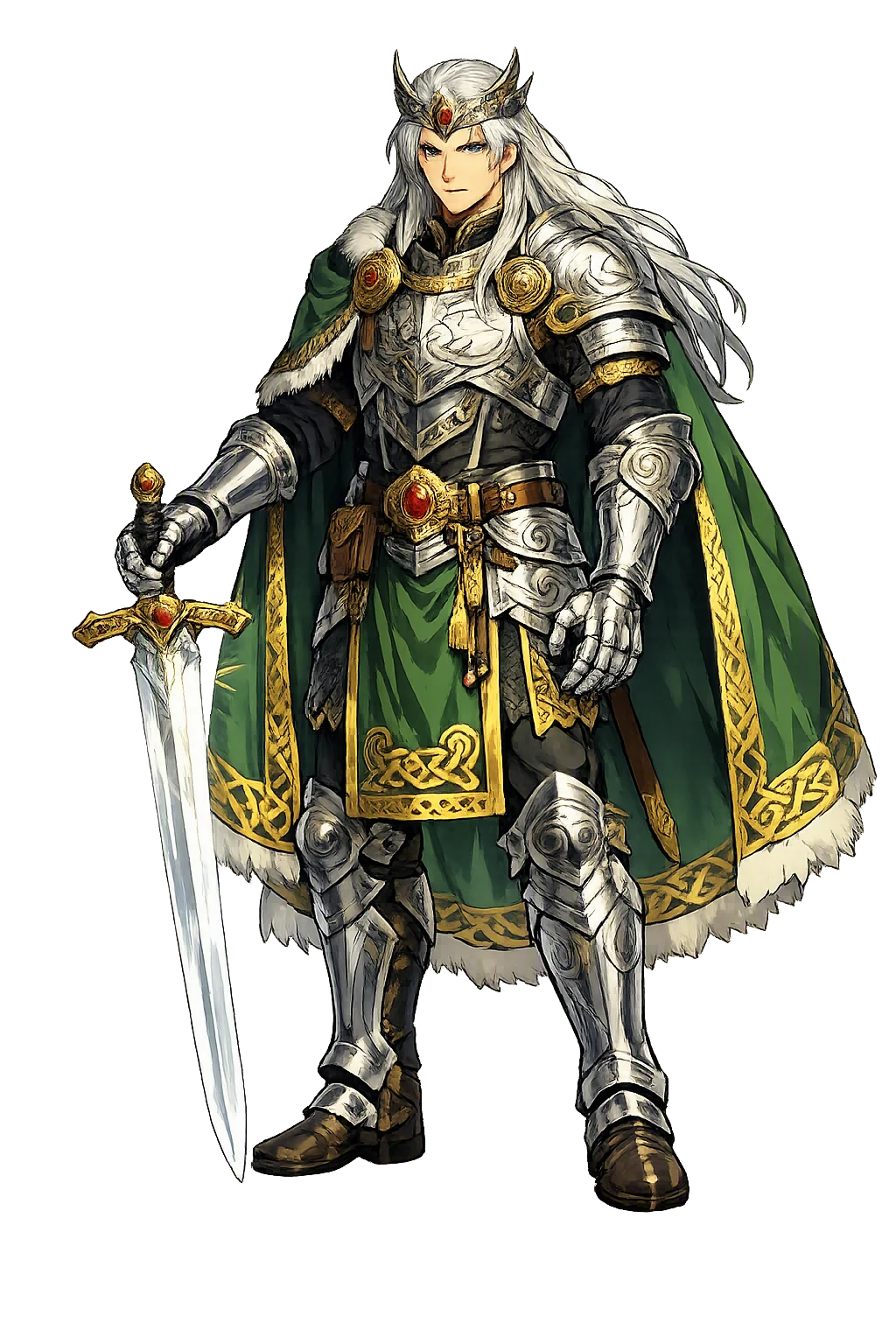
Why Nuada belongs in your address bar
Every address bar is a choice. When you type Nuada, you are not typing a novelty; you are restoring a name that the early DNS, built for English typewriters, could not carry. The plain ASCII form nuada is a leftover of that constraint, not the name itself. This post is the long version of the restoration: where the name comes from, how the Celtic transcription tradition wrote it, how it is pronounced, what the myths and the material record preserve, and why its Unicode form now lives as a working domain. The claim throughout is simple — the original spelling is not decoration. It is the name.
At a Glance
- Restored name: Nuada
- ASCII form: nuada
- Meaning: "Cloud-maker, hunter"
- Domain of influence: War, King of Tuatha
- Pantheon: Celtic
- Classification: Tier 2
Overview
Nuada (nuada) — War, King of Tuatha · First King of the Tuatha Dé Danann — is the silver-handed king whose story turns on the body of the ruler: he lost his right arm winning Ireland from the Fir Bolg, lost his throne to the law that no blemished man may be king, and won both back through the craft of the physician-gods.
Old Irish Nuadu (later Nuada) bears the byname Airgetlám, 'Silver-hand', from the arm of silver the physician Dian Cécht made him after the First Battle of Mag Tuired. The name itself belongs to one of the clearest pan-Celtic families: Welsh Nudd and Lludd Llaw Eraint ('Lludd of the Silver Hand') and the Gaulish Nodens of Lydney Park stand beside the Irish king, and scholars reconstruct a Common Celtic stem behind all three — though its meaning, 'cloud-maker' or 'catcher, fisher', remains honestly debated.
PuniCodex restores the name as Nuada — identical, letter for letter, to the attested medieval spelling. No form of the name is currently held as a domain: the plain ASCII nuada.com is registered to a third party outside the collection and is watched for release, so this temple stands without an owned address. Tier 2 by the mechanical rule: there is no diacritic or distinctive letter for ASCII to lose.
The Name
The name is attested in Old Irish as Nuadu (Middle Irish and modern Nuada; modern Irish Nuadha), with the byname Airgetlám — airget 'silver' + lám 'hand, arm'. Its etymology is debated and this edition treats it as such: one proposal reads the name as 'cloud-maker', connecting it with Welsh nudd 'mist'; the other, argued by Tolkien for the Gaulish form, derives it from a root meaning 'to catch, acquire, make use of' — a 'catcher' or fisher-hunter, which would fit the hounds and fishermen of the Lydney temple imagery.
The cognate chain is the name's strongest evidence. Welsh Nudd and Lludd Llaw Eraint ('Lludd of the Silver Hand') translate the Irish byname word for word; Gaulish Nodens (also written Nodons, Nudens) is the dedicatory name of the temple at Lydney Park in Gloucestershire. Mac Cana and Koch reconstruct a Common Celtic Noudont- / Noudo- behind all three forms.
Because the attested spelling is plain ASCII, the letter-by-letter transformation is the identity map:
- n → N — Same, capitalized
- u → u — Same
- a → a — Same
- d → d — Same
- a → a — Same
The name is classified Tier 2 by the mechanical rule: the restoration preserves no diacritic and no distinctive letter, because the medieval scribes wrote none. The project holds no domain for this entry: nuada.com is registered outside the collection and is watched for release, and this temple claims no address.
The Original Script
The name is preserved in medieval Irish vellum manuscripts in the Insular Latin bookhand as Nuadu / Nuada — Old Irish, recorded in the recensions of the Lebor Gabála Érenn and in the battle texts of the Mythological Cycle, which survive in late-medieval and early-modern codices but preserve much older material. No Ogham inscription names him; the Insular manuscript form is the primary witness.
The rendering is straightforward because the scribes left nothing for modern editors to restore:
- The name is a single stem, Nuadu, with the nominative ending intact; the byname Airgetlám compounds airget 'silver' and lám 'hand, arm'.
- Old Irish orthography of the manuscript period does not mark vowel length or lenition with diacritics in this name, so the attested spelling is plain ASCII.
- In the Ogham letter-row the name would have been notched ᚅᚒᚐᚇᚐ (N-U-A-D-A) — a mechanical transliteration, not an attested carving; no stone yet found carries the theonym.
- The Unicode form Nuada is therefore identical to the ASCII input, and the temple says so rather than inventing marks the sources do not contain.
Pronunciation
The reconstructed pronunciation of the Old Irish form is /ˈnuː.að.u/ — Old Irish Reconstruction.
Phoneme by phoneme:
- N- — Broad alveolar nasal [n̪ˠ], unlenited, as in every Old Irish initial n
- -uː- — Long close back [uː], stressed on the first syllable as in all Old Irish words
- -a- — Open [a] across the syllable boundary
- -ð- — Lenited d, the voiced dental fricative [ð] of English this; medieval scribes wrote the lenition without marking it
- -u — Short final [u], the nominative ending of the earliest form Nuadu
For the modern speaker, the closest approximation is: 'NOO-ah-oo' — the first vowel long, the middle consonant softened toward 'th', the ending short. The everyday modern pronunciation 'NOO-uh-duh' is an anglicized convenience, not the medieval sound.
Kindred and historical forms of the name:
- Old Irish — Nuadu, later Nuada; byname Airgetlám, 'Silver-hand'
- Middle Welsh — Nudd; Lludd Llaw Eraint, 'Lludd of the Silver Hand'
- Gaulish — Nodens (Nodons, Nudens), as inscribed at Lydney Park
- Modern Irish — Nuadha, the living form
Nuada is Tier 2 because the attested form is already plain ASCII: there is nothing for the restoration to recover, and the temple is honest about that — the work here is scholarly, not orthographic.
Mythology
Nuada's mythology is a single continuous arc across two battles and one interregnum: the arm, the silver, the satire, the return, and the death. The Dagda, Ogma, and Lúg move through it as comrades; Balor ends it.
The First Battle of Mag Tuired (Lebor Gabála; Fraser's 'First Battle of Moytura')
The Tuatha Dé Danann, come to Ireland with Nuada seven years their king, demanded the country from the Fir Bolg. At Mag Tuired in Connacht the battle was joined, and Nuada fought Sreng, the Fir Bolg champion: Sreng struck off his right arm at the shoulder, yet the Tuatha Dé Danann carried the field, and the Fir Bolg king Eochaid mac Eirc was driven to his death seeking water. Ireland was won — by a king now unwhole.
The Silver Hand, and the Hand of Flesh (Lebor Gabála)
The law held that no man with a blemish could be king of Ireland, so the sovereignty passed to Bres mac Elatha. Dian Cécht the physician, with Credne the brazier, made Nuada a full arm of silver that moved in every joint — hence Airgetlám. Then Dian Cécht's son Miach did the impossible thing: he laid the severed arm to the stump and healed it 'joint to joint and vein to vein' in thrice nine days. Dian Cécht, envious of the son who had outdone the father, struck Miach dead; from the grave grew three hundred and sixty-five herbs, one for every joint and sinew, which Miach's sister Airmed spread on her mantle in their order — and which Dian Cécht scattered, so that the complete art of healing perished with his jealousy.
Bres and the First Satire in Ireland (Lebor Gabála; Cath Maige Tuired)
Bres ruled as his blood dictated: the champions of Ireland were put to carrying firewood and digging dykes, the knives were not greased at the feast, and the poet Cairbre mac Etaine, denied hospitality, made against Bres what the tradition counts the first satire in Ireland — and blisters rose on the king's face. The same blemish law that had unseated Nuada now unseated Bres; with his arm made flesh again, Nuada took back the kingship.
The Second Battle and the King's Death (Cath Maige Tuired)
When the war with the Fomorians could no longer be delayed, a stranger came to Tara claiming every craft at once — 'I am a wright; a smith; a champion; a harper; a poet' — and the doorkeeper's rule was that no man without an art could enter. Lúg the Ildánach, the many-skilled, won his way to the chessboard, and Nuada, seeing in him the leader the war required, gave him his own seat. At the Second Battle of Mag Tuired, Nuada Airgetlám and Macha his wife fell together at the hands of Balor of the Evil Eye; the Tuatha Dé Danann won the battle and buried their first king.
Symbols & Iconography
Nuada's iconography is narrative and, uniquely among Irish gods, also archaeological — through his Gaulish cognate the name has a real temple inventory:
- The silver arm — Dian Cécht's masterpiece, made with Credne the brazier, moving in every joint: wholeness restored by craft, and the source of the byname Airgetlám
- The sword from Findias — one of the Four Treasures the Tuatha Dé Danann brought from the northern cities of the world; once drawn, no one escaped from it
- Tara (Temair) — the seat of the kingship of Ireland, where the blemish law was enforced and where Nuada yielded the champion's seat to Lugh
- The physician's toolkit — silver-work and flesh-work: the arm made by art and the arm regrown by healing, the two technologies of restoration
- Dog and fisherman (as Nodens) — the bronze hounds and sea imagery of the Lydney temple, where the name's oldest recoverable meaning — hunter, catcher, fisher — seems still to be speaking
Archaeology & Evidence
In Ireland, Nuada is a figure of texts: no inscription, cult site, or votive deposit names him, and his evidence is the manuscript record of the Mythological Cycle. His Gaulish cognate, however, has one of the finest excavated sanctuaries in Roman Britain. The temple of Nodens at Lydney Park, Gloucestershire, set above the Severn estuary, was built in the later third century CE and rebuilt in the fourth; the Wheelers' excavations of 1928–29 uncovered its mosaic floors, guest-house and baths, and a rich votive assemblage: inscribed slabs reading DEVO NODENTI and D M NODONTI ('to the god Mars Nodens'), bronze dogs — the healer's animal — a relief of fishermen, and offerings of pins, bracelets, and coins.
The site's most haunting find is the curse tablet of Silvianus, who had lost a gold ring and dedicated half its value to Nodens on condition that the god deny health to the thief, 'among those who bear the name Senicianus', until the ring was brought to the temple. A gold ring inscribed SENICIANE VIVAS IN DEO ('Senicianus, may you live in God') was found at Silchester a century earlier, and the two are now displayed together as plausibly the very ring of the curse. On the Irish side the material witnesses are the codices: the Second Battle of Mag Tuired survives complete only in the sixteenth-century British Library Harley MS 5280, and the First Battle in a single late vellum copy edited by Fraser.
Realm & Domain
Nuada rules where kingship, war, and healing meet: he is the king whose right to rule was settled by his body's wholeness, the war-leader of both battles of Mag Tuired, and the patient of the two greatest healings in the Irish corpus.
Kingship
First king of the Tuatha Dé Danann in Ireland; the blemish law unseated him and his restoration confirmed the law's symmetry — it unseated the unjust Bres by the same standard.
War
Victor of the First Battle of Mag Tuired against the Fir Bolg; lord of the sword from Findias that none escaped; fallen commander at the Second Battle, yielding the champion's seat to Lúg before the fighting.
Healing
The recipient of Dian Cécht's silver arm and of Miach's greater healing, 'joint to joint and vein to vein' — the mythic proof-text for healing as a sovereign art.
Justice (as Nodens)
At Lydney Park his Gaulish cognate heard the curse of Silvianus against a ring-thief: the god who withholds health until wrong is put right.
Across Cultures
Nuada's cross-border identity is the strongest in the Celtic pantheon: a single name runs through three traditions with its silver hand intact. In Welsh he is Nudd, and in full form Lludd Llaw Eraint — 'Lludd of the Silver Hand', king of Britain in the tale Lludd a Llefelys, where he frees his realm from three plagues; the byname translates Irish Airgetlám word for word (llaw 'hand', eraint 'silver'). In Gaulish he is Nodens, god of the temple at Lydney Park, where Roman dedicants equated him with Mars, and where the imagery of hounds and fishermen suggests the older meaning of the name still at work.
Roman Britain kept the name in stone. The Silvianus curse tablet calls on 'Lord Nodens' to deny the thief of a stolen ring his health until the ring reaches the god's temple — justice enforced through the body, the same logic as the Irish blemish law. Within the Irish corpus, closely related figures include Lúg (who inherits the war-leadership), Dian Cécht (whose craft makes the king's name), and Macha (the wife who falls beside him).
Cultural Legacy
Nuada's modern afterlife began in an excavation report. When the Wheelers published the Lydney Park dig in 1932, the appendix on the god's name was written by J. R. R. Tolkien, then Rawlinson and Bosworth Professor of Anglo-Saxon at Oxford — 'The Name "Nodens"' is a small classic of philology, and the Silchester ring associated with the Silvianus curse was shown to Tolkien decades later, fuelling the enduring (if unprovable) romance that the One Ring owes something to Nodens.
In Ireland the name never died: modern Irish Nuadha remains a given name, and Nuada's sword from Findias was borne on the old arms of St Patrick's College, Maynooth. Popular culture discovered him late but decisively — Guillermo del Toro's Hellboy II: The Golden Army (2008) made Prince Nuada Silverlance the most famous silver-handed figure in modern film — and the wider fantasy motif of the magical prosthetic hand descends, directly or not, from Airgetlám. In contemporary Celtic paganism Nuada is honoured as a god of rightful sovereignty, healing, and justice restored.
The Scholarly Record
The account of Nuada given in this edition rests on the witnesses and reference works listed below. The Irish cycle supplies the narrative; the Welsh and Gaulish cognates secure the name-family; the Lydney report supplies the archaeology.
- Lebor Gabála Érenn, ed. and trans. R. A. S. Macalister, 5 vols., Irish Texts Society (London: Irish Texts Society, 1937–56), vol. 4 — the arrival, the First Battle, the silver arm, Miach and Airmed, the kingship of Bres.
- Cath Maige Tuired: The Second Battle of Mag Tuired, ed. and trans. Elizabeth A. Gray, Irish Texts Society 52 (London: Irish Texts Society, 1982) — Lugh's coming to Tara; the deaths of Nuada and Macha.
- Fraser, J., 'The First Battle of Moytura', Ériu 8 (1916), 1–63 — the sole-copy text; Sreng's stroke.
- The Mabinogion, trans. Sioned Davies (Oxford: Oxford University Press, 2007): Lludd a Llefelys; Culhwch ac Olwen — Nudd and Lludd Llaw Eraint.
- Mac Cana, Proinsias, Celtic Mythology, 3rd ed. (London: Chancellor Press, 1996) — the Nuadu–Nudd–Nodens family.
- Koch, John T. (ed.), Celtic Culture: A Historical Encyclopedia, 5 vols. (Santa Barbara: ABC-CLIO, 2006), s.v. Nuadu, Nodens, Lydney Park.
- Jackson, Kenneth Hurlstone, The Oldest Irish Tradition: A Window on the Iron Age (Cambridge: Cambridge University Press, 1964) — kingship and social setting.
- Thurneysen, Rudolf, A Grammar of Old Irish, rev. ed. (Dublin: DIAS, 1946) — phonology and name-forms.
- Wheeler, R. E. M., and T. V. Wheeler, Report on the Excavation... in Lydney Park, Gloucestershire (Oxford: Oxford University Press, 1932), with Appendix I: J. R. R. Tolkien, 'The Name "Nodens"'.
- McManus, Damian, A Guide to Ogam, Maynooth Monographs 4 (Maynooth: An Sagart, 1991) — the Ogham letter-row.
A Meditation
Nuada is the king who had to be rebuilt. The myth does not soften the law that unmakes him — a blemished man cannot be king, and the rule is applied as firmly to the oppressive Bres as to the wounded hero — but it answers the law with the whole craft of the divine physicians: first silver, then flesh. Between the two arms lies the cycle's deepest thought, that a made thing can carry a man back to himself but cannot carry him all the way; Miach's healing is greater than Dian Cécht's, and it costs Miach his life.
What remains is a sovereignty defined by fitness rather than possession. Nuada surrenders the throne without rebellion, serves his people maimed, takes the kingship back without vengeance, and at the end surrenders his own seat to the young god whose skills the war needs. The first king of the Tuatha Dé Danann is, at every crisis, the one who lets go — of the throne, of the silver, of the seat of honour. The myth measures kingship by what a ruler is willing to give up for the thing he rules.
The Unicode Restoration
Nuada is classified as Tier 2: the restoration needs no distinctive letters or diacritics its ASCII form would lose. The ASCII fallback nuada still resolves everywhere, but it is the restored form that carries the name's full information. That is the whole thesis of this temple: the marks are the message.
Why This Restoration Matters
Restoring Nuada is part of a larger effort to make the web multilingual by default. The PuniCodex project does not ask users to learn a new alphabet; it asks the infrastructure to respect the alphabets that already exist. Every section of this post — the script, the sound, the myths, the evidence — converges on the same point: the marks in Nuada are information, and information deserves an address of its own. A single Unicode domain is a small proof, but it is a proof that scales: every name restored makes the next one easier, and every visit to the temple is a vote for the restored form.
Explore Further
This post is one doorway into the temple. The home page carries the full character breakdown and the ambient canvas; the lore page tells the myths in long form; the Scholarly Edition preserves the sources, pronunciation data, and revision history; and the patron wall supports the restoration directly. For the wider map, browse the Lexicon, explore the Pantheon, or return to the PuniCodex blog.
Related Names
Sources
The full scholarly apparatus — every citation, revision, and review — lives in the Scholarly Edition. Key references for this post:
- Lebor Gabála Érenn, ed. and trans. R. A. S. Macalister, 5 vols., Irish Texts Society 34, 35, 39, 41, 44 (London: Irish Texts Society, 1937–56), vol. 4 (Tuatha Dé Danann; First Battle of Mag Tuired; Airgetlám; Bres).
- Mac Cana, Proinsias, Celtic Mythology, 3rd ed. (London: Chancellor Press, 1996), s.v. Nuadu, Nudd, Nodens.
- Koch, John T. (ed.), Celtic Culture: A Historical Encyclopedia, 5 vols. (Santa Barbara: ABC-CLIO, 2006), s.v. Nuadu Airgetlám, Nodens, Lydney Park.
- Mac Cana, Proinsias, Celtic Mythology, 3rd ed. (Chancellor Press, 1996); Koch, John T. (ed.), Celtic Culture: A Historical Encyclopedia (ABC-CLIO, 2006), s.v. Nuadu.
- Lexicon authorities for this entry: Lebor Gabála, MacKillop.