The Authentic Orthography
Youth, War, Rebellion · Youth, War, Rebellion · Nezha (from Sanskrit Nalakuvara)
Unicode restoration and ASCII comparison
哪吒
The name in its original Chinese form. Nézhā (哪吒) is attested in the source tradition — “Nezha (from Sanskrit Nalakuvara)”. Its macron-length vowels and acute stress marks carry the full phonetic and orthographic weight of the source tradition.
nezha
Reduced to plain nezha, the name loses everything that made it specific: macron-length vowels and acute stress marks. What remains is an ASCII string that machines can parse but that no longer speaks with its original voice.
Nézhā
The Unicode restoration recovers what ASCII flattened. Nézhā restores macron-length vowels and acute stress marks, returning the name to its original written dignity. The domain encodes to Punycode, but the browser displays the truth.
Nézhā.com → xn--nzh-bma6j.com
The non-ASCII characters in Nézhā are encoded while the ASCII remains visible. To the DNS, it is Punycode. To humanity, it is Nézhā.
How Nézhā is preserved in writing
A bespoke provenance study for Nézhā is being prepared by the PUNICODEX scholarly team.
Contribute scholarly provenance →Owned, ideal, and ASCII forms of Nézhā
Nézhā
Restores 哪吒. The live temple domain — nézhā.com.
nezha
Flattens 哪吒. The plain ASCII fallback — what DNS and legacy systems see.
How Nézhā was spoken
Filial Sacrifice, Divine Weaponry, Unconquerable Youth
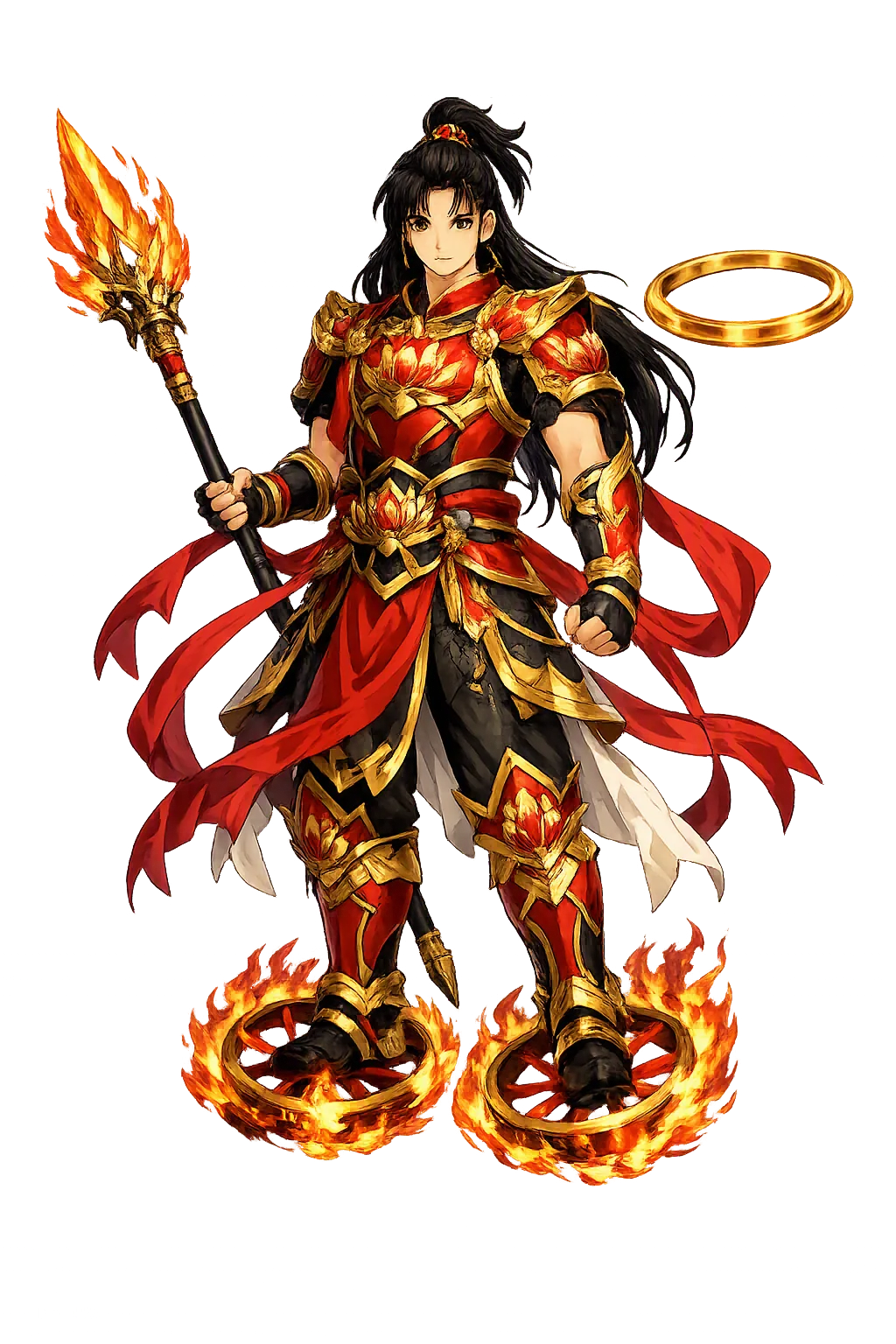
Nézhā is the child who would not stay born. Third son of the garrison commander Li Jing, he came into the world after three and a half years of pregnancy — not as an infant but as a ball of flesh, which his father split with a sword to reveal a walking, talking boy. The immortal Taiyi Zhenren took him as a disciple and armed him as no child has ever been armed: the Universe Ring, the Red Armillary Sash, the Fire-Tipped Spear, and the Wind Fire Wheels on which he rides the sky.
What follows is one of the most harrowing arcs in Chinese myth: a boy who kills the Dragon King's son, returns his flesh to his father and his bones to his mother to spare them heaven's vengeance, and is rebuilt from lotus roots and blossoms — a body owed to no one. From there he becomes the vanguard of Jiāng Zǐyá's Zhou army in the Investiture of the Gods and, in Journey to the West, the celestial marshal sent to battle Sūn Wùkōng.
Qiánkūnquān, the golden ring of heaven and earth, first of the weapons Taiyi Zhenren bestowed — a cosmic bracelet that strikes with the weight of the world it names.
Bathing in the sea, Nézhā stirred the waters with his sash until the Dragon King's palace shook — the act that killed Āo Bǐng and set the cycle of debt and sacrifice in motion.
His soul rebuilt from lotus roots and blossoms by Taiyi Zhenren, Nézhā returns in a body owing flesh to no parent — purity, renewal, and freedom from the debt of birth.
Fēnghuǒlún, the paired wheels of wind and flame beneath his feet — the mount that carries the celestial vanguard faster than storm across the three realms.
Stories of Nézhā
The Nézhā cycle is the great Chinese myth of the filial rebel — a story in which the most radical act of disobedience and the most extreme act of filial piety turn out to be the same act. Its canonical form was fixed in the Ming dynasty, above all in the Investiture of the Gods.
Lady Yīn carries her third child for three years and six months. When the birth finally comes, what emerges is not an infant but a ball of flesh, and Li Jing, garrison commander of Chéntānguān, strikes at it with his sword, certain it is a demon. The ball splits open — and out steps a boy already able to walk and speak, a divine embryo sent down as the disciple of the immortal Taiyi Zhenren. The wrongness of the birth is the point: Nézhā enters the world already owing nothing to ordinary nature.
Bathing in the Nine-Bend River where it meets the East Sea, the boy dips his Red Armillary Sash in the water — and the sash, an instrument of cosmic order, churns the sea until the palace of the Dragon King Āo Guǎng trembles on its foundations. When the Dragon King's third son, Āo Bǐng, rises to punish the offender, Nézhā kills him. A child has bloodied the bureaucracy of the waters, and the Dragon King of the East Sea will have justice from heaven itself.
To spare his parents the Dragon King's vengeance, Nézhā takes his own life — and frames the deed as an accounting: he returns his flesh to his father and his bones to his mother, paying back the body they gave him so that his crime dies with him and no debt remains to be collected from his house. It is the most shocking sentence in Chinese popular mythology, filial piety pressed so hard it becomes separation. The motif is old — Chan Buddhist texts of the Song dynasty already speak of Nézhā rending flesh and bone to repay his parents.
His wandering soul is gathered by Taiyi Zhenren, who rebuilds him from lotus roots for limbs and lotus blossoms for flesh — the lotus rebirth. Remade, Nézhā becomes what the old body never could be: a warrior free of the debt of birth. In the Investiture of the Gods he rides his Wind Fire Wheels as vanguard of Jiāng Zǐyá's Zhou army in the overthrow of the Shang; in Journey to the West he serves heaven as a celestial marshal, sent down to do battle with Sūn Wùkōng — one rebel conscripted against another.
Nézhā teaches that the deepest bond and the deepest freedom can be purchased with the same act. He does not simply disobey his parents, as the Western rebel does; he pays them back — flesh for flesh, bone for bone — and discovers that what remains after the debt is settled is not nothing but everything: a self made of lotus, owing its shape to no one's expectation. The myth refuses the easy lesson. His sacrifice is genuinely filial and genuinely annihilating; his rebirth is genuinely free and genuinely owed to a master's compassion.
Enter Extended Lore