PuniCodex

Extended Lore

哪吒 Nézhā

Etymology · Phonology · Orthography · Cultural Legacy · Primary Sources

Tier 1 Nézhā.com
Nézhā — Youth, War, Rebellion
01

Quick Facts

Essential information about Nézhā, Youth, War, Rebellion

Original Script哪吒
Unicode RestorationNézhā
Reconstructed Pronunciation/nɤ˧˥ ʈʂa˥/
PantheonChinese
DomainYouth, War, Rebellion
MeaningNezha (from Sanskrit Nalakuvara)
ClassificationTier 1
Primary DomainNézhā.com
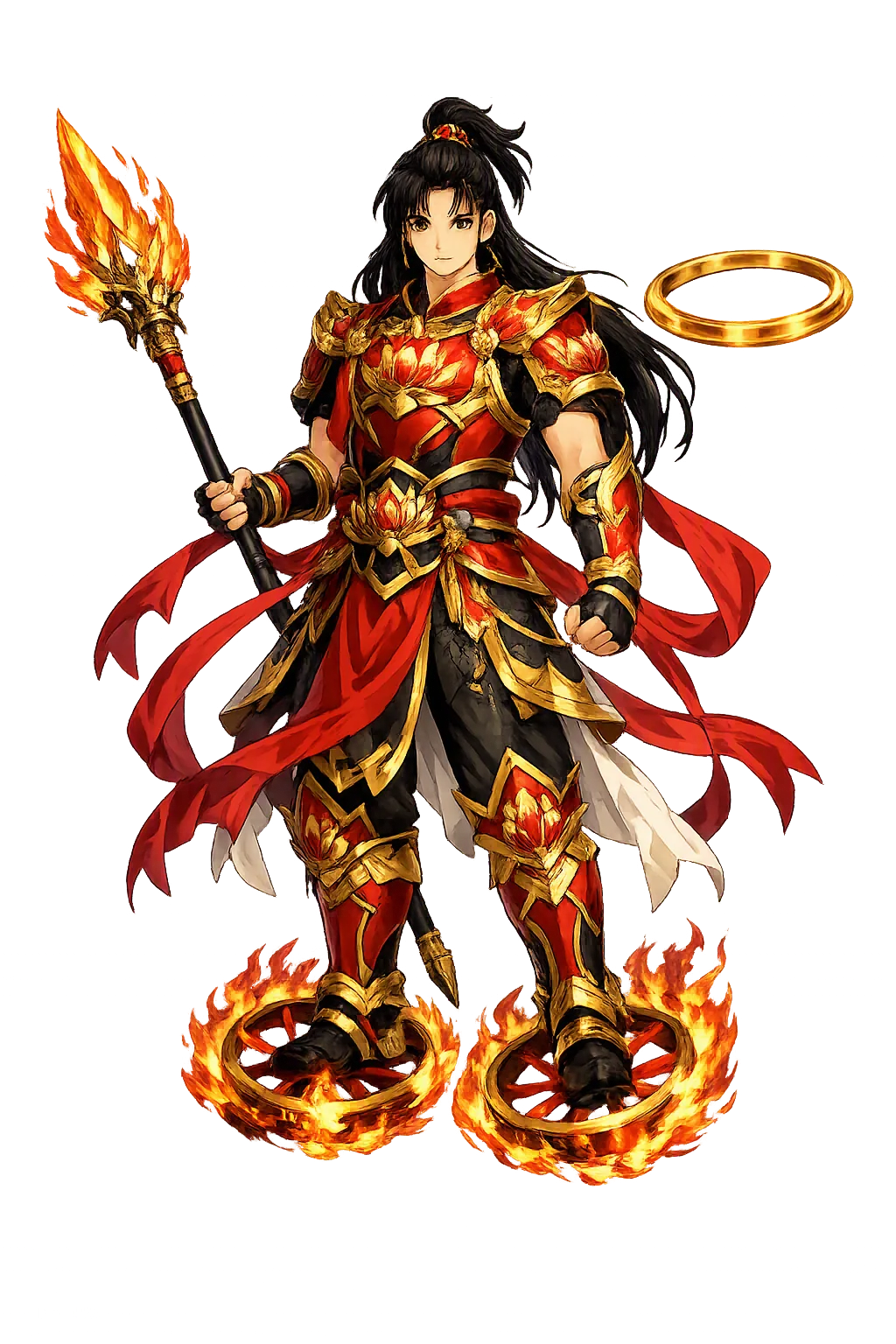
Sacred SymbolsUniverse Ring (乾坤圈), Red Armillary Sash (混天綾), Fire-Tipped Spear (火尖槍), Wind Fire Wheels (風火輪), Lotus (蓮花)
02

Etymology & Word Family

From original script to Unicode restoration

Original Script 哪吒 Nézhā — "Nezha (from Sanskrit Nalakuvara)"
Unicode Restoration Nézhā Restored stress, length, and script
Modern ASCII nezha Plain-ASCII fallback

哪吒 is the settled transcription of a name that entered Chinese through Buddhist transmission from Sanskrit Nalakūvara, son of the guardian king Vaiśravaṇa. The Modern Standard Mandarin reading is Nézhā: 吒 zhā (Tone 1) is the value recorded in the Unihan Database (Unicode Consortium, kMandarin) and standard dictionaries, while 哪 carries here its special proper-name reading né (Tone 2), preserved only in this name and recorded as such in the standard dictionaries (Xiandai Hanyu Cidian, Hanyu Da Cidian); its ordinary interrogative reading is nǎ (Tone 3), the value given under kMandarin in the Unihan Database. Because the name is a medieval transcription of a foreign theonym rather than a native Chinese word, Old Chinese reconstruction does not apply.

03

Unicode Character Breakdown

Character-by-character philological analysis

CharacterUnicodeNameBlockPhonetic Role
NU+004ELatin Capital Letter NBasic LatinSame, capitalized
éU+00E9Latin Small Letter E with AcuteLatin-1 SupplementStress on e
zU+007ALatin Small Letter ZBasic LatinSame
hU+0068Latin Small Letter HBasic LatinSame
āU+0101Latin Small Letter A with MacronLatin Extended-ALong vowel

The Tier 1 classification reflects how much of the original phonology this restoration preserves — stress and vowel length for Greek names, distinctive letters and diacritics for every other tradition.

04

Cultural Significance

From ancient cult to modern Unicode

Ancient Domain

Nézhā is the child who would not stay born. Third son of the garrison commander Li Jing, he came into the world after three and a half years of pregnancy — not as an infant but as a ball of flesh, which his father split with a sword to reveal a walking, talking boy. The immortal Taiyi Zhenren took him as a disciple and armed him as no child has ever been armed: the Universe Ring, the Red Armillary Sash, the Fire-Tipped Spear, and the Wind Fire Wheels on which he rides the sky.

What follows is one of the most harrowing arcs in Chinese myth: a boy who kills the Dragon King's son, returns his flesh to his father and his bones to his mother to spare them heaven's vengeance, and is rebuilt from lotus roots and blossoms — a body owed to no one. From there he becomes the vanguard of Jiāng Zǐyá's Zhou army in the Investiture of the Gods and, in Journey to the West, the celestial marshal sent to battle Sūn Wùkōng.

Nézhā in Later Traditions

Nézhā is himself a product of transmission: the name enters Chinese through Buddhism as a transcription of Sanskrit Nalakūvara, a son of the guardian king Vaiśravaṇa, and the earliest Chinese forms (那吒, read closer to Nata) preserve that foreign sound. As the figure was naturalized, the genealogy was rewritten — his father became the historical-flavored general Li Jing, who absorbed Vaiśravaṇa's iconography wholesale and became the pagoda-bearing Heavenly King (托塔天王) of the Chinese celestial court. Taoism then claimed the child outright: under the title Zhōngtán Yuánshuài, Marshal of the Central Altar, Nézhā became one of the most vividly worshipped protectors in the Chinese ritual pantheon. The figure traveled with the Chinese world — to Korea, Vietnam, and Japan (where he is Nataku) — but it is in the Sinitic ritual tradition, and above all in the temples and processions of Taiwan and the southeastern diaspora, that the lotus-born marshal remains a living god rather than a literary memory.

Modern Legacy

No Chinese deity has had a stronger twenty-first century. Nézhā's cult thrives in Taiwan and the diaspora, where the Marshal of the Central Altar dances in temple processions — in recent decades to electronic music, the 'techno Nézhā' of modern festival culture. On screen, the 2019 animated feature Ne Zha became the highest-grossing animated film in Chinese history, its defiant reading of the myth — fate is a rumor the child refuses — resonating with a generation; Ne Zha 2 (2025) went further, breaking global box-office records for animation. The rebel child who returned his body to his parents has become, arguably, the most popular Chinese deity of the modern era: an emblem of youth that will not be told what it owes.

Unicode Restoration as Cultural Act

Restoring Nézhā in a domain name is more than orthographic accuracy. It is a statement that the internet should recognize the full range of human writing — not only the ASCII keyboard.

05

Frequently Asked Questions

Common questions about Nézhā, Youth, War, Rebellion, and Unicode restoration

01How do you pronounce Nézhā?

In reconstructed pronunciation, Nézhā is /nɤ˧˥ ʈʂa˥/ — approximately NUH-jah — the first syllable rises like a question, the second stays high and level; keep the 'zh' retroflex, tongue curled back, closer to 'dr' than to 'j'..

02What does Nézhā mean?

Nézhā means Nezha (from Sanskrit Nalakuvara) in the chinese tradition.

03What are the symbols of Nézhā?

Nézhā is associated with Universe Ring (乾坤圈) (Cosmic sovereignty in miniature — heaven and earth bound into a single striking weapon), Red Armillary Sash (混天綾) (The seven-chi silk that churns seas and binds foes; the instrument of the East Sea upheaval), Fire-Tipped Spear (火尖槍) (Martial fire and unrelenting advance, the spear of the vanguard who never retreats), Wind Fire Wheels (風火輪) (Unstoppable motion — the storm itself harnessed as a vehicle for the young marshal), Lotus (蓮花) (Rebirth without debt: purity rising from the water, a body remade beyond blood and bone).

04Why restore Nézhā in Unicode?

Plain ASCII nezha strips the stress, length, and script that make the name specific. Unicode restoration returns the name to its original written dignity.

05What is the most important myth about Nézhā?

Lady Yīn carries her third child for three years and six months. When the birth finally comes, what emerges is not an infant but a ball of flesh, and Li Jing, garrison commander of Chéntānguān, strikes at it with his sword, certain it is a demon. The ball splits open — and out steps a boy already able to walk and speak, a divine embryo sent down as the disciple of the immortal Taiyi Zhenren. The wrongness of the birth is the point: Nézhā enters the world already owing nothing to ordinary nature.

06

Scholarly Sources

The philological foundations of this restoration

Every claim on this page is grounded in established scholarship. The orthographic restorations follow disciplinary convention. The etymological chain follows the best available reference works. This is not invention — it is resurrection through scholarship.

Lexicography & Philology

  • Journey to the West
  • Chinese folklore

Primary Texts

  • Primary sources in the chinese tradition for Nézhā.

Archaeology & Art History

  • Material evidence — iconography, inscriptions, and temple archaeology — for Nézhā and related cults.
  • Nézhā is a textual rather than an archaeological figure, and his attestation history tracks the Buddhist transmission itself. The name first appears in Tang-dynasty Buddhist translations as 那吒 (Nata), a transcription of Sanskrit Nalakūvara, son of the guardian king Vaiśravaṇa, whose cult flourished in Tang China and whose iconography — armor, spear, and reliquary pagoda — later passed to Nézhā's literary father, Li Jing. By the Song dynasty the flesh-and-bone-returning motif was current in Chan literature, and Yuan-era drama gave the child a stage life. The canonical narrative was fixed in the Ming novels: the Investiture of the Gods supplied the full cycle from flesh ball to lotus rebirth, and Journey to the West installed him as a marshal of the celestial court. Material attestation is chiefly cultic — temple statuary of the Marshal of the Central Altar, a wheel-riding, ring-bearing youth, across southeastern China, Taiwan, and the diaspora.

Religious Studies

  • Fēngshén Yǎnyì (Investiture of the Gods)
  • Wu Cheng'en, Xīyóujì (Journey to the West)
  • Nezha (encyclopedia entry)
  • Chinese Text Project
  • Vaiśravaṇa (encyclopedia entry)
  • Taiyi Zhenren (encyclopedia entry)
  • Ao Guang, Dragon King of the East Sea (encyclopedia entry)
  • Unihan Database (Unicode Consortium)
Return

The Surface Awaits

You have traced the name from its earliest attestation to its Unicode restoration. Now return to the myth. The story is where the name lives.

Back to Lore
Nézhā mascot