
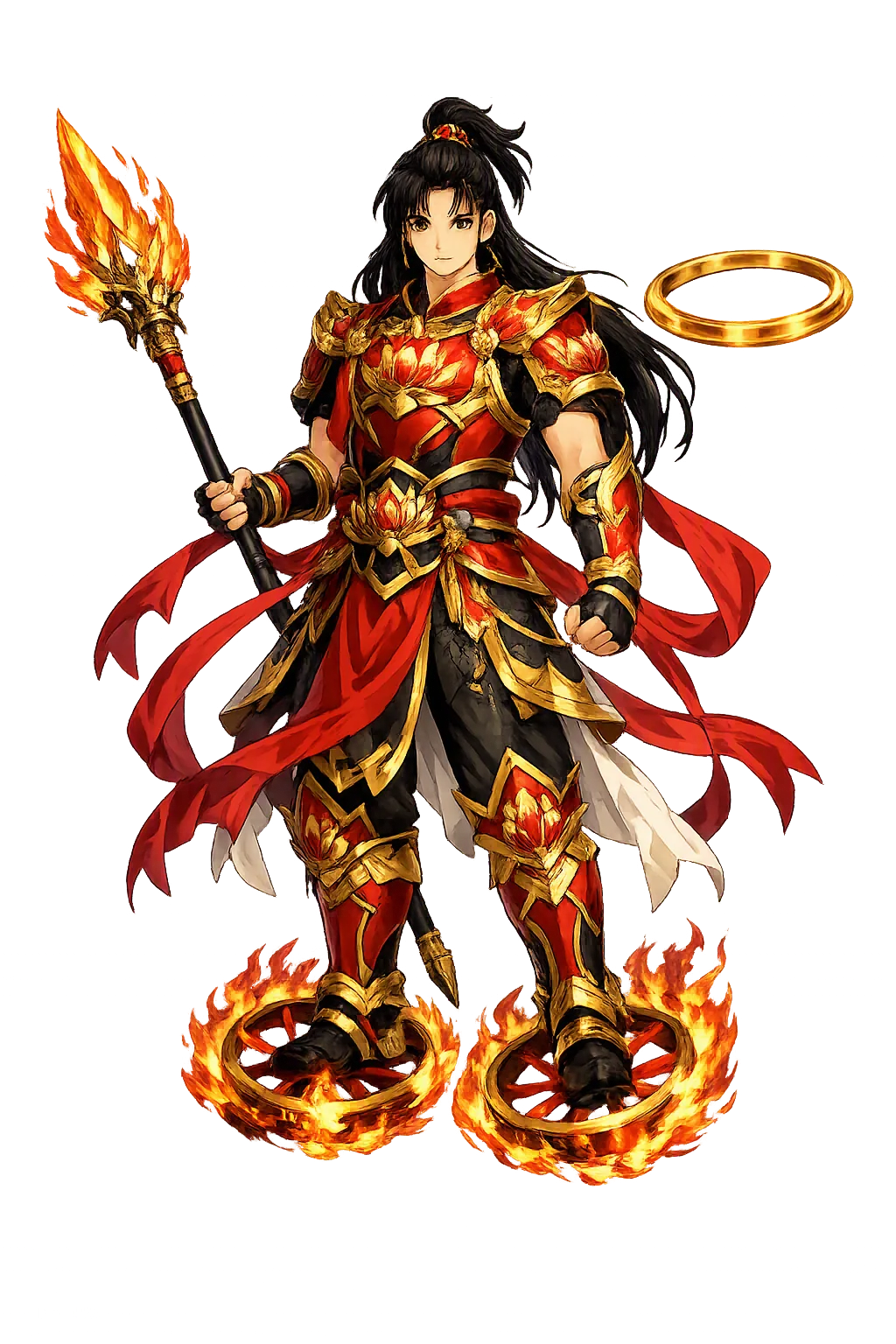
The name Nézhā and the world it opens
A name is a door. Nézhā opens onto an entire world: the domain of youth, war, rebellion, a Chinese tradition, and centuries of storytelling, worship, and scholarship. This post walks through that world room by room — the name and its roots, the original script, the sound of it, the myths, the symbols, the sites, the afterlife across cultures — and ends at the newest room of all: a Unicode domain that makes the whole structure addressable. nezha gets you to the same building, but only the restored form tells you why it was built.
At a Glance
- Restored name: Nézhā
- ASCII form: nezha
- Meaning: "Nezha (from Sanskrit Nalakuvara)"
- Domain of influence: Youth, War, Rebellion
- Pantheon: Chinese
- Classification: Tier 1
- Original script: 哪吒 (Chinese characters)
- Live domain: nézhā.com
Overview
Nézhā (nezha) — Youth, War, Rebellion · Nezha (from Sanskrit Nalakuvara) — belongs to the Chinese tradition, where it is catalogued under the domain "Youth, War, Rebellion". The name means "Nezha (from Sanskrit Nalakuvara)".
Nézhā is the child who would not stay born. Third son of the garrison commander Li Jing, he came into the world after three and a half years of pregnancy — not as an infant but as a ball of flesh, which his father split with a sword to reveal a walking, talking boy. The immortal Taiyi Zhenren took him as a disciple and armed him as no child has ever been armed: the Universe Ring, the Red Armillary Sash, the Fire-Tipped Spear, and the Wind Fire Wheels on which he rides the sky.
What follows is one of the most harrowing arcs in Chinese myth: a boy who kills the Dragon King's son, returns his flesh to his father and his bones to his mother to spare them heaven's vengeance, and is rebuilt from lotus roots and blossoms — a body owed to no one. From there he becomes the vanguard of Jiāng Zǐyá's Zhou army in the Investiture of the Gods and, in Journey to the West, the celestial marshal sent to battle Sūn Wùkōng.
PuniCodex restores the name as Nézhā and serves its temple at nézhā.com. The restoration preserves at least one distinctive feature — a diacritic or a distinctive letter — that the ASCII form loses, and exactly one historically valid Unicode restoration exists, which places the name in Tier 1. The plain ASCII form nezha survives as a modern convenience imposed by the early domain-name system; the restoration, not the fallback, is the form the project defends as philologically complete.
The Name
The name is attested in Chinese characters as 哪吒. Etymologically it means "Nezha (from Sanskrit Nalakuvara)".
The ASCII form nezha survives only because the early domain-name system could not carry diacritics; it is a technological compromise, not an ancient spelling. The Unicode restoration Nézhā recovers both the stress accent and the vowel length of the original directly in the address bar. The restoration preserves at least one distinctive feature — a diacritic or a distinctive letter — that the ASCII form loses, and exactly one historically valid Unicode restoration exists, which places the name in Tier 1.
The letter-by-letter transformation runs:
- n → N — Same, capitalized
- e → é — Stress on e
- z → z — Same
- h → h — Same
- a → ā — Long vowel
The project holds the domain nézhā.com (xn--nzh-bma6j.com) as the canonical home of this name.
The Original Script
The name is written in Chinese characters as 哪吒. This original script is the form against which the ASCII fallback nezha and the PuniCodex restoration Nézhā are measured: the restoration preserves both its pitch accent and its vowel quantity of the written form, so that a reader typing the modern address still speaks the ancient name.
The original script is 哪吒, identical in traditional and simplified Chinese. Pinyin Nézhā combines the special proper-name reading né (Tone 2) of 哪 — preserved only in this name, the ordinary interrogative reading being nǎ — with 吒 zhā (Tone 1), as recorded in the standard dictionaries and the Unihan Database. The name is a medieval transcription of Sanskrit Nalakūvara, so no Old Chinese reconstruction applies. The tone-marked restoration Nézhā maps directly to the registrable domain form: the display keeps both diacritics (é and ā, both registrable IDN characters), and no apostrophe is required anywhere in the name.
Pronunciation
The reconstructed pronunciation of the name is /nɤ˧˥ ʈʂa˥/ — Modern Standard Mandarin (Pinyin).
Phoneme by phoneme:
- Né- — Voiced alveolar nasal [n] plus the unrounded close-mid back vowel [ɤ], with Tone 2 (rising, ˧˥). 哪 carries this reading only in the theophoric name; its ordinary interrogative reading is nǎ (Tone 3).
- -zhā — Voiceless unaspirated retroflex affricate [ʈʂ] plus open central vowel [a], with Tone 1 (high level, ˥). Pinyin 'zh' denotes the retroflex series, not the English 'zh' of 'measure'.
For the modern speaker, the closest approximation is: NUH-jah — the first syllable rises like a question, the second stays high and level; keep the 'zh' retroflex, tongue curled back, closer to 'dr' than to 'j'.
Kindred and historical forms of the name:
- Traditional — 哪吒
- Simplified — 哪吒
- Wade-Giles — No²-cha¹
- Older transcriptions — 那吒 Nàzhā / Nata, the earlier Buddhist transcription of Sanskrit Nalakūvara
- Religious title — 中壇元帥 Zhōngtán Yuánshuài (Marshal of the Central Altar)
- Related terms — 乾坤圈 Qiánkūnquān (Universe Ring); 混天綾 Hùntiānlíng (Red Armillary Sash); 風火輪 Fēnghuǒlún (Wind Fire Wheels)
哪吒 is the settled transcription of a name that entered Chinese through Buddhist transmission from Sanskrit Nalakūvara, son of the guardian king Vaiśravaṇa. The Modern Standard Mandarin reading is Nézhā: 吒 zhā (Tone 1) is the value recorded in the Unihan Database (Unicode Consortium, kMandarin) and standard dictionaries, while 哪 carries here its special proper-name reading né (Tone 2), preserved only in this name and recorded as such in the standard dictionaries (Xiandai Hanyu Cidian, Hanyu Da Cidian); its ordinary interrogative reading is nǎ (Tone 3), the value given under kMandarin in the Unihan Database. Because the name is a medieval transcription of a foreign theonym rather than a native Chinese word, Old Chinese reconstruction does not apply.
Mythology
The Nézhā cycle is the great Chinese myth of the filial rebel — a story in which the most radical act of disobedience and the most extreme act of filial piety turn out to be the same act. Its canonical form was fixed in the Ming dynasty, above all in the Investiture of the Gods.
The Flesh Ball (Birth)
Lady Yīn carries her third child for three years and six months. When the birth finally comes, what emerges is not an infant but a ball of flesh, and Li Jing, garrison commander of Chéntānguān, strikes at it with his sword, certain it is a demon. The ball splits open — and out steps a boy already able to walk and speak, a divine embryo sent down as the disciple of the immortal Taiyi Zhenren. The wrongness of the birth is the point: Nézhā enters the world already owing nothing to ordinary nature.
The Dragon King's Third Son (East Sea)
Bathing in the Nine-Bend River where it meets the East Sea, the boy dips his Red Armillary Sash in the water — and the sash, an instrument of cosmic order, churns the sea until the palace of the Dragon King Āo Guǎng trembles on its foundations. When the Dragon King's third son, Āo Bǐng, rises to punish the offender, Nézhā kills him. A child has bloodied the bureaucracy of the waters, and the Dragon King of the East Sea will have justice from heaven itself.
Flesh to Father, Bone to Mother (Sacrifice)
To spare his parents the Dragon King's vengeance, Nézhā takes his own life — and frames the deed as an accounting: he returns his flesh to his father and his bones to his mother, paying back the body they gave him so that his crime dies with him and no debt remains to be collected from his house. It is the most shocking sentence in Chinese popular mythology, filial piety pressed so hard it becomes separation. The motif is old — Chan Buddhist texts of the Song dynasty already speak of Nézhā rending flesh and bone to repay his parents.
The Lotus Incarnation (Rebirth)
His wandering soul is gathered by Taiyi Zhenren, who rebuilds him from lotus roots for limbs and lotus blossoms for flesh — the lotus rebirth. Remade, Nézhā becomes what the old body never could be: a warrior free of the debt of birth. In the Investiture of the Gods he rides his Wind Fire Wheels as vanguard of Jiāng Zǐyá's Zhou army in the overthrow of the Shang; in Journey to the West he serves heaven as a celestial marshal, sent down to do battle with Sūn Wùkōng — one rebel conscripted against another.
Symbols & Iconography
The iconography associated with Nézhā concentrates in a small set of recurring attributes, each a compressed statement about the name:
- Universe Ring (乾坤圈) — Cosmic sovereignty in miniature — heaven and earth bound into a single striking weapon
- Red Armillary Sash (混天綾) — The seven-chi silk that churns seas and binds foes; the instrument of the East Sea upheaval
- Fire-Tipped Spear (火尖槍) — Martial fire and unrelenting advance, the spear of the vanguard who never retreats
- Wind Fire Wheels (風火輪) — Unstoppable motion — the storm itself harnessed as a vehicle for the young marshal
- Lotus (蓮花) — Rebirth without debt: purity rising from the water, a body remade beyond blood and bone
Archaeology & Evidence
Nézhā is a textual rather than an archaeological figure, and his attestation history tracks the Buddhist transmission itself. The name first appears in Tang-dynasty Buddhist translations as 那吒 (Nata), a transcription of Sanskrit Nalakūvara, son of the guardian king Vaiśravaṇa, whose cult flourished in Tang China and whose iconography — armor, spear, and reliquary pagoda — later passed to Nézhā's literary father, Li Jing. By the Song dynasty the flesh-and-bone-returning motif was current in Chan literature, and Yuan-era drama gave the child a stage life. The canonical narrative was fixed in the Ming novels: the Investiture of the Gods supplied the full cycle from flesh ball to lotus rebirth, and Journey to the West installed him as a marshal of the celestial court. Material attestation is chiefly cultic — temple statuary of the Marshal of the Central Altar, a wheel-riding, ring-bearing youth, across southeastern China, Taiwan, and the diaspora.
Realm & Domain
Nézhā is the child who would not stay born. Third son of the garrison commander Li Jing, he came into the world after three and a half years of pregnancy — not as an infant but as a ball of flesh, which his father split with a sword to reveal a walking, talking boy. The immortal Taiyi Zhenren took him as a disciple and armed him as no child has ever been armed: the Universe Ring, the Red Armillary Sash, the Fire-Tipped Spear, and the Wind Fire Wheels on which he rides the sky.
What follows is one of the most harrowing arcs in Chinese myth: a boy who kills the Dragon King's son, returns his flesh to his father and his bones to his mother to spare them heaven's vengeance, and is rebuilt from lotus roots and blossoms — a body owed to no one. From there he becomes the vanguard of Jiāng Zǐyá's Zhou army in the Investiture of the Gods and, in Journey to the West, the celestial marshal sent to battle Sūn Wùkōng.
The Universe Ring
Qiánkūnquān, the golden ring of heaven and earth, first of the weapons Taiyi Zhenren bestowed — a cosmic bracelet that strikes with the weight of the world it names.
The Eastern Sea
Bathing in the sea, Nézhā stirred the waters with his sash until the Dragon King's palace shook — the act that killed Āo Bǐng and set the cycle of debt and sacrifice in motion.
The Lotus Rebirth
His soul rebuilt from lotus roots and blossoms by Taiyi Zhenren, Nézhā returns in a body owing flesh to no parent — purity, renewal, and freedom from the debt of birth.
The Wind Fire Wheels
Fēnghuǒlún, the paired wheels of wind and flame beneath his feet — the mount that carries the celestial vanguard faster than storm across the three realms.
Across Cultures
Nézhā is himself a product of transmission: the name enters Chinese through Buddhism as a transcription of Sanskrit Nalakūvara, a son of the guardian king Vaiśravaṇa, and the earliest Chinese forms (那吒, read closer to Nata) preserve that foreign sound. As the figure was naturalized, the genealogy was rewritten — his father became the historical-flavored general Li Jing, who absorbed Vaiśravaṇa's iconography wholesale and became the pagoda-bearing Heavenly King (托塔天王) of the Chinese celestial court. Taoism then claimed the child outright: under the title Zhōngtán Yuánshuài, Marshal of the Central Altar, Nézhā became one of the most vividly worshipped protectors in the Chinese ritual pantheon. The figure traveled with the Chinese world — to Korea, Vietnam, and Japan (where he is Nataku) — but it is in the Sinitic ritual tradition, and above all in the temples and processions of Taiwan and the southeastern diaspora, that the lotus-born marshal remains a living god rather than a literary memory.
Within the Chinese tradition, closely related names in the corpus include Bāguà, Cháng'é, Fúxī, Guāndì, Guānyīn, and Hòuyì.
Cultural Legacy
No Chinese deity has had a stronger twenty-first century. Nézhā's cult thrives in Taiwan and the diaspora, where the Marshal of the Central Altar dances in temple processions — in recent decades to electronic music, the 'techno Nézhā' of modern festival culture. On screen, the 2019 animated feature Ne Zha became the highest-grossing animated film in Chinese history, its defiant reading of the myth — fate is a rumor the child refuses — resonating with a generation; Ne Zha 2 (2025) went further, breaking global box-office records for animation. The rebel child who returned his body to his parents has become, arguably, the most popular Chinese deity of the modern era: an emblem of youth that will not be told what it owes.
The Scholarly Record
The account of Nézhā given in this edition rests on the witnesses and reference works listed below. Lexica and etymological dictionaries secure the form and meaning of the name; the literary and religious texts supply the narrative evidence.
- Fēngshén Yǎnyì (Investiture of the Gods). Full text
- Wu Cheng'en, Xīyóujì (Journey to the West). Full text
- Nezha (encyclopedia entry). Full text
- Chinese Text Project. Full text
- Vaiśravaṇa (encyclopedia entry). Full text
- Taiyi Zhenren (encyclopedia entry). Full text
- Ao Guang, Dragon King of the East Sea (encyclopedia entry). Full text
- Unihan Database (Unicode Consortium). Full text
A Meditation
Nézhā teaches that the deepest bond and the deepest freedom can be purchased with the same act. He does not simply disobey his parents, as the Western rebel does; he pays them back — flesh for flesh, bone for bone — and discovers that what remains after the debt is settled is not nothing but everything: a self made of lotus, owing its shape to no one's expectation. The myth refuses the easy lesson. His sacrifice is genuinely filial and genuinely annihilating; his rebirth is genuinely free and genuinely owed to a master's compassion.
To name a domain Nézhā is to claim that paradox: the right to begin again without denying where you came from. The lotus does not pretend it was never in the mud. It rises out of it, blooms above the water, and carries the memory of the depths in every petal — the child of the East Sea who became the vanguard of heaven, still riding the wind on wheels of fire.
The Unicode Restoration
Nézhā is classified as Tier 1: the restoration preserves at least one distinctive feature — a diacritic or a distinctive letter — that the ASCII form loses. The ASCII fallback nezha still resolves everywhere, but it is the restored form that carries the name's full information. Across the 5 characters of the name, the restoration adjusts 2: 1 mark of stress (é); 1 mark of length (ā). That is the whole thesis of this temple: the marks are the message.
The Domain Name
The restored name is live as a working domain: nézhā.com, which the DNS carries in punycode form as xn--nzh-bma6j.com — an ASCII-compatible encoding that lets a non-ASCII name travel the global network without breaking older infrastructure. The visitor sees Nézhā; the machines see the encoding. That duality is the engineering compromise on which the entire restoration rests, and it is why a name written the way its own tradition wrote it in Chinese characters can now be typed into any browser on earth.
Why This Restoration Matters
A door only matters if people walk through it. nézhā.com is open, and everything behind it — the myths, the scholarship, the canvas, the patrons — hangs on the restored spelling. The PuniCodex project bets that the web will make room for names as they were actually written, and Nézhā is one of its standing proofs. Visit, share, cite, type it yourself: each use is a small rehearsal for a web where no name has to hide its marks to be found.
Explore Further
This post is one doorway into the temple. The home page carries the full character breakdown and the ambient canvas; the lore page tells the myths in long form; the Scholarly Edition preserves the sources, pronunciation data, and revision history; and the patron wall supports the restoration directly. For the wider map, browse the Lexicon, explore the Pantheon, or return to the PuniCodex blog.
Related Names
Sources
The full scholarly apparatus — every citation, revision, and review — lives in the Scholarly Edition. Key references for this post:
- Fēngshén Yǎnyì (Investiture of the Gods).
- Wu Cheng'en, Xīyóujì (Journey to the West).
- Nezha (encyclopedia entry).
- Chinese Text Project.
- Vaiśravaṇa (encyclopedia entry).
- Taiyi Zhenren (encyclopedia entry).
- Lexicon authorities for this entry: Journey to the West, Chinese folklore.