
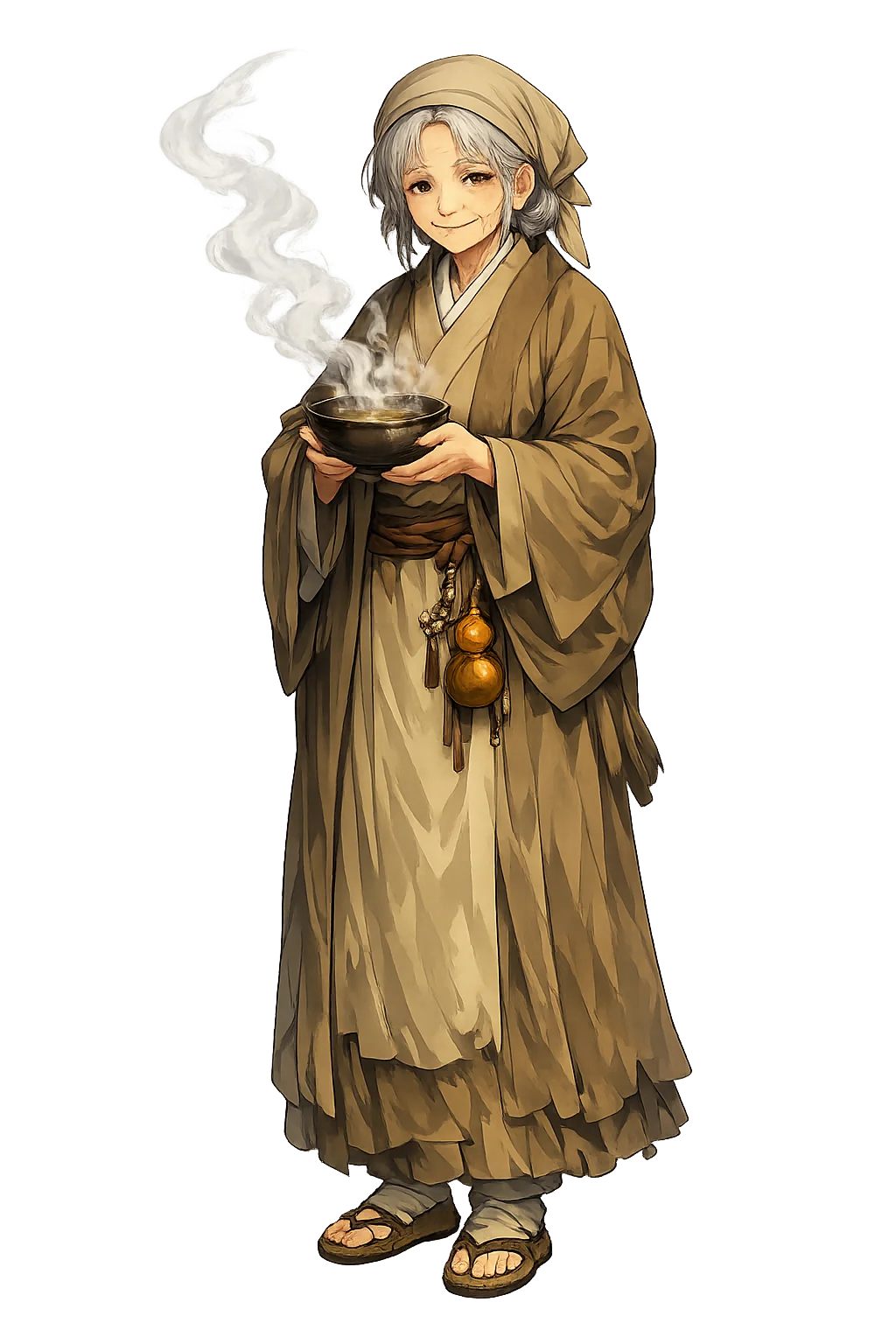
The hidden history behind Méngpó
Behind the modern ASCII form mengpo hides a much longer story. Méngpó reaches back through manuscripts, inscriptions, and oral tradition long before it ever touched a keyboard, and every mark in the restored spelling is a receipt from that journey. In what follows we trace the name from its Chinese characters attestations through its mythology, its cult, its symbols, and its afterlife in other cultures — and we show how the PuniCodex project turned that philological record into a Unicode domain that resolves today. The history was never lost. It was only waiting for the infrastructure to catch up.
At a Glance
- Restored name: Méngpó
- ASCII form: mengpo
- Meaning: "'Old Lady Meng' (孟婆), the goddess who brews the tea of forgetfulness"
- Domain of influence: Forgetting, Passage, Tea
- Pantheon: Chinese
- Classification: Tier 2
- Live domain: méngpó.com
Overview
Méngpó (mengpo) — The Tea at the Bridge — belongs to the Chinese tradition, where it is catalogued under the domain "Forgetting, Passage, Tea". The name means "'Old Lady Meng' (孟婆), the goddess who brews the tea of forgetfulness".
Mèngpó keeps the last station of the Chinese underworld: at the Nàihé Bridge, where souls cross to rebirth, she serves her five-flavored tea — and every soul that drinks forgets its life, its loves, and its griefs, clean for the next beginning.
PuniCodex restores the name as Méngpó and serves its temple at méngpó.com. The original preserves one prosodic feature — stress or vowel length — rather than both, which places the name in Tier 2. The plain ASCII form mengpo survives as a modern convenience imposed by the early domain-name system; the restoration, not the fallback, is the form the project defends as philologically complete.
The Name
No indigenous written attestation survives for this name; Méngpó is a scholarly transliteration of the reconstructed spoken form. Etymologically the name means "'Old Lady Meng' (孟婆), the goddess who brews the tea of forgetfulness".
The ASCII form mengpo survives only because the early domain-name system could not carry diacritics; it is a technological compromise, not an ancient spelling. The Unicode restoration Méngpó recovers the stress accent of the original directly in the address bar. The original preserves one prosodic feature — stress or vowel length — rather than both, which places the name in Tier 2.
The letter-by-letter transformation runs:
- m → M — Same letter
- e → é — Stress mark (acute/tone)
- n → n — Same letter
- g → g — Same letter
- p → p — Same letter
- o → ó — Stress mark (acute/tone)
The project holds the domain méngpó.com (xn--mngp-bpa7d.com) as the canonical home of this name.
The Original Script
The original script for this chinese name has not yet been added to PUNICODEX. The form shown is a scholarly transliteration.
The form Méngpó is therefore a scholarly transliteration rather than an attested ancient spelling; it encodes the reconstructed sound of the name for modern use, and no mark in it is decorative.
Written 孟婆: Mèng (eldest; a surname) above pó (old woman, with the woman radical). Her name appears in Ming and Qing fiction and in the vivid bureaucratic cosmologies of Chinese folk religion — a goddess documented by storytellers rather than canonized by councils.
Pronunciation
The reconstructed pronunciation of the name is /məŋ˥˩ pʰwo˧˥/ — Mandarin (Hanyu Pinyin with tones).
For the modern speaker, the closest approximation is: mung-pwoh, falling tone on Meng, rising on Po.
Kindred and historical forms of the name:
- Chinese — 孟婆
- Owned form — Mèngpó
Mèngpó 孟婆 means "Old Lady Meng": mèng in the falling tone, a surname suggesting seniority; pó, "grandmother, old woman," in the rising tone. The name belongs to folk religion rather than scripture — which is why its spelling never needed the scholar's precision the goddess herself so carefully erases.
Mythology
Mèngpó's myth is a single scene, retold for centuries: the old woman, the bridge, the bowl — the gentlest moment in the whole machinery of the afterlife.
The Last Station (The Office)
Chinese folk cosmology orders the underworld like an administration: Yánluó's ten courts judge the deeds of the life, assign the punishments and the repayments — and then send the soul to Mèngpó. At the Nàihé Bridge she ladles her tea of five flavors; the soul drinks, and the record of the life — the loves, the hatreds, the unfinished business — dissolves. Only then is it fit to be reborn.
Why She Serves (The Legend)
Folk tellings give her a biography: she was, some say, a woman of the mortal world who grieved her dead so deeply that heaven gave her this office — that no other soul need carry grief across the boundary. Others make her a wind-spirit of antiquity, or a servant of the underworld's lord promoted for her gentle hand. The variants agree on the point: the one who erases memory does it out of mercy, having known what memory costs.
Those Who Will Not Drink (The Refusal)
The tales always leave a door: a soul that refuses the tea, or spills it, carries fragments across — and is born with a birthmark, a déjà vu, a face it cannot forget. Chinese fiction is full of such revenants: lovers recognizing lovers across lifetimes, enemies resuming ancient quarrels, all because one soul at the bridge would not finish the bowl. Memory, in the folklore, is a debt carried by the stubborn.
Symbols & Iconography
The iconography associated with Méngpó concentrates in a small set of recurring attributes, each a compressed statement about the name:
- The teapot — Her instrument: oblivion brewed with care, not inflicted
- The bowl — The single serving every soul receives — neither more nor less
- The bridge — The crossing between judgment and rebirth, where memory ends
Archaeology & Evidence
A folk goddess has no canonical temple archive, but her cosmology has monuments: the Fengdu ghost city on the Yangtze — China's "capital of the underworld" — preserves the Nàihé Bridge in stone, crossed by pilgrims and tourists for centuries, with its three arches for the virtuous, the ordinary, and the damned. Ming-Qing underworld scroll-paintings and the woodblock illustrations of the Jade Record (Yùlì) show her at her station, ladle in hand, among the ten courts' bureaucrats.
Her geography is the geography of judgment. At Fengdu, the ghost-city on the Yangtze, the Nàihé Bridge stands in stone — three arches, for the virtuous, the ordinary, and the wicked — and pilgrims have crossed it for centuries as a rehearsal for the real crossing. The Ten Kings temples of late imperial China and the underworld scrolls of the Ningbo workshops place her at her station between the fifth court and rebirth. In modern Taiwan and the mainland temple revival, her shrine stands where the folk cosmology puts her: at the exit of the courts, ladle in hand.
Realm & Domain
Mèngpó keeps the last station of the Chinese underworld: at the Nàihé Bridge, where souls cross to rebirth, she serves her five-flavored tea — and every soul that drinks forgets its life, its loves, and its griefs, clean for the next beginning.
The Five Flavors
Sweet, sour, bitter, pungent, salty — the whole of a life, steeped into one last cup.
Nàihé Bridge
The "Bridge of No Alternative": every soul crosses, and none crosses back remembering.
The Records
Yánluó's courts judge the life; her tea releases it — bureaucracy's final kindness.
The River of Forgetfulness
China's own Lethe — the waters beneath the bridge that wash the old self away.
Across Cultures
She is the folk fusion at its most organic: Buddhist rebirth doctrine, Daoist underworld bureaucracy, and village storytelling meet in her bowl. Comparative scholars line her up beside Lethe — the Greek river of forgetfulness the dead must drink — noting that two civilizations independently decided memory cannot survive rebirth. In modern Chinese media she has become a star: films, songs, and web novels cast her as the melancholy romantic of the underworld, the goddess who remembers everything precisely so that others may forget.
Within the Chinese tradition, closely related names in the corpus include [[bagua|Bāguà]], [[fuxi|Fúxī]], [[guanyin|Guānyīn]], [[long|Lóng]], [[nuwa|Nǚwā]], and [[pangu|Pángǔ]].
Cultural Legacy
"Mèngpó's soup" (孟婆汤) is a living idiom for oblivion — offered ruefully at partings and breakups across the Chinese internet. Her imagery saturates East Asian popular culture: the Nàihé Bridge scene is a fixture of afterlife drama from opera to anime-adjacent fantasy. The deeper legacy is conceptual: she embodies a mercy the modern world debates — whether healing requires forgetting — and gives the debate a face, a bridge, and a bowl.
The Scholarly Record
The account of Méngpó given in this edition rests on the witnesses and reference works listed below. Lexica and etymological dictionaries secure the form and meaning of the name; the literary and religious texts supply the narrative evidence.
- Chinese folk religion (regional cults and underworld traditions), documented across temple and funerary practice, ongoing.
- Chinese folklore, Oral and compiled folk tales, various.
- Stephen F. Teiser, The Ghost Festival in Medieval China, Princeton University Press, 1988.
- Anne Birrell, Chinese Mythology: An Introduction, Johns Hopkins University Press, 1993.
- Chinese Buddhist texts (Hanwen Canon), CBETA / Taishō Tripiṭaka, 400. Full text
- Fēngshén Yǎnyì (Investiture of the Gods), various; English abridgment as Creation of the Gods, 1600.
A Meditation
Mèngpó is the goddess of letting go. Every tradition knows that some memories are poison; she alone made the antidote an act of hospitality — a cup of tea, served by a grandmother, at the bridge. She asks the question every grief eventually reaches: what would it cost you to forget — and what would it cost you to remember forever?
Her bowl is the folk answer to a question philosophy never settled: whether a person is their memories. The underworld's mercy is also its amnesty — the murderer and the mother drink alike, and both are reborn unburdened. We moderns keep our records differently: nothing is forgotten, everything is archived. She stands at the bridge asking the question the digital age most needs: what is forgiveness, if not a permission to forget — and who will serve the tea?
The Unicode Restoration
Méngpó is classified as Tier 2: the original preserves at least one philological feature that ASCII cannot encode. The ASCII fallback mengpo still resolves everywhere, but it is the restored form that carries the name's full information. Across the 6 characters of the name, the restoration adjusts 2: 2 marks of stress (é, ó). That is the whole thesis of this temple: the marks are the message.
Character by Character
The journey from mengpo to Méngpó, one character at a time:
- m → M — Same letter
- e → é — Stress mark (acute/tone)
- n → n — Same letter
- g → g — Same letter
- p → p — Same letter
- o → ó — Stress mark (acute/tone)
The Domain Name
The restored name is live as a working domain: méngpó.com, which the DNS carries in punycode form as xn--mngp-bpa7d.com — an ASCII-compatible encoding that lets a non-ASCII name travel the global network without breaking older infrastructure. The visitor sees Méngpó; the machines see the encoding. That duality is the engineering compromise on which the entire restoration rests, and it is why a name written the way its own tradition wrote it in Chinese characters can now be typed into any browser on earth.
The Chinese Pantheon
Méngpó is one of 46 entries the PuniCodex lexicon catalogues under the Chinese pantheon. The Pantheon page gathers the tradition's major figures in one place, and the Lexicon lets you filter all 915 restorations by tradition, tier, or script — the fastest way to see where this name sits among its kin.
Frequently Asked Questions
What does Méngpó mean? The traditional gloss is "'Old Lady Meng' (孟婆), the goddess who brews the tea of forgetfulness."
Which tradition does Méngpó belong to? Méngpó is catalogued in the Chinese pantheon of the PuniCodex lexicon.
Why is Méngpó classified as Tier 2? Because the original preserves at least one philological feature that ASCII cannot encode — and the marks in the restored spelling preserve exactly that evidence.
Is Méngpó a working domain? Yes — méngpó.com resolves today and routes to this temple.
What is the punycode for méngpó.com? The DNS encoding is xn--mngp-bpa7d.com; browsers perform the translation automatically, so visitors only ever see the restored name.
Typing Méngpó
You do not need a special keyboard to use this restoration. The PuniCodex Type Tool converts the ASCII form mengpo into Méngpó as you type, and the browser extension offers the same conversion inside any text field. Copy the restored form, paste it into the address bar, and the DNS does the rest.
Sister Temples
Other temples in the Chinese pantheon include Jiǔhuá, Kūnlún, and Lánlíng — each with its own restoration story, its own scholarly record, and its own place in the lexicon.
Why This Restoration Matters
The story of Méngpó did not end in antiquity; it changed medium. Names that survive for millennia do so because each generation finds a new carrier for them — clay, papyrus, print, and now DNS. The PuniCodex restoration simply makes the carrier honest: the spelling that resolves is the spelling the evidence supports. If this post showed anything, it is that mengpo and Méngpó are not the same name with different styling. They are a summary and the text it summarizes. The web can now serve the text.
Explore Further
This post is one doorway into the temple. The home page carries the full character breakdown and the ambient canvas; the lore page tells the myths in long form; the Scholarly Edition preserves the sources, pronunciation data, and revision history; and the patron wall supports the restoration directly. For the wider map, browse the Lexicon, explore the Pantheon, or return to the PuniCodex blog.
Related Names
Sources
The full scholarly apparatus — every citation, revision, and review — lives in the Scholarly Edition. Key references for this post:
- Journey to the West (Xīyóu Jì), Ming dynasty printed edition, 1592.
- Chinese Buddhist texts (Hanwen Canon), CBETA / Taishō Tripiṭaka, 400.
- Chinese folk religion (regional cults and underworld traditions), documented across temple and funerary practice, ongoing.
- Chinese folklore, Oral and compiled folk tales, various.
- Stephen F. Teiser, The Ghost Festival in Medieval China, Princeton University Press, 1988.
- The Fengdu temple records; Teiser, Ten Kings.
- Lexicon authorities for this entry: Journey to the West, Chinese folk religion, Werner.