
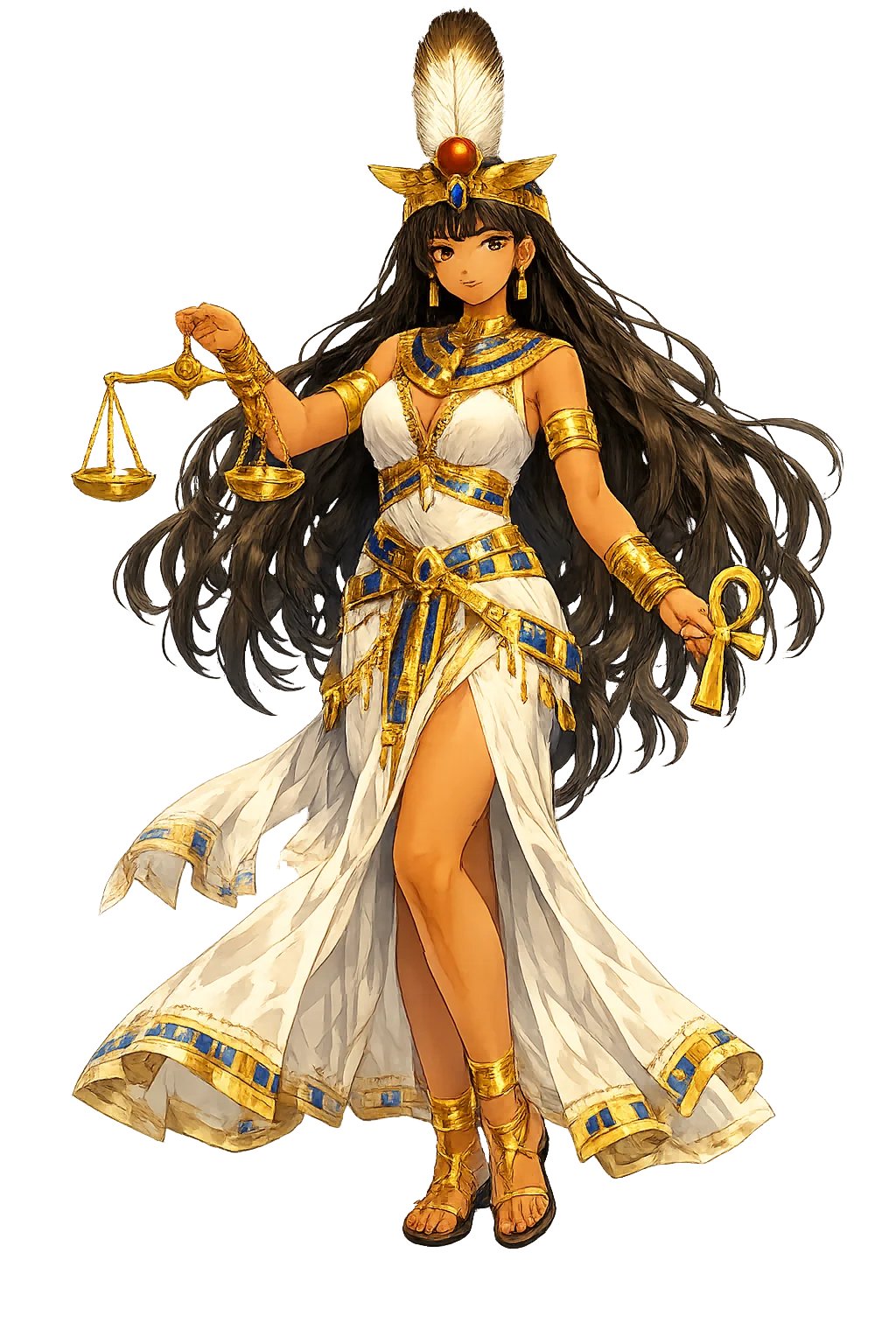
The appointments Mꜣꜥt made — and who is keeping them
The mistake is reading myths as entertainment. Mꜣꜥt's cycle reads more like a charter — each story assigning a duty the modern world still pays for.
At a Glance
- Temple: Mꜣꜥt
- Pantheon: Egyptian
- Domain of influence: Truth, Justice, Order
- Pattern seats: 5
- Sectors touched: Commerce & Governance · Home & Lifestyle · Energy & Natural World · Society & Spirit · Technology & Innovation
- Strongest seat: Legal, Justice & Compliance
- Series: The Resonance Files, No. 144 of 271
The Cycle, Read Forward
Legal, Justice & Compliance — through Maat at the Creation of the World
In Egyptian cosmogonic texts, Maat comes into being at the very first moment of creation. The Memphite Theology preserved on the Shabaka Stone describes Ptah conceiving the world through the heart's thought and the tongue's command, with Maat as the ordering principle that makes creation stable.
The atlas states the seat in one line: Truth, justice, and order; the feather against which every heart is weighed. The story above is the long version of the same sentence. Industries do not invent their archetypes; they inherit them and call them best practice.
Architecture & Spatial Design — through The Weighing of the Heart
The most famous scene in Egyptian funerary religion shows the heart of the deceased being weighed on a balance against the feather of Maat. The ibis-headed god Thoth records the result, while the monstrous Amemet, “the Devourer,” waits nearby to consume those whose hearts prove heavy with sin.
The atlas states the seat in one line: Her plumb line set the cosmic axes of the temples; straightness is her hieroglyph and the builder's creed. The story above is the long version of the same sentence. The trade thinks it is optimizing a process. It is re-enacting a charter.
Environmental & Climate Services — through The Return of the Distant Eye
In the myth of the Destruction of Mankind, Re grows weary of human rebellion and sends his fierce Eye—often identified with Sekhmet or Hathor—to punish the earth. Her violence is so thorough that the gods fear nothing mortal will survive; they trick her into drunkenness by flooding the fields with beer dyed red like blood.
The atlas states the seat in one line: The balance that keeps the Nile within its banks; ecological harmony was her portfolio before the word existed. The story above is the long version of the same sentence. Industries do not invent their archetypes; they inherit them and call them best practice.
Philosophy, Ethics & Standards — through Maat at the Creation of the World
In Egyptian cosmogonic texts, Maat comes into being at the very first moment of creation. The Memphite Theology preserved on the Shabaka Stone describes Ptah conceiving the world through the heart's thought and the tongue's command, with Maat as the ordering principle that makes creation stable.
The atlas states the seat in one line: Truth weighed against a feather; ethics made measurable. The story above is the long version of the same sentence. That is the cycle working: story becomes duty, duty becomes trade.
The Theme That Runs the Cycle
Mꜣꜥt is the Egyptian cosmos made moral. She is truth, straightness, the even plumb line, the feather against which the heart is weighed, and the divine order that keeps the sun on course and the Nile within its banks. Unlike a law code, Maat is a state of being: the king upholds her, the priest recites her, the scribe writes her, and the justified dead speak her name before the gods. To live in Maat is to move in harmony with the structure of reality itself. Maat's principle governed law, astronomy, architecture, and ethics. Temples were oriented to cosmic axes, judgments weighed against her feather, and kings ruled as her deputies. Even Akhenaten's solar revolution phrased itself in Maat's language, demonstrating that the concept was too fundamental to be overthrown, only reinterpreted.
The Method, Stated Plainly
Skeptical? Good — the system is built for you. Every seat in this file carries its why-line and its weight, the full derivation is public at the methodology page, and the challenge process is part of the design. Falsifiable is not a posture here; it is the mechanism.
For the Ones Who Work There
If you work in legal, justice & compliance, architecture & spatial design, or any trade this temple holds a seat in, this is the honest version of what a placement means: your industry beside the story it has been re-telling all along — on the temple floor itself, before an audience that came specifically to read it. The patron tier and the advertising terms describe the mechanics; the resonance above describes the fit.
The File Continues
One of 271 Resonance Files — the series where the pantheon goes to work. Read the founding dispatch for the name, the Restoration File for the spelling, or the whole archive end to end.
Continue the series — previous: Mꜥ (read it) · next: Manannán (read it).
The Resonance Files are argued from the same canonical record as the pattern atlas itself: the lexicon, the lore catalog, and the cited sources. Every seat can be challenged at the methodology page — and the challenge is the point.