
Pronouncing Mꜣꜥt: a guide for the curious
Saying Mꜣꜥt aloud is harder than reading it on a screen, and more rewarding. The restored spelling is a compressed pronunciation guide: every accent and macron is an instruction. This post unpacks those instructions — the reconstructed sound, the phoneme-by-phoneme record, the kindred forms in neighboring languages — and then zooms out to the full record around the name: its Hieroglyphs writing, its mythology, its cult, and its modern life as a Unicode domain. Whether you arrive as a linguist, a reader of myth, or a domainer, you will leave able to say the name the way the evidence suggests it was said — and able to type it the way it was written.
At a Glance
- Restored name: Mꜣꜥt
- ASCII form: maat
- Meaning: "Truth, straightness (Egyptian mꜣꜥt)"
- Domain of influence: Truth, Justice, Order
- Pantheon: Egyptian
- Classification: Tier 2
- Original script: 𓁦 (Hieroglyphs)
- Live domain: Mꜣꜥt.com
Overview
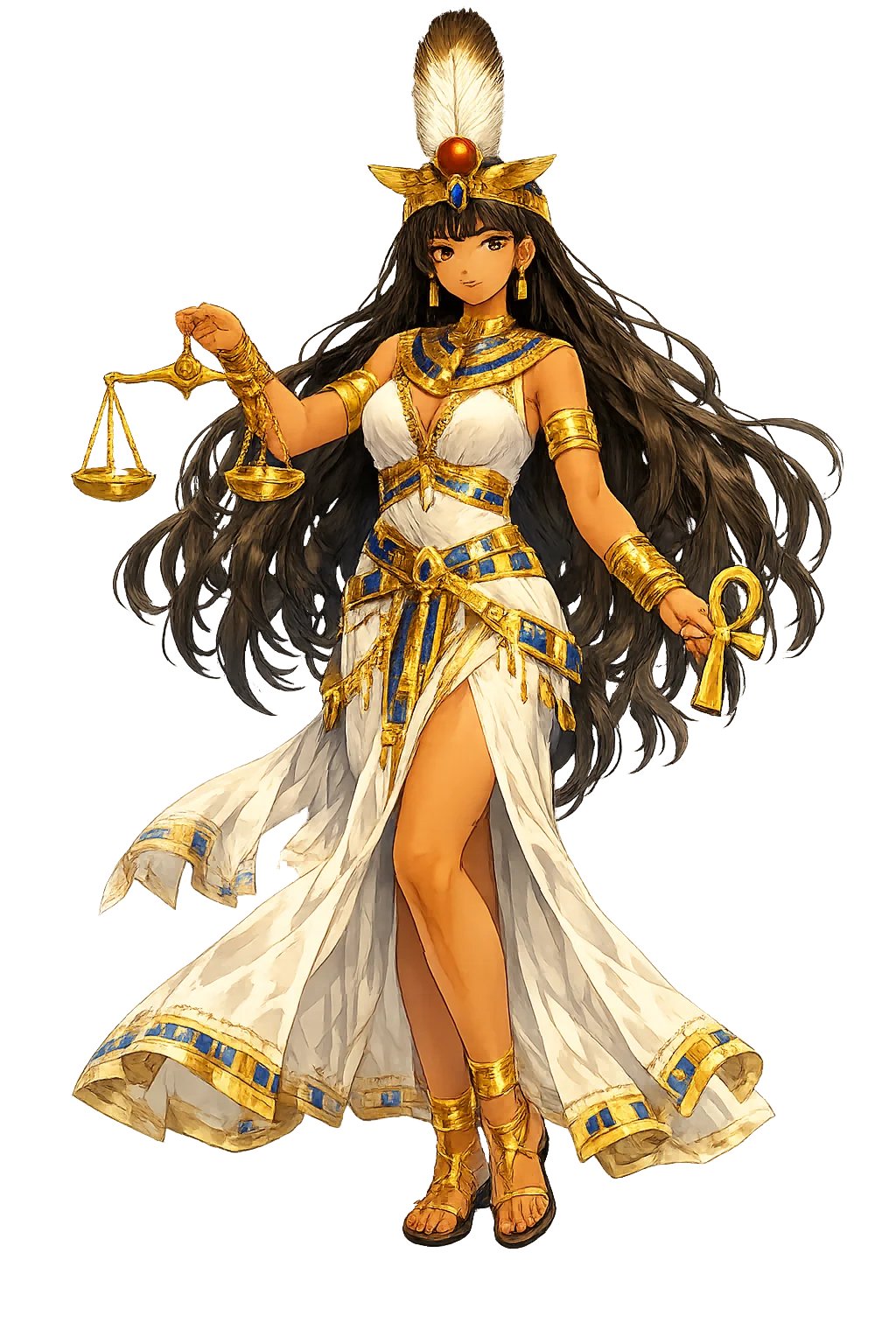
Mꜣꜥt (maat) is the Egyptian concept of truth, justice, and cosmic order personified as a goddess. The noun mꜣꜥt derives from the verb mꜣꜥ 'to be straight, level, true', and denotes both an ethical standard — the rightness against which every life is measured — and the physical order of the created world: the regular Nile flood, the solar circuit, and the legitimate reign.
As a goddess she is the daughter of Rꜥ and travels in his solar barque, and she is the standard of the funerary tribunal: in Book of the Dead Spell 125 the heart of the dead is weighed against her feather. The king's central ritual gesture is the presentation of a small figure of Maat to the gods, returning order to its divine source.
PuniCodex restores the name as Mꜣꜥt, preserving the Egyptological alef (ꜣ) and ayin (ꜥ) of the standard transliteration, and serves its temple at Mꜣꜥt.com. The plain ASCII form maat is a modern technological fallback, not an ancient spelling; the restoration preserves a single class of diacritic detail — its marked consonants — rather than both stress and vowel length, which places the name in Tier 2.
The Name
The name is attested in Hieroglyphs as 𓁦 (Gardiner C10, the seated goddess wearing the feather). Etymologically mꜣꜥt is the abstract noun of the verb mꜣꜥ 'to be straight, level, true'; its core meanings are 'truth, rightness, justice, order', and the hieroglyphic spelling records consonants only.
The ASCII form maat survives only because the early domain-name system could not carry diacritics; it is a technological compromise, not an ancient spelling. The Unicode restoration Mꜣꜥt recovers the full diacritic detail of the scholarly transliteration directly in the address bar. The name preserves a single class of diacritic detail — its marked consonants — rather than both stress and vowel length, which places it in Tier 2.
The letter-by-letter transformation runs:
- m → M — Same
- a → ꜣ — Alef: glottal stop
- a → ꜥ — Ayin: pharyngeal fricative
- t → t — Same
The canonical temple for this name is served at Mꜣꜥt.com (xn--mt-sq8hia.com).
Etymology & Roots
The recorded derivation reads: From Egyptian mꜣꜥt 'truth, justice, order', abstracted from the verb mꜣꜥ 'to be true, straight'; the hieroglyphic spelling records consonants only.
The root gloss is "truth, straightness."
The reconstruction is classed as attested.
The Original Script
The name is preserved in Hieroglyphs as 𓁦 — Egyptian hieroglyphic, attested from the Old Kingdom to Late Antiquity (c. 2600 BCE – 400 CE) in Egypt. The script is written right-to-left or top-to-bottom.
The scholarly transliteration is Mꜣꜥt (Egyptological convention). The original vocalisation is unknown; the conventional reading is /ˈmɑː.ʕɑːt/, reconstructed from Coptic and comparative evidence.
The rendering proceeds step by step:
- The Egyptian name is written 𓁦 in hieroglyphs — a single logogram showing the seated, feather-wearing goddess (Gardiner C10).
- Hieroglyphs combine logograms, phonograms, and determinatives; the exact function of each sign depends on context.
- Egyptian writing does not record vowels; the vocalised form is a modern convention.
- The Unicode restoration Mꜣꜥt uses Egyptological alef/ayin and other registrable characters; the hieroglyphic form is not registrable in .com.
Pronunciation
The reconstructed pronunciation of the name is /maʕʔaːt/ — Egyptological Reconstruction.
Phoneme by phoneme:
- m — Bilabial nasal [m], the first consonant of the word mꜣꜥt
- ꜣ — Glottal stop [ʔ], Egyptological alef; some scholars vocalise this as a light 'a' glide
- ꜥ — Voiced pharyngeal fricative [ʕ], the ayin that gives the root its throaty core
- -t — Voiceless alveolar stop [t], the feminine ending that turns the verbal root into the abstract noun 'truth'
For the modern speaker, the closest approximation is: 'mah-ʿAHT' — a soft 'm', a deep throaty 'ah' in the middle, and a crisp final 't'.
Kindred and historical forms of the name:
- Egyptian — mꜣꜥt, the standard hieroglyphic spelling of Maat with the feather of truth
- Coptic — ⲙⲉ (me), also ⲙⲏⲉ (mēe), 'truth, righteousness', the late Egyptian reflex of mꜣꜥt
- Greek — no Greek rendering of the name is attested; Greek authors left Maat untranslated, though later scholars have compared her to dikē (justice)
Mꜣꜥt is a Tier-2 restoration of a consonantal Egyptian word. The Egyptological alef (ꜣ) and ayin (ꜥ) are both preserved, marking two different throat sounds that English lacks. The final -t is the feminine abstract ending; the word literally means 'straightness' or 'rightness'.
Mythology
Mꜣꜥt is the Egyptian cosmos made moral. She is truth, straightness, the even plumb line, the feather against which the heart is weighed, and the divine order that keeps the sun on course and the Nile within its banks. Unlike a law code, Maat is a state of being: the king upholds her, the priest recites her, the scribe writes her, and the justified dead speak her name before the gods. To live in Maat is to move in harmony with the structure of reality itself. Maat's principle governed law, astronomy, architecture, and ethics. Temples were oriented to cosmic axes, judgments weighed against her feather, and kings ruled as her deputies. Even Akhenaten's solar revolution phrased itself in Maat's language, demonstrating that the concept was too fundamental to be overthrown, only reinterpreted.
Maat at the Creation of the World (Cosmogony)
In Egyptian cosmogonic texts, Maat comes into being at the very first moment of creation. The Memphite Theology preserved on the Shabaka Stone describes Ptah conceiving the world through the heart's thought and the tongue's command, with Maat as the ordering principle that makes creation stable. Other hymns say that Re “lives on Maat” each morning, feeding upon her as nourishment. Without Maat, the sun would not rise, the stars would stray, and the chaos that existed before the world would rush back in.
The Weighing of the Heart (Judgment)
The most famous scene in Egyptian funerary religion shows the heart of the deceased being weighed on a balance against the feather of Maat. The ibis-headed god Thoth records the result, while the monstrous Amemet, “the Devourer,” waits nearby to consume those whose hearts prove heavy with sin. This is not merely a legal trial but a metaphysical test: the heart must be light because it has lived in accordance with the straightness Maat represents. Those who pass are declared true of voice and admitted to the company of the gods.
Kings throughout Egyptian history presented small images of Maat to the gods in temple ritual, symbolically restoring cosmic order to its source. The act declared that the pharaoh's reign was not tyranny but stewardship: he kept the world aligned with Maat so that Maat could keep the world in being.
The Return of the Distant Eye (Cosmogony)
In the myth of the Destruction of Mankind, Re grows weary of human rebellion and sends his fierce Eye—often identified with Sekhmet or Hathor—to punish the earth. Her violence is so thorough that the gods fear nothing mortal will survive; they trick her into drunkenness by flooding the fields with beer dyed red like blood. When the frenzy subsides, Maat is restored to the divine king and the world is re-established on its proper foundation. The story dramatizes Maat not as static balance but as the active restoration of harmony after divine wrath has threatened to unmake creation.
Symbols & Iconography
The iconography associated with Mꜣꜥt concentrates in a small set of recurring attributes, each a compressed statement about the name:
- Ostrich feather — The feather of truth weighed against the heart in the judgement hall
- Set-scales — The balance on which the heart is tested before Osiris
- Kneeling goddess with feather — Maat as the personification of cosmic order, often shown kneeling or winged
- Primeval mound (benben) — The first land rising from chaos, ordered by the presence of Maat
- Pharaoh offering Maat — The ritual gesture by which the king upholds truth and renews the cosmos
Archaeology & Evidence
No independent temple of Maat is archaeologically attested; her cult was exercised inside the sanctuaries of other gods, and the chief priestly title she generated was the vizier's 'priest of Maat' (ḥm-nṯr mꜣꜥt), binding the highest judge of the land to her name.
The material record is nonetheless dense. Temple reliefs from the New Kingdom onward show the kneeling king presenting a small figure of Maat to the gods — the so-called 'offering of Maat' — and royal statuary was recovered in quantity from the Karnak cachette excavated by Georges Legrain in 1903–1907. Funerary papyri such as those of Ani and Hunefer fixed the vignette of her feather on the scales, while the Instruction of Ptahhotep and the Instruction of Amenemope anchor the concept in daily ethics.
Realm & Domain
The noun mꜣꜥt names the straightness that holds both cosmos and society together; its documented spheres — judgement, kingship, ritual, and daily ethics — run from the Old Kingdom to the Roman period.
Feather of Truth
The heart of the deceased is weighed against Maat's feather; only the light heart passes the tribunal.
Cosmic Order
Re "lives on Maat" each morning; without her, the sun would not rise and chaos would rush back in.
Straightness
Maat is the plumb line, the even measure, the straight path that kings, priests, and scribes must keep.
Kingly Offering
Pharaohs presented small figures of Maat to the gods, ritually restoring order to its divine source.
Across Cultures
Maat's combinations were internal to Egyptian theology rather than with foreign gods. In the solar barque she travels with Rꜥ as his daughter, and late temple theology regularly pairs her with Thoth: Thoth 'acts with Maat', and the two stand together at the judgement. The tribunal itself is named the Hall of the Two Truths (wśḫt mꜣꜥty), doubling the goddess into the 'Two Maats'.
No equation of Maat with a Greek or Roman deity is attested in the classical sources; Greek writers, who matched Amun with Zeus and Thoth with Hermes, left her untranslated. The comparison with Greek dikē (justice) and themis (established order) is a modern scholarly analogy, not an ancient syncretism.
Kindred figures in the PuniCodex cross-tradition index include Šamaš and Ṣàngó, each linked through justice, law, and truth.
Cultural Legacy
The word never died with the temples: Coptic, the last stage of the Egyptian language, preserved mꜣꜥt as ⲙⲉ / ⲙⲏⲉ (me, mēe), 'truth, righteousness', the ordinary word by which Coptic translators rendered Greek alētheia and dikaiosynē in the Bible.
In modern scholarship Maat anchors the study of Egyptian ethics — the verdict mꜣꜥ-ḫrw 'true of voice' remains the standard term for the justified dead — and the concept has been taken up well beyond Egyptology: the feather-and-scales image circulates as an emblem of justice, and Afrocentric and Kemetic movements invoke Maat and her forty-two principles as a classical African philosophy of moral order.
Restoring Mꜣꜥt in Unicode preserves the name's cultural specificity — the alef and ayin that English lacks — against the flattening force of plain ASCII.
The Scholarly Record
The account of Mꜣꜥt given in this edition rests on the witnesses and reference works listed below. The lexica secure the form and meaning of the name; the religious corpora supply the narrative and ritual evidence; the modern monographs frame the concept.
- Faulkner, R. O. The Ancient Egyptian Pyramid Texts. Oxford: Clarendon, 1969.
- Faulkner, R. O. The Ancient Egyptian Coffin Texts. Warminster: Aris & Phillips, 1973–1978.
- Faulkner, R. O. (trans.); Andrews, C. (ed.). The Ancient Egyptian Book of the Dead. London: British Museum Press, 1985 (Spells 15 and 125; Papyrus of Ani, BM EA 10470).
- Erman, A. & Grapow, H. Wörterbuch der ägyptischen Sprache, vol. II, s.v. mꜣꜥt.
- Assmann, J. Ma'at: Gerechtigkeit und Unsterblichkeit im Alten Ägypten. Munich: C. H. Beck, 1990.
- Lichtheim, M. Ancient Egyptian Literature, vols. I–II. Berkeley: University of California Press, 1973–1976 (Memphite Theology; Destruction of Mankind; Amenemope).
- Karenga, M. Maat, The Moral Ideal in Ancient Egypt. Los Angeles: University of Sankore Press, 2004.
A Meditation
To contemplate Mꜣꜥt is to confront a civilisation's wager that ethics and physics are one thing. The plumb line that makes a wall true and the honesty that makes a verdict true are the same word; the feather light enough to ride the wind is heavy enough to outweigh a guilty heart. Egyptian thought located this unity not in statute but in the structure of the real, so that every act of straight measurement — of grain, of land, of speech — was a small enactment of the cosmos.
The restored spelling slows the eye. Between the two throat consonants of Mꜣꜥt lies the difference between 'truth' as an English abstraction and a word that meant, before everything else, that something is level.
The Unicode Restoration
Mꜣꜥt is classified as Tier 2: the original preserves at least one philological feature that ASCII cannot encode. The ASCII fallback maat still resolves everywhere, but it is the restored form that carries the name's full information. Across the 4 characters of the name, the restoration adjusts 2: 2 further adjustments (ꜣ, ꜥ). That is the whole thesis of this temple: the marks are the message.
Character by Character
The journey from maat to Mꜣꜥt, one character at a time:
- m → M — Same
- a → ꜣ — Alef: glottal stop
- a → ꜥ — Ayin: pharyngeal fricative
- t → t — Same
The Domain Name
The restored name is live as a working domain: Mꜣꜥt.com, which the DNS carries in punycode form as xn--mt-sq8hia.com — an ASCII-compatible encoding that lets a non-ASCII name travel the global network without breaking older infrastructure. The visitor sees Mꜣꜥt; the machines see the encoding. That duality is the engineering compromise on which the entire restoration rests, and it is why a name written the way its own tradition wrote it in Hieroglyphs can now be typed into any browser on earth.
The Egyptian Pantheon
Mꜣꜥt is one of 66 entries the PuniCodex lexicon catalogues under the Egyptian pantheon. The Pantheon page gathers the tradition's major figures in one place, and the Lexicon lets you filter all 895 restorations by tradition, tier, or script — the fastest way to see where this name sits among its kin.
Frequently Asked Questions
What does Mꜣꜥt mean? The traditional gloss is "Truth, straightness (Egyptian mꜣꜥt)."
Which tradition does Mꜣꜥt belong to? Mꜣꜥt is catalogued in the Egyptian pantheon of the PuniCodex lexicon.
Why is Mꜣꜥt classified as Tier 2? Because the original preserves at least one philological feature that ASCII cannot encode — and the marks in the restored spelling preserve exactly that evidence.
Is Mꜣꜥt a working domain? Yes — Mꜣꜥt.com resolves today and routes to this temple.
What is the punycode for Mꜣꜥt.com? The DNS encoding is xn--mt-sq8hia.com; browsers perform the translation automatically, so visitors only ever see the restored name.
Why This Restoration Matters
Pronunciation turns out to be the heart of the matter. The marks in Mꜣꜥt are instructions for the voice, and a web that strips them is a web that mispronounces the past at scale. The restoration hands the instructions back: say it as the evidence suggests, type it as the tradition wrote it, and let the punycode machinery do the quiet translation in between. That is all the PuniCodex project asks of the infrastructure — and everything it asks of you, the reader, is to use the whole name.
Explore Further
This post is one doorway into the temple. The home page carries the full character breakdown and the ambient canvas; the lore page tells the myths in long form; the Scholarly Edition preserves the sources, pronunciation data, and revision history; and the patron wall supports the restoration directly. For the wider map, browse the Lexicon, explore the Pantheon, or return to the PuniCodex blog.
Related Names
Sources
The full scholarly apparatus — every citation, revision, and review — lives in the Scholarly Edition. Key references for this post:
- James P. Allen, Middle Egyptian: An Introduction to the Language and Culture of Hieroglyphs, Cambridge University Press, 2000.
- Assmann, J. Ma'at: Gerechtigkeit und Unsterblichkeit im Alten Ägypten. Munich: C. H. Beck, 1990.
- Faulkner, R. O. (trans.); Andrews, C. (ed.). The Ancient Egyptian Book of the Dead. London: British Museum Press, 1985 (Spell 125).
- Erman, A. & Grapow, H. Wörterbuch der ägyptischen Sprache, vol. II, s.v. mꜣꜥt.
- Faulkner, R. O. A Concise Dictionary of Middle Egyptian. Oxford: Griffith Institute, 1962, s.v. mꜣꜥt.
- Lexicon authorities for this entry: Faulkner, Wb.