
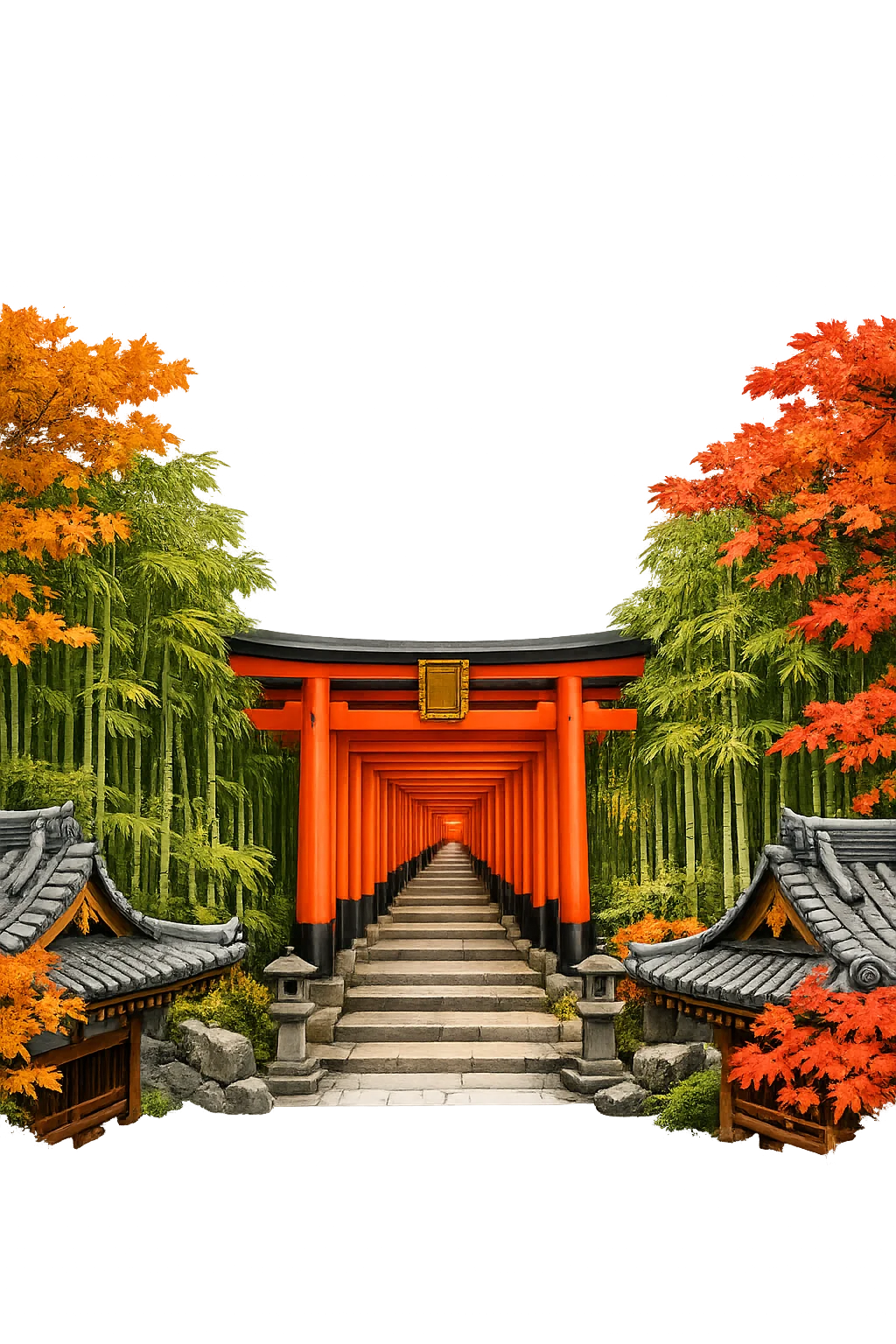
The provenance file on Kyōto
The provenance file for Kyōto. Nothing here is unsourced; that is what the file is for.
Provenance
1. The attestation. 京都 — "Capital city". On record: Japan Ministry of Land, Infrastructure, Transport and Tourism, Heian-kyō heritage, UNESCO World Heritage Centre, Historic Monuments of Ancient Kyoto, Kyoto City Official Travel Guide, Japan Experience, Heian-jingū.
2. The preserved evidence. o → ō (Macron: long vowel) — absent from the ASCII form kyoto, present in the restoration, verifiable against the sources above.
3. The narrative record. Heian-kyō, the Capital of Peace — In 794 CE Emperor Kammu moved the court from Nagaoka-kyō to a new site modelled on the Tang-dynasty capital Chang'an. He named it Heian-kyō, 'Capital of Peace and Tranquillity' — the city we now call Kyōto. Guardians of the Four Directions — Kammu enlisted two local clans, the Hata and the Kamo, and established protective shrines at key geomantic points to shield the new capital from malign influences. Matsunoo Taisha and Fushimi Inari guarded the west and south-east, while the Kamo shrines — Shimogamo and Kamigamo — stood to the north.
4. The physical record. The Heian-kyō grid survives in Karasuma Street postholes and palace foundations excavated by the Kyoto City Archaeological Research Institute. The Daigokuden audience hall of the former imperial palace has been reconstructed on its archaeological footprint, while Kiyomizu-dera's wooden stage, Kinkaku-ji's golden pavilion, and the Kamo shrines' Tadasu no Mori forest anchor more than a millennium of imperial, Buddhist, and Shinto material culture.
5. The current holding. The temple at /sites/kyoto/, classified Tier 1. Tier-1 is not a compliment; it is a measurement. This restoration keeps something the ASCII form provably loses, and the measurement is repeatable.
6. The documented resonances. Travel, Tourism & Place Branding, Architecture & Spatial Design, Manufacturing, Craft & Automation — seats argued and weighted in the pattern atlas, read through the myths in this temple's Resonance File.
7. The primary sources. Kojiki, Nihon Shoki — the library this file answers to, open at the Sacred Texts collection.
8. The continuing record. Kyōto is the city modern Japan uses to remember itself. With seventeen UNESCO World Heritage sites, thousands of temples and shrines, and living traditions such as geiko districts, tea ceremony, and Noh, Kyōto is the material archive of pre-modern Japanese civilization.
At a Glance
- Restored name: Kyōto
- ASCII form: kyoto
- Meaning: "Capital city"
- Domain of influence: Imperial Capital, Kansai
- Pantheon: Japanese
- Classification: Tier 1
- Original script: 京都
- Series: The Restoration Files, No. 134 of 271
The File Continues
Read the founding dispatch for the name's full story, the Resonance File for the archetype at work — or the whole archive in one sitting.
Continue the series — previous file: Kṣitigarbha (read it here) · next file: Kyūshū (read it here).
The Restoration Files are written from the same canonical record as the temples themselves: the lexicon, the lore catalog, the pattern atlas, and the cited scholarly sources. If a file ever disagrees with its temple, the temple is right — tell us, and the file will be corrected.