
The many faces of Kyōto
No important name has only one face. Kyōto appears as a figure of myth, a scholarly reconstruction, a piece of material culture, a memory carried across languages, and — most recently — a Unicode domain. This post looks at each face in turn: the name and its roots, the Japanese characters original, the reconstructed pronunciation, the mythological record, the symbols and sanctuaries, the cross-cultural afterlife, and the engineering that lets the restored spelling resolve in a browser. Taken together, those faces explain why kyoto was never going to be enough — and why the restored form is worth a domain of its own.
At a Glance
- Restored name: Kyōto
- ASCII form: kyoto
- Meaning: "Capital city"
- Domain of influence: Imperial Capital, Kansai
- Pantheon: Japanese
- Classification: Tier 1
- Original script: 京都 (Japanese characters)
- Live domain: kyōto.com
Overview
Kyōto (kyoto) — Capital city — belongs to the Japanese tradition, where it is catalogued under the domain "Imperial Capital, Kansai". The name means "Capital city".
Kyōto was Japan's imperial capital from 794 to 1868, a city laid out on a Chinese grid and guarded by shrines at its four directions. It became the stage on which emperors, aristocrats, monks, and shoguns performed the art of traditional Japan.
PuniCodex restores the name as Kyōto and serves its temple at kyōto.com. The original carries both stress and vowel length, and exactly one historically valid Unicode restoration exists, which places the name in Tier 1. The plain ASCII form kyoto survives as a modern convenience imposed by the early domain-name system; the restoration, not the fallback, is the form the project defends as philologically complete.
The Name
The name is attested in Japanese characters as 京都. Etymologically it means "Capital city".
The reconstructed proto-form is 京都 (proto-sino-tibetan, "capital + city"). From Japanese 京都 "capital city"; the imperial capital for over 1,000 years.
The ASCII form kyoto survives only because the early domain-name system could not carry diacritics; it is a technological compromise, not an ancient spelling. The Unicode restoration Kyōto recovers the vowel length of the original directly in the address bar. The original carries both stress and vowel length, and exactly one historically valid Unicode restoration exists, which places the name in Tier 1.
The letter-by-letter transformation runs:
- k → K — Same
- y → y — Same
- o → ō — Macron: long vowel
- t → t — Same
- o → o — Short vowel
The project holds the domain kyōto.com (xn--kyto-m3a.com) as the canonical home of this name.
Etymology & Roots
The recorded derivation reads: From Japanese 京都 "capital city"; the imperial capital for over 1,000 years.
The reconstructed proto-form is 京都 (proto-sino-tibetan), glossed as "capital + city".
The reconstruction is classed as attested.
The Original Script
The name is preserved in Japanese characters as 京都 — Kanji (Sino-Japanese logographs), attested Heian – present, in Japan. The script is written left-to-right; traditional top-to-bottom.
The scholarly transliteration is Kyōto (Hepburn romanisation with macron), giving the normalized reading /kʲoːto/.
The rendering proceeds step by step:
- The name is written with the kanji 京都.
- Each kanji carries both a semantic meaning and Sino-Japanese (on'yomi) and native Japanese (kun'yomi) readings.
- Hepburn romanisation with macron marks long vowels, which the ASCII form loses.
- The Unicode restoration Kyōto is used for DNS because the kanji form is not supported in the .com IDN table.
Pronunciation
The reconstructed pronunciation of the name is /kjoːto/ — Hepburn Japanese Reconstruction.
Phoneme by phoneme:
- Kyō- — Palatalized [kʲ] followed by long close-mid back vowel [oː]; the macron marks the two-mora length that makes the name Tier 1.
- -to — Voiceless alveolar stop [t] plus short open back vowel [o], the Sino-Japanese word for 'capital'.
For the modern speaker, the closest approximation is: 'KYOH-toh' — the first syllable is long and lightly pitched; the second is short and unstressed.
Kindred and historical forms of the name:
- Sino-Japanese — 京都 (kyō-to), 'capital city', a compound borrowed from Chinese political vocabulary
- Old Japanese — Heian-kyō (平安京), 'capital of peace and tranquillity', the city's founding name in 794 CE
- Chinese — Chang'an (長安), the Tang capital whose grid plan inspired Heian-kyō's urban design
Kyōto is Tier 1 because the Hepburn restoration preserves the long vowel ō. Japanese pitch falls on the first mora, but the registrable form marks length rather than pitch, following the project's convention for Japanese entries.
Mythology
Kyōto was Japan's imperial capital for more than a thousand years, a city planned according to Chinese geomancy, guarded by shrines at its four directions, and later celebrated as the soul of traditional Japan. Its history is not merely administrative; it is a story of deliberate cosmic placement, aristocratic culture, and survival through war and modernization.
Heian-kyō, the Capital of Peace (Foundation)
In 794 CE Emperor Kammu moved the court from Nagaoka-kyō to a new site modelled on the Tang-dynasty capital Chang'an. He named it Heian-kyō, 'Capital of Peace and Tranquillity' — the city we now call Kyōto. The location was chosen with feng-shui geomancy in mind: mountains to the north, east and west, the Kamo River to the east, and a grid of avenues designed to mirror cosmic order. The Japanese Ministry of Land, Infrastructure, Transport and Tourism notes that this Chinese-inspired grid remains the skeleton of the modern city.
Guardians of the Four Directions (Sacred Geography)
Kammu enlisted two local clans, the Hata and the Kamo, and established protective shrines at key geomantic points to shield the new capital from malign influences. Matsunoo Taisha and Fushimi Inari guarded the west and south-east, while the Kamo shrines — Shimogamo and Kamigamo — stood to the north. These shrines still anchor Kyōto's sacred geography and are among the seventeen UNESCO World Heritage sites that define the city's historic landscape.
The Tale of Genji and the Aristocratic City (Heian Culture)
During the Heian period (794–1185) Kyōto became the stage for a court culture of extraordinary refinement. It was in this city that Murasaki Shikibu composed The Tale of Genji, often called the world's first novel, and that aristocrats competed in poetry, incense, and the courtly pursuits recorded in The Pillow Book of Sei Shōnagon. The imperial palace and the villas of the nobility turned the city into a work of art as much as a seat of government.
From Capital to Cultural Soul (Survival)
Political power shifted to Kamakura, then Edo, and finally to Tōkyō in 1868, yet Kyōto remained the symbolic heart of Japan. The Ōnin War (1467–1477) burned much of the medieval city, but Kyōto was rebuilt by Oda Nobunaga, Toyotomi Hideyoshi, and the Tokugawa shoguns. Spared from atomic bombing in 1945, it preserves more pre-modern architecture than any other Japanese city and was named a UNESCO World Heritage site in 1994.
Symbols & Iconography
The iconography associated with Kyōto concentrates in a small set of recurring attributes, each a compressed statement about the name:
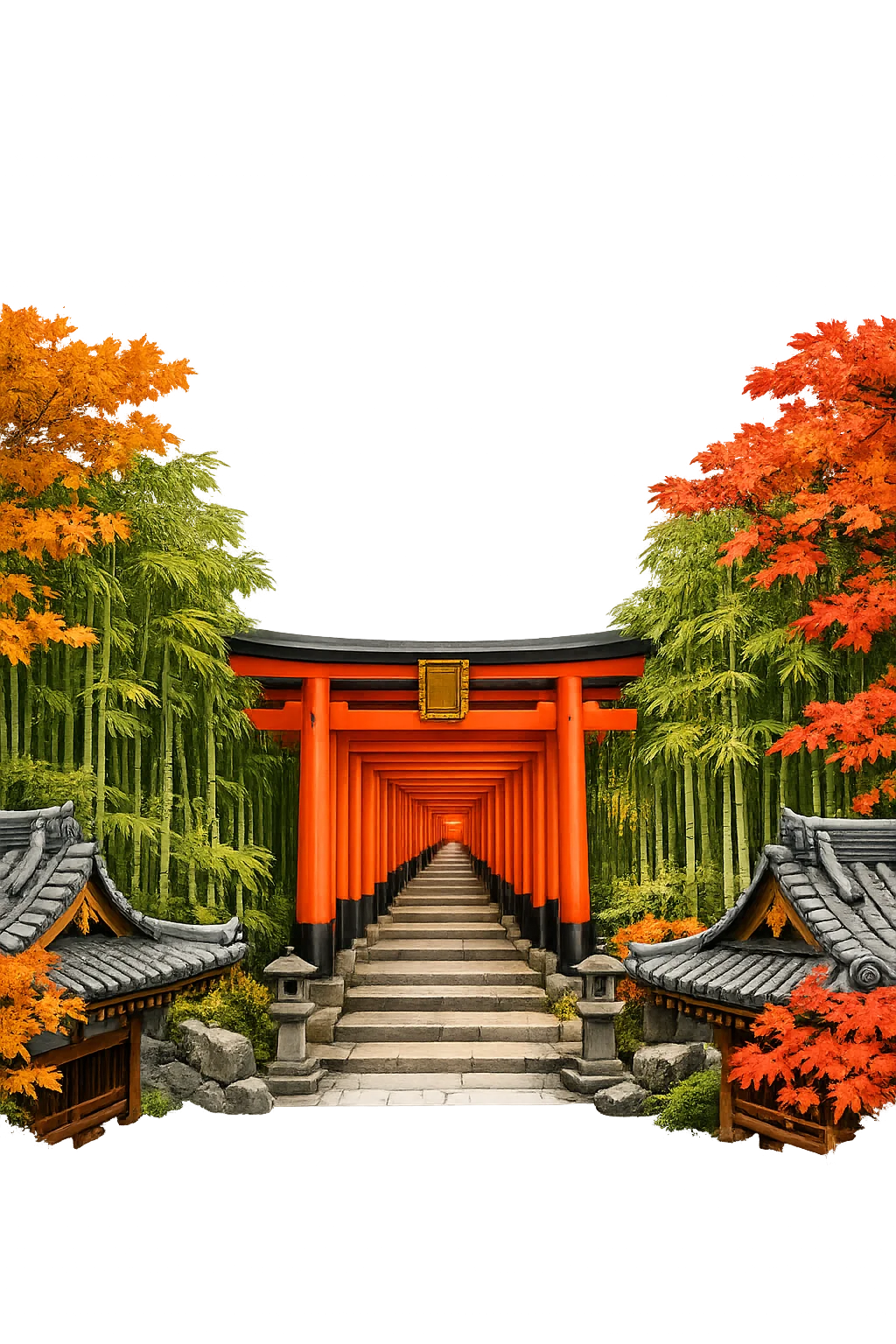
- Torii — At Fushimi Inari Taisha thousands of donated vermilion gates, the senbon torii, tunnel up the mountain behind the shrine, each inscribed with the name of the business that offered it: votive architecture on an industrial scale, honouring the kami of rice and, by extension, prosperity.
- Five-storied pagoda — The 55-metre pagoda of Tō-ji, the temple Kūkai received in 823 as the seat of esoteric Shingon ritual, is the tallest wooden tower in Japan; rebuilt in 1644 after repeated fires, it remains the fixed point of the city's southern skyline.
- Chrysanthemum — The sixteen-petal chrysanthemum crest of the imperial house ties the city to the throne it housed for more than a millennium, an emblem that outlasted the court's removal to Tōkyō in 1868.
- Five-story pagoda — The Buddhist tower visible above the city, a reminder of Kyōto's monastic wealth and patronage
Archaeology & Evidence
Kyōto's archaeology is unusually legible because the city was built on a dated plan. The Kyoto City Archaeological Research Institute has traced the grid of Heian-kyō — laid out in 794 on the model of the Tang capital Chang'an — in postholes, avenue lines, and palace foundations across the modern street plan, and a reconstruction of the Daigokuden, the great audience hall of the Heian Palace, now rises on the excavated footprint of the original. The monuments carry their own stratigraphy: the Kamo shrines are rebuilt at twenty-one-year intervals in the shikinen sengū cycle that preserves eighth-century carpentry as living technique; Kinkaku-ji's gold-leafed relic hall is a 1955 reconstruction of the pavilion burned in 1950; and the famous stage of Kiyomizu-dera, rebuilt in 1633 without nails, still overlooks the Otowa spring from which the temple takes its name.
Realm & Domain
Kyōto was Japan's imperial capital from 794 to 1868, a city laid out on a Chinese grid and guarded by shrines at its four directions. It became the stage on which emperors, aristocrats, monks, and shoguns performed the art of traditional Japan.
Heian Grid
Kammu's capital was modelled on Tang Chang'an, with north-south avenues defining a geomantically ordered city.
Temple and Shrine
Kiyomizu-dera, Kinkaku-ji, Shimogamo, and Kamigamo anchor more than a millennium of Buddhist and Shinto culture.
Tea and Court Culture
The Way of Tea, Noh theatre, and ikebana were refined here after political power moved to the samurai east.
City of Craft
Nishijin textiles, Kiyomizu pottery, and yuzen dyeing turned Kyōto into a living museum of Japanese artisanship.
Across Cultures
Kyōto is a palimpsest of Chinese, Buddhist, Shinto, and aristocratic layers.
The city's grid and geomancy came from Tang China; its shrines were staffed by local clans who wove kami worship into an imperial frame. Buddhism arrived from Korea and China, and by the Heian period the esoteric schools of Tendai on Mount Hiei and Shingon at Tō-ji shaped both court ritual and mountain practice. The later fusion of Zen, tea, and warrior taste at the Ashikaga villas produced a culture that exported itself back to China and on to the West. Modern Kyōto markets this synthesis as 'traditional Japan', even as the city remains a centre of research, sake brewing, and craft production.
Within the Japanese tradition, closely related names in the corpus include [[fujin|Fūjin]], [[jizo|Jizō]], [[kobe|Kōbe]], [[nikko|Nikkō]], and [[osaka|Ōsaka]].
Cultural Legacy
Kyōto is the city modern Japan uses to remember itself.
Seventeen of its temples, shrines, and a castle were inscribed together as a UNESCO World Heritage property in 1994, and its living institutions — the geiko districts, the Gion Matsuri, the tea schools, Noh, Nishijin weaving — keep pre-modern Japanese civilisation in working order rather than in glass cases. The city survived the Ōnin War, the Meiji transfer of the court, and the Second World War, from which it emerged largely unbombed, and in December 1997 its name entered global politics when the Kyoto Protocol on climate change was adopted there, making 'Kyōto' a household word far beyond Japan. For Japanese and visitors alike, the city stands for the aesthetic and spiritual values that industrial modernity threatened but did not erase.
The Scholarly Record
The account of Kyōto given in this edition rests on the witnesses and reference works listed below. The continuation chronicles date the capital's foundation; the court literature supplies the city's self-description; the modern reference and heritage apparatus secures the material record.
- Shoku Nihongi and Nihon Kōki (continuation chronicles of the Rikkokushi), on the capitals of 784 and 794.
- Murasaki Shikibu, The Tale of Genji (early eleventh century).
- Sei Shōnagon, The Pillow Book (ca. 1000).
- Engishiki (Procedures of the Engi Era), 927, Jinmyōchō register of Yamashiro province shrines.
- UNESCO World Heritage Centre, Historic Monuments of Ancient Kyoto (Kyoto, Uji and Otsu Cities), inscribed 1994. Listing
- Ponsonby-Fane, Richard, Kyoto: The Old Capital of Japan, 794–1869.
- Sansom, George, Japan: A Short Cultural History.
- Kyoto City Archaeological Research Institute, Heian-kyō excavation reports.
A Meditation
Kyōto means simply 'capital city' — the plainest name a city can carry, as if the place were the idea of a capital itself. For more than a thousand years it was: a rectangle of avenues drawn on paper in 794, aligned to the compass and the cosmos, and then filled with ten centuries of living. The continuation chronicles record the move and give the new city its founding name, 'capital of peace and tranquillity'.
To contemplate Kyōto is to consider what remains when function departs. The emperor left in 1868, yet the grid still stands, the shrines still keep their festivals, and the name — now a historical courtesy — still outweighs the word's plain meaning. The restored form, Kyōto, with its long ō, asks to be pronounced slowly, like a name that has time.
The Unicode Restoration
Kyōto is classified as Tier 1: the original carries both stress and length, and only one valid Unicode restoration exists. The ASCII fallback kyoto still resolves everywhere, but it is the restored form that carries the name's full information. Across the 5 characters of the name, the restoration adjusts 1: 1 mark of length (ō). That is the whole thesis of this temple: the marks are the message.
Character by Character
The journey from kyoto to Kyōto, one character at a time:
- k → K — Same
- y → y — Same
- o → ō — Macron: long vowel
- t → t — Same
- o → o — Short vowel
The Domain Name
The restored name is live as a working domain: kyōto.com, which the DNS carries in punycode form as xn--kyto-m3a.com — an ASCII-compatible encoding that lets a non-ASCII name travel the global network without breaking older infrastructure. The visitor sees Kyōto; the machines see the encoding. That duality is the engineering compromise on which the entire restoration rests, and it is why a name written the way its own tradition wrote it in Japanese characters can now be typed into any browser on earth.
The Japanese Pantheon
Kyōto is one of 43 entries the PuniCodex lexicon catalogues under the Japanese pantheon. The Pantheon page gathers the tradition's major figures in one place, and the Lexicon lets you filter all 895 restorations by tradition, tier, or script — the fastest way to see where this name sits among its kin.
Frequently Asked Questions
What does Kyōto mean? The traditional gloss is "Capital city."
Which tradition does Kyōto belong to? Kyōto is catalogued in the Japanese pantheon of the PuniCodex lexicon.
Why is Kyōto classified as Tier 1? Because the original carries both stress and length, and only one valid Unicode restoration exists — and the marks in the restored spelling preserve exactly that evidence.
Is Kyōto a working domain? Yes — kyōto.com resolves today and routes to this temple.
What is the punycode for kyōto.com? The DNS encoding is xn--kyto-m3a.com; browsers perform the translation automatically, so visitors only ever see the restored name.
Typing Kyōto
You do not need a special keyboard to use this restoration. The PuniCodex Type Tool converts the ASCII form kyoto into Kyōto as you type, and the browser extension offers the same conversion inside any text field. Copy the restored form, paste it into the address bar, and the DNS does the rest.
Sister Temples
Other temples in the Japanese pantheon include Nagoya, and Nishinakahime — each with its own restoration story, its own scholarly record, and its own place in the lexicon.
Why This Restoration Matters
Myth, script, sound, cult, legacy, domain: the faces of Kyōto add up to a single argument — that a name is a record, and records deserve fidelity. The PuniCodex restoration keeps that record in working order: the temple presents it, the Scholarly Edition footnotes it, the lexicon catalogs it, and the domain makes it addressable. kyoto will always exist as a fallback. But fallback is not identity. Kyōto is the name; everything else is a convenience.
Explore Further
This post is one doorway into the temple. The home page carries the full character breakdown and the ambient canvas; the lore page tells the myths in long form; the Scholarly Edition preserves the sources, pronunciation data, and revision history; and the patron wall supports the restoration directly. For the wider map, browse the Lexicon, explore the Pantheon, or return to the PuniCodex blog.
Related Names
Sources
The full scholarly apparatus — every citation, revision, and review — lives in the Scholarly Edition. Key references for this post:
- UNESCO World Heritage Centre, Historic Monuments of Ancient Kyoto (Kyoto, Uji and Otsu Cities), inscribed 1994.
- Kojiki (Records of Ancient Matters), 712; trans. D. L. Philippi.
- Kojiki (Records of Ancient Matters), Translated by Basil Hall Chamberlain, 712.
- Japan Ministry of Land, Infrastructure, Transport and Tourism, Heian-kyō heritage.
- UNESCO World Heritage Centre, Historic Monuments of Ancient Kyoto.
- Kyoto City Official Travel Guide.
- Reader, Ian, and George J. Tanabe Jr., Practically Religious: Worldly Benefits and the Common Religion of Japan (University of Hawai'i Press, 1998), on the Inari cult.
- Lexicon authorities for this entry: Hepburn, Kojiki.