
Pronouncing Kōbe: a guide for the curious
Saying Kōbe aloud is harder than reading it on a screen, and more rewarding. The restored spelling is a compressed pronunciation guide: every accent and macron is an instruction. This post unpacks those instructions — the reconstructed sound, the phoneme-by-phoneme record, the kindred forms in neighboring languages — and then zooms out to the full record around the name: its Japanese characters writing, its mythology, its cult, and its modern life as a Unicode domain. Whether you arrive as a linguist, a reader of myth, or a domainer, you will leave able to say the name the way the evidence suggests it was said — and able to type it the way it was written.
At a Glance
- Restored name: Kōbe
- ASCII form: kobe
- Meaning: "Door to the gods or support door"
- Domain of influence: Port City, Hyōgo
- Pantheon: Japanese
- Classification: Tier 1
- Original script: 神戸 (Japanese characters)
- Live domain: kōbe.com
Overview
Kōbe (kobe) — Door to the gods or support door — belongs to the Japanese tradition, where it is catalogued under the domain "Port City, Hyōgo". The name means "Door to the gods or support door".
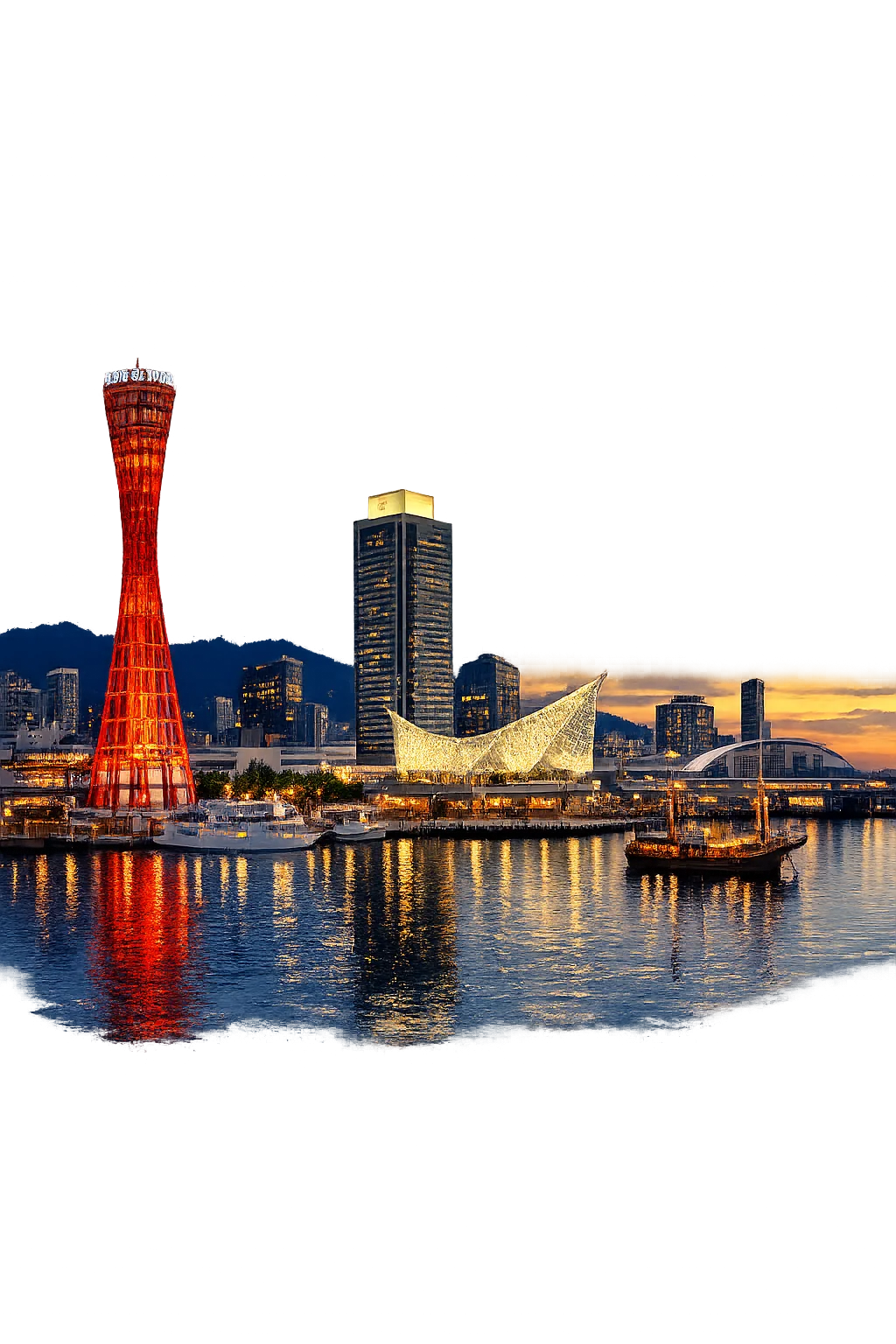
Kōbe stands where the Rokkō mountains meet the Inland Sea, a city whose name remembers the families who served the Ikuta Shrine and whose history has turned on thresholds: between shrine estate and port, between seclusion and openness, between destruction and recovery.
PuniCodex restores the name as Kōbe and serves its temple at kōbe.com. The original carries both stress and vowel length, and exactly one historically valid Unicode restoration exists, which places the name in Tier 1. The plain ASCII form kobe survives as a modern convenience imposed by the early domain-name system; the restoration, not the fallback, is the form the project defends as philologically complete.
The Name
The name is attested in Japanese characters as 神戸. Etymologically it means "Door to the gods or support door".
The reconstructed proto-form is 神戸 (proto-sino-tibetan, "god + door, gate"). From Japanese 神戸 (Kanbe) "god's door"; ancient shrine port.
The ASCII form kobe survives only because the early domain-name system could not carry diacritics; it is a technological compromise, not an ancient spelling. The Unicode restoration Kōbe recovers the vowel length of the original directly in the address bar. The original carries both stress and vowel length, and exactly one historically valid Unicode restoration exists, which places the name in Tier 1.
The letter-by-letter transformation runs:
- k → K — Same
- o → ō — Macron: long vowel
- b → b — Same
- e → e — Same
The project holds the domain kōbe.com (xn--kbe-qxa.com) as the canonical home of this name.
Etymology & Roots
The recorded derivation reads: From Japanese 神戸 (Kanbe) "god's door"; ancient shrine port.
The reconstructed proto-form is 神戸 (proto-sino-tibetan), glossed as "god + door, gate".
The reconstruction is classed as attested.
The Original Script
The name is preserved in Japanese characters as 神戸 — Kanji (Sino-Japanese logographs), attested Heian – present, in Japan. The script is written left-to-right; traditional top-to-bottom.
The scholarly transliteration is Kōbe (Hepburn romanisation with macron), giving the normalized reading /koːbe/.
The rendering proceeds step by step:
- The name is written with the kanji 神戸.
- Each kanji carries both a semantic meaning and Sino-Japanese (on'yomi) and native Japanese (kun'yomi) readings.
- Hepburn romanisation with macron marks long vowels, which the ASCII form loses.
- The Unicode restoration Kōbe is used for DNS because the kanji form is not supported in the .com IDN table.
Pronunciation
The reconstructed pronunciation of the name is /koːbe/ — Hepburn Japanese Reconstruction.
Phoneme by phoneme:
- Kō- — Voiceless velar stop [k] followed by long close-mid back vowel [oː]; the macron marks a two-mora vowel length that makes the name Tier 1.
- -be — Voiced bilabial stop [b] plus short open-mid front vowel [e], a common ending in old Japanese place-names.
For the modern speaker, the closest approximation is: 'KOH-beh' — hold the first vowel roughly twice as long as the second, without stress in the English sense.
Kindred and historical forms of the name:
- Japanese — 神戸 (kanbe), 'gate of the god' or 'supporting door', the old toponym behind the modern city
- Japanese — 生田 (Ikuta), the shrine whose kanbe serving families gave Kōbe its name
- Old Japanese — Owada-no-tomari, the Nara- and Heian-period harbour at the site of modern Kōbe
Kōbe is Tier 1 because the Hepburn restoration preserves the long vowel ō of the first mora. Japanese pitch accent is not marked here; the macron is the single distinctive prosodic feature preserved in the registrable form.
Mythology
Kōbe is a city of thresholds: between mountain and sea, between ancient shrine and modern port, between Japan and the wider world. Its name comes from kanbe, the title of the families who served the Ikuta Shrine, and its modern identity was forged when it opened to foreign trade in 1868.
Ikuta Shrine and the Nihon Shoki (Origins)
The Nihon Shoki, Japan's second-oldest chronicle, places the foundation of Ikuta Shrine in the reign of Empress Jingū — conventionally dated AD 201 — when the kami Wakahirume-no-mikoto was enshrined at Ikuta in Settsu province. The shrine gave its name to the surrounding district and to the kanbe — shrine-supporting families — from whom the modern city of Kōbe takes its name. For centuries the area around the shrine was a modest port settlement at the foot of the Rokkō mountains, looking out over the Inland Sea.
Owada-no-Tomari and the Medieval Port (Trade)
By the Nara and Heian periods the harbour here was known as Owada-no-Tomari, a stop for ships travelling between the imperial capital and western Japan. In 1180 Taira no Kiyomori briefly moved the capital to Fukuhara-kyō, in what is now Kōbe, hoping to control both court and commerce. Although the capital returned to Kyōto after only a few months, the episode revealed the strategic value of Kōbe's sheltered bay.
The Port Opens to the World (Opening)
On 1 January 1868 the Port of Hyōgo opened to foreign shipping, ending more than two centuries of national seclusion. Foreign merchants settled on the low hills of the Yamate district — later known as Kitano-ijinkan-gai — bringing Western architecture, sports, and trade. Kōbe quickly became one of Japan's most cosmopolitan cities, a reputation it retains today.
Earthquake and Rebirth (Resilience)
On 17 January 1995 the Great Hanshin Earthquake struck Kōbe, killing more than six thousand people and destroying large parts of the port and city centre. The recovery became a model of urban reconstruction and disaster preparedness. Today Kōbe remains Japan's fourth-busiest container port and is known worldwide for Kōbe beef, Arima Onsen, and the resilient spirit of its people.
Symbols & Iconography
The iconography associated with Kōbe concentrates in a small set of recurring attributes, each a compressed statement about the name:
- Torii — The vermilion gate of Ikuta Shrine, set before the sacred grove (Ikuta no mori) in the modern city centre; the shrine is registered in the Engishiki (927) among the officially recognised shrines of Settsu province, so the gate has marked the threshold between street and sanctuary in continuous ritual use for more than a millennium.
- Ship — The vessel as agent of encounter: the medieval harbour works at Ōwada-no-tomari made the bay a stop for coastal shipping, and the steamships that called after the 1868 opening turned a shrine anchorage into an international port.
- Western-style house — The ijinkan mansions of Kitano, above all the Kazamidori no Yakata (Weathercock House, 1909), built for a German merchant and now protected as an Important Cultural Property, materialise the treaty-port era in brick, clapboard and weathercock.
Archaeology & Evidence
The material record of Kōbe begins long before the port. Bronze ritual bells (dōtaku) of the Yayoi period unearthed at Sakuragaoka, and the Goshikizuka Kofun — a keyhole-shaped tomb of the late fourth century, the largest of its kind in Hyōgo Prefecture and now a National Historic Site — attest early elite authority around the sheltered bay. Medieval layers belong to the harbour: at Ōwada-no-tomari the twelfth-century port works associated with Taira no Kiyomori, including the artificial island Kyōgashima, document an early programme of deliberate port construction. The treaty-port era survives standing: the ijinkan of Kitano, notably the Kazamidori no Yakata of 1909, are protected as Important Cultural Properties, while a stretch of the wharves shattered in 1995 is preserved in place at the Port of Kobe Earthquake Memorial Park as a monument of modern archaeology.
Realm & Domain
Kōbe stands where the Rokkō mountains meet the Inland Sea, a city whose name remembers the families who served the Ikuta Shrine and whose history has turned on thresholds: between shrine estate and port, between seclusion and openness, between destruction and recovery.
Ikuta Shrine
The ancient Shinto shrine whose kanbe families lent their title to the city; its forest is Kōbe's mythic origin point.
Maritime Gateway
Owada-no-tomari and the medieval port made Kōbe the arrival point for continental envoys, Buddhism, and trade.
Foreign Settlement
The 1868 opening of the port brought Western merchants to Kitano-ijinkan-gai, creating Japan's most cosmopolitan hillside.
Resilience
The 1995 Great Hanshin Earthquake levelled districts and broke the port, yet Kōbe rebuilt as a model of urban recovery.
Across Cultures
Kōbe has always been a place where worlds overlap.
Shinto and Buddhism shared the city's sacred landscape for centuries, with Ikuta Shrine and the Buddhist temples of the Rokkō foothills serving overlapping communities. After the port opened in 1868, the foreign settlement brought Western Christianity, Judaism and Islam into the same streets: the Kobe Muslim Mosque (1935) is Japan's oldest surviving purpose-built mosque, and the Ohel Shlomo synagogue continues a Jewish presence that dates to the early years of the settlement. A Shinto shrine, a mosque, a synagogue and former consulates now stand within walking distance of one another, and the city's culinary identity — sake from the Nada breweries, Chinese cooking in Nankinmachi, the beef that carries the city's name — is itself a product of this long encounter.
Within the Japanese tradition, closely related names in the corpus include [[fujin|Fūjin]], [[jizo|Jizō]], [[kyoto|Kyōto]], [[nikko|Nikkō]], and [[osaka|Ōsaka]].
Cultural Legacy
Kōbe is the city Japan built to face outward.
One of the first ports reopened to foreign trade in the modern era, it set the pattern for Japan's international port cities and remains a byword for cosmopolitan openness. The 1995 Great Hanshin-Awaji Earthquake made it something more specific: a global reference for disaster recovery. In January 2005, ten years after the quake, the United Nations World Conference on Disaster Reduction convened in Kōbe and adopted the Hyogo Framework for Action 2005–2015, a landmark international framework for reducing disaster risk, named for the prefecture that had rebuilt itself. Beyond the port, the city's name travels with its products — the branded Tajima-gyu sold worldwide as Kōbe beef, the sake of the Nada breweries, the ancient hot spring of Arima — while in Japanese popular memory Kōbe stands for both the rewards and the risks of living on a fault line, literal and historical.
The Scholarly Record
The account of Kōbe given in this edition rests on the witnesses and reference works listed below. The chronicles and liturgies secure the antiquity of the god-door cult; the war-tale, the treaty-port historiography and the disaster-risk record carry the city from shrine estate to modern port.
- Nihon Shoki (Chronicles of Japan), 720; trans. W. G. Aston. Full text
- Kojiki (Records of Ancient Matters), 712; trans. D. L. Philippi. Full text
- The Tale of the Heike (Heike monogatari): the Fukuhara-kyō episode and the battle of Ichi-no-Tani.
- Engishiki (Procedures of the Engi Era), 927, Jinmyōchō register of Settsu province shrines.
- Man'yōshū (Collection of Ten Thousand Leaves), ca. 759, poems of the Settsu coast and Ōwada-no-tomari.
- Hoare, James E., Japan's Treaty Ports and Foreign Settlements: The Uninvited Guests, 1858–1899 (Routledge, 1994).
- United Nations, Hyogo Framework for Action 2005–2015 (World Conference on Disaster Reduction, Kōbe, 2005).
A Meditation
Kōbe's name keeps a door in it: kanbe, the 'god-door', named the households that served the Ikuta Shrine, and a door is never only an entrance. It is a threshold that faces two ways — toward the sanctuary and toward the street, toward the mountain and toward the sea.
To contemplate Kōbe is to stand in that doorway. Every phase of the city's life has been an opening and a closing: the shrine estate that became a harbour, the harbour closed by two centuries of seclusion, the port thrown open in 1868, the city broken in 1995 and opened again by rebuilding. The restored form — Kōbe — asks the reader to hold the threshold rather than rush through it: to notice that a name can be both a door to the gods and a door to the world, and that the same hinge carries both.
The Unicode Restoration
Kōbe is classified as Tier 1: the original carries both stress and length, and only one valid Unicode restoration exists. The ASCII fallback kobe still resolves everywhere, but it is the restored form that carries the name's full information. Across the 4 characters of the name, the restoration adjusts 1: 1 mark of length (ō). That is the whole thesis of this temple: the marks are the message.
Character by Character
The journey from kobe to Kōbe, one character at a time:
- k → K — Same
- o → ō — Macron: long vowel
- b → b — Same
- e → e — Same
The Domain Name
The restored name is live as a working domain: kōbe.com, which the DNS carries in punycode form as xn--kbe-qxa.com — an ASCII-compatible encoding that lets a non-ASCII name travel the global network without breaking older infrastructure. The visitor sees Kōbe; the machines see the encoding. That duality is the engineering compromise on which the entire restoration rests, and it is why a name written the way its own tradition wrote it in Japanese characters can now be typed into any browser on earth.
The Japanese Pantheon
Kōbe is one of 43 entries the PuniCodex lexicon catalogues under the Japanese pantheon. The Pantheon page gathers the tradition's major figures in one place, and the Lexicon lets you filter all 895 restorations by tradition, tier, or script — the fastest way to see where this name sits among its kin.
Frequently Asked Questions
What does Kōbe mean? The traditional gloss is "Door to the gods or support door."
Which tradition does Kōbe belong to? Kōbe is catalogued in the Japanese pantheon of the PuniCodex lexicon.
Why is Kōbe classified as Tier 1? Because the original carries both stress and length, and only one valid Unicode restoration exists — and the marks in the restored spelling preserve exactly that evidence.
Is Kōbe a working domain? Yes — kōbe.com resolves today and routes to this temple.
What is the punycode for kōbe.com? The DNS encoding is xn--kbe-qxa.com; browsers perform the translation automatically, so visitors only ever see the restored name.
Typing Kōbe
You do not need a special keyboard to use this restoration. The PuniCodex Type Tool converts the ASCII form kobe into Kōbe as you type, and the browser extension offers the same conversion inside any text field. Copy the restored form, paste it into the address bar, and the DNS does the rest.
Why This Restoration Matters
Pronunciation turns out to be the heart of the matter. The marks in Kōbe are instructions for the voice, and a web that strips them is a web that mispronounces the past at scale. The restoration hands the instructions back: say it as the evidence suggests, type it as the tradition wrote it, and let the punycode machinery do the quiet translation in between. That is all the PuniCodex project asks of the infrastructure — and everything it asks of you, the reader, is to use the whole name.
Explore Further
This post is one doorway into the temple. The home page carries the full character breakdown and the ambient canvas; the lore page tells the myths in long form; the Scholarly Edition preserves the sources, pronunciation data, and revision history; and the patron wall supports the restoration directly. For the wider map, browse the Lexicon, explore the Pantheon, or return to the PuniCodex blog.
Related Names
Sources
The full scholarly apparatus — every citation, revision, and review — lives in the Scholarly Edition. Key references for this post:
- Nihon Shoki (Chronicles of Japan), Translated by W. G. Aston (excerpts), 720.
- Kojiki (Records of Ancient Matters), 712; trans. D. L. Philippi.
- Kojiki (Records of Ancient Matters), Translated by Basil Hall Chamberlain, 712.
- Kōbe City official history and tourism materials.
- Cambridge University Press, History of Kobe ( extracts).
- Engishiki (Procedures of the Engi Era), 927, Jinmyōchō register of Settsu province shrines.
- Hoare, James E., Japan's Treaty Ports and Foreign Settlements: The Uninvited Guests, 1858–1899 (Routledge, 1994).
- Lexicon authorities for this entry: Hepburn, Kojiki.