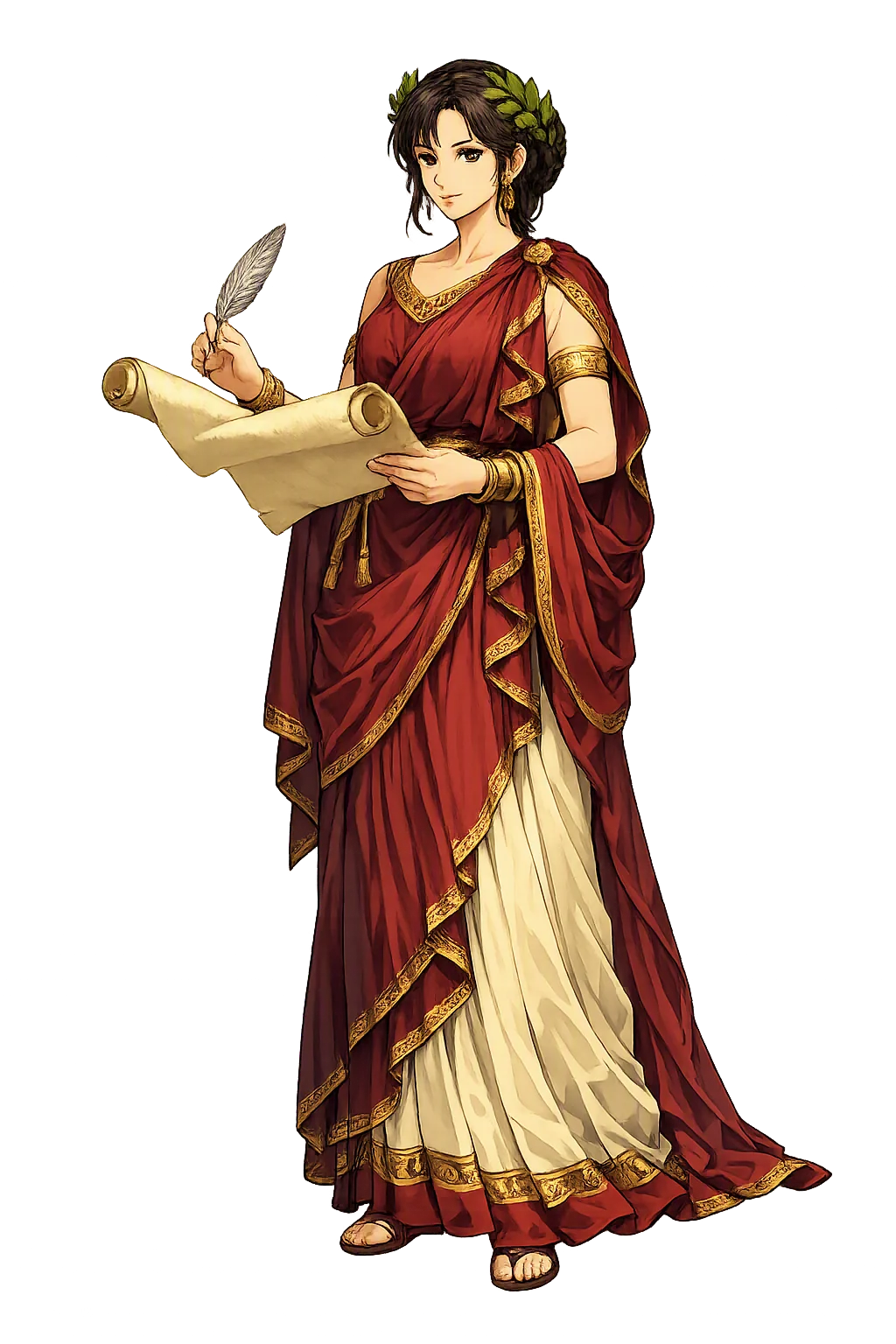
Kleió through the eyes of sculptors, painters, and craftsmen across the ages

Clio, Museo Pio-Clementino (Inv. 291) — Roman marble of the 2nd century CE from the Villa of Cassius near Tivoli: the Muse of History stands in the Vatican's Hall of the Muses, scroll in hand, her head a non-pertinent ancient restoration.

The Muses Sarcophagus, Louvre (Ma 475) — a marble sarcophagus of the early 2nd century AD found by the Via Ostiense, where Kleiṓ appears with her writing tablets, recording memory among her eight sisters.

The Vichten Mosaic, c. 240 AD — from a Roman villa in Gallia Belgica and now in Luxembourg's National Museum of History and Art, this tessellated Kleiṓ presides over the Nine Muses' cycle, diptych in hand.

The Nine Muses Mosaic from Kos — a Roman-era floor recovered on Kos and set today in the Grand Master's Palace in Rhodes, portraying Kleiṓ with the scroll that marks her domain over recorded time.

Clio from Hadrian's Villa (Prado E-68) — a Roman marble of 130–150 AD unearthed at the emperor's Tivoli retreat, showing the Muse enthroned, the historian's composure carved in stone.

Charles Meynier, Clio, Muse of History (1800) — the Neoclassical canvas at the Cleveland Museum of Art crowns the Muse with laurel as she writes the deeds of ages into her great book.

Artemisia Gentileschi, Clio (1632) — the Baroque master's Muse of History turns from her open book, trumpet at hand, ready to proclaim the fame her pages preserve.
