
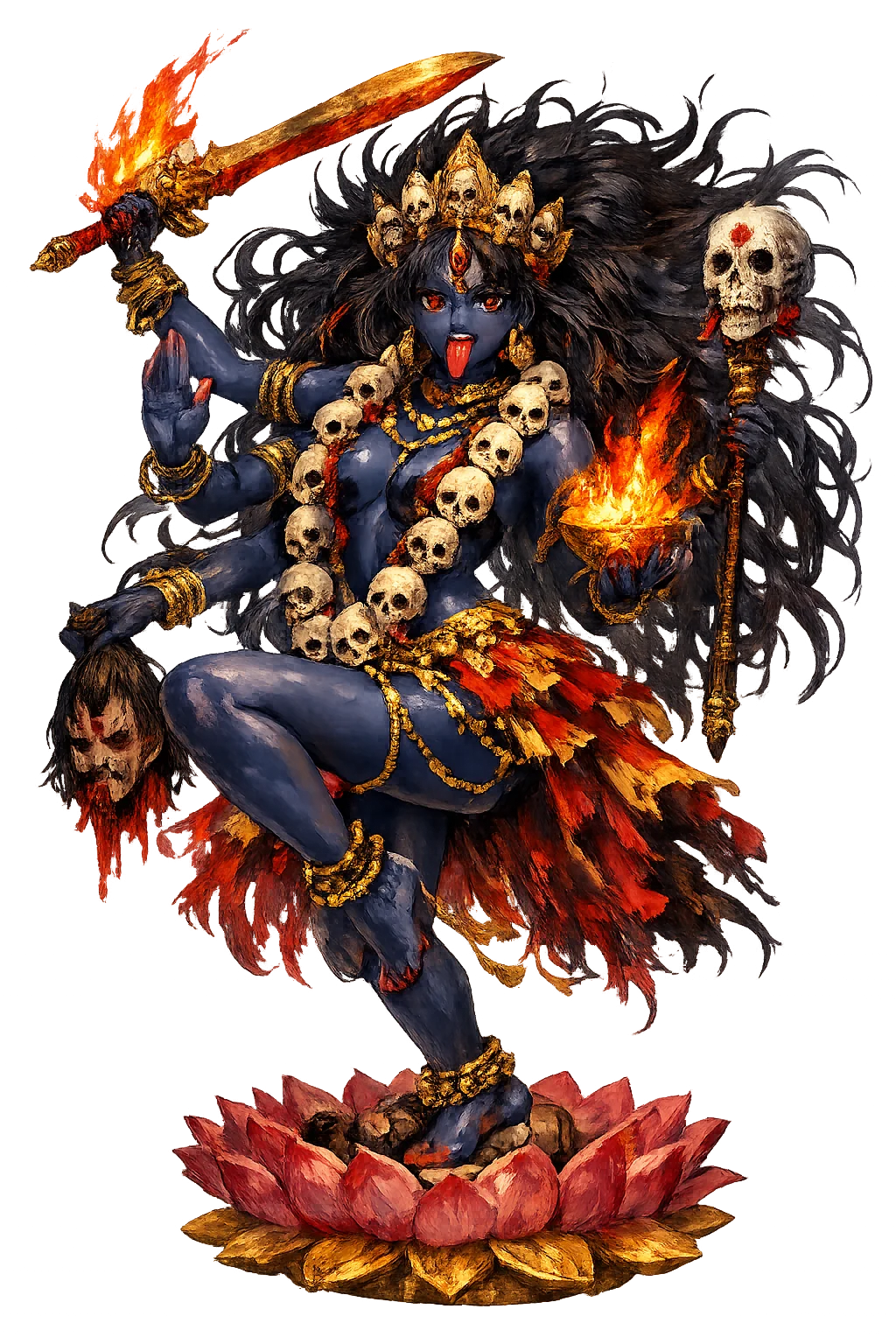
The working life of Kālī: from the myths to the modern trades
Archetypes are not metaphors; they are job descriptions written early. Kālī's was unusually clear.
Kālī emerges most famously from the brow of the goddess Durgā in the seventh chapter of the Devī Māhātmya, during the war against the demons Śumbha and Niśumbha — after Mahiṣāsura's fall. But her deepest myths are Tantric, centered on the Dakṣa sacrifice and the dismemberment of Satī, the first wife of Śiva.
The pattern atlas — which maps every flagship temple to the industries its archetype demonstrably resonates with, each match argued and open to challenge — seats this temple in 3 industries. This file reads those seats the way they were earned: through the myths.
At a Glance
- Temple: Kālī
- Pantheon: Sanskrit
- Domain of influence: Time, Destruction, Empowerment
- Pattern seats: 3
- Sectors touched: Commerce & Governance · Culture & Entertainment · Health & Wellbeing
- Strongest seat: Defense, Military & Security
- Series: The Resonance Files, No. 127 of 271
The Myth at Work
From the Brow of Durgā. In the Devī Māhātmya, when the demon Raktavīja proves impossible to kill because each drop of his blood spawns a new warrior, Durgā manifests Kālī from her forehead. Kālī drinks the demon's blood and devours his clones, her tongue lapping every drop before it touches the earth. — that is not just a story. It is a business model, four thousand years early.
The Dakṣa Yajña and Satī. Satī, daughter of the proud king Dakṣa, immolates herself in protest after her father insults her husband Śiva. Śiva, mad with grief, dances the Tāṇḍava with her corpse upon his shoulder, threatening to unmake the cosmos. — remember the shape of that act. You will see it again, wearing a logo.
The Seats
Each of these is argued in the atlas with a weight and a why-line. What the atlas cannot fit in one line is the whole myth — so here is each seat with its story restored.
Defense, Military & Security
Defense contracting, security services, and strategic studies. (Sector: Commerce & Governance)
The raw form of śakti, the power that destroys to create — war as cosmic necessity, wearing a garland of skulls. Swap the costume and the sentence is indistinguishable from the myth. That is what a resonance seat means.
Timekeeping & Calendar Systems
Watches, calendars, and time sciences. (Sector: Culture & Entertainment)
The why-line says it in one breath: Her name derives from kāla, time; the black mistress of duration. That is not a resemblance; it is the same act, performed in a newer building.
Yoga, Meditation & Holistic Wellness
Yoga, meditation, and mind-body practice. (Sector: Health & Wellbeing)
Fierce empowerment; modern goddess spirituality’s strongest current. — the atlas stops there, out of discipline. The myth keeps going: the function Kālī performs in the stories is precisely the function this industry sells.
Read the myth again after the seats and it stops sounding ancient: Kālī emerges most famously from the brow of the goddess Durgā in the seventh chapter of the Devī Māhātmya, during the war against the demons Śumbha and Niśumbha — after Mahiṣāsura's fall. The age changed. The work did not.
The Method, Stated Plainly
None of this is numerology. A seat exists only where the match can be argued from the deity's documented domains and deeds — weighted, published, and falsifiable. The full derivation, the weights, and the challenge process are public on the methodology page. If a seat in this file reads wrong, the atlas itself tells you how to prove it — and the correction becomes part of the record.
For the Ones Who Work There
If you work in defense, military & security, timekeeping & calendar systems, or any trade this temple holds a seat in, this is the honest version of what a placement means: your industry beside the story it has been re-telling all along — on the temple floor itself, before an audience that came specifically to read it. The patron tier and the advertising terms describe the mechanics; the resonance above describes the fit. The story is the pitch; the seats are just where it already works.
The File Continues
This is one of 271 Resonance Files — the third dispatch from every flagship temple, where the myths meet the markets. The temple's founding dispatch tells the name's story; its Restoration File tells the spelling's; the blog index holds the whole archive.
Continue the series — previous: Kꜣ (read it) · next: Kanaloa (read it).
The Resonance Files are argued from the same canonical record as the pattern atlas itself: the lexicon, the lore catalog, and the cited sources. Every seat can be challenged at the methodology page — and the challenge is the point.