The Authentic Orthography
Time, Destruction, Empowerment · of Satyavatī, wife of king Śāntanu and mother of Vyāsa or Kṛṣṇadvaipāyana (after her marriage she had a son Vicitravīrya, whose widows were married by Kṛṣṇadvaipāyana
Unicode restoration and ASCII comparison
काली
The name in its original Sanskrit form. Kālī (काली) is attested in the source tradition — “of Satyavatī, wife of king Śāntanu and mother of Vyāsa or Kṛṣṇadvaipāyana (after her marriage she had a son Vicitravīrya, whose widows were married by Kṛṣṇadvaipāyana”. Its macron-length vowels carry the full phonetic and orthographic weight of the source tradition.
kali
Reduced to plain kali, the name loses everything that made it specific: macron-length vowels. What remains is an ASCII string that machines can parse but that no longer speaks with its original voice.
Kālī
The Unicode restoration recovers what ASCII flattened. Kālī restores macron-length vowels, returning the name to its original written dignity. The domain encodes to Punycode, but the browser displays the truth.
Kālī.com → xn--kl-dla3o.com
The non-ASCII characters in Kālī are encoded while the ASCII remains visible. To the DNS, it is Punycode. To humanity, it is Kālī.
How Kālī travels from ancient script to the modern URL
Sanskrit Kālī; from kāla “time, black"; the black goddess of time, destruction, and transformation.
Time, Destruction, Empowerment
The IAST form Kālī uses registrable Latin diacritics; the Devanagari form is not supported in .com.
How Kālī was spoken
Time, Destruction, Empowerment
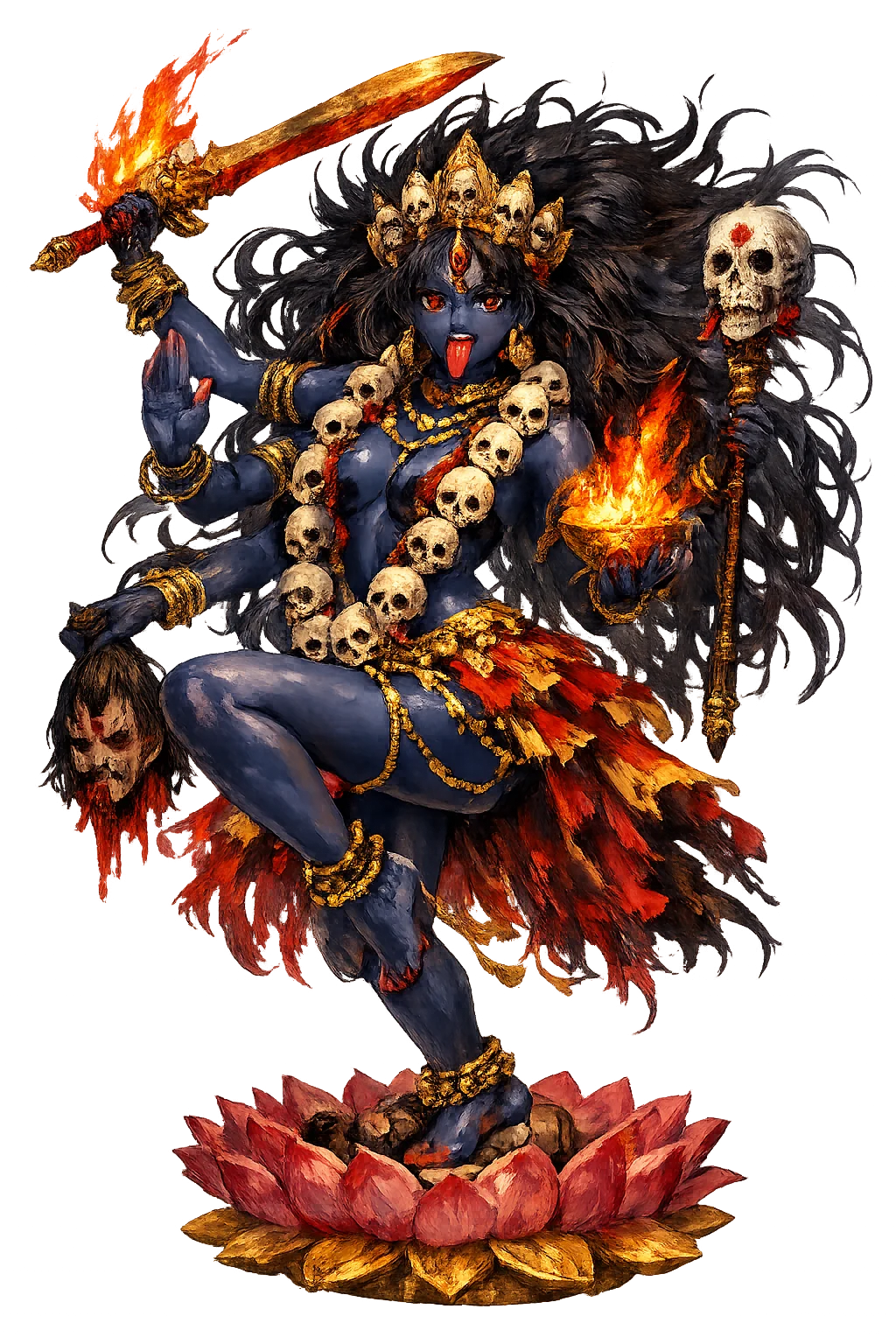
Kālī is the most terrifying and most tender of Hindu goddesses. She appears when the boundary between life and death, order and chaos, becomes thin enough to see through. With black skin, a garland of skulls, and a tongue that laps blood, she is the raw form of śakti — the feminine power that creates by destroying and destroys by creating.
As the feminine of kāla, she is time itself — the devourer of minutes, years, and egos.
Her sword severs the head of ignorance; her dance grinds the demon of ego beneath her feet.
Especially for the marginalized, Kālī is the mother who grants ferocious courage against oppression.
She stands outside conventional purity, teaching that the sacred includes what society rejects.
Stories of Kālī
Kālī emerges most famously from the brow of the goddess Durgā during her battle with the buffalo-demon Mahiṣāsura. But her deepest myths are Tantric, centered on the Dakṣa sacrifice and the dismemberment of Satī, the first wife of Śiva.
In the Devī Māhātmya, when the demon Raktavīja proves impossible to kill because each drop of his blood spawns a new warrior, Durgā manifests Kālī from her forehead. Kālī drinks the demon's blood and devours his clones, her tongue lapping every drop before it touches the earth. This is her first cosmic act: not rage for its own sake, but surgical ferocity against entropy.
Satī, daughter of the proud king Dakṣa, immolates herself in protest after her father insults her husband Śiva. Śiva, mad with grief, dances the Tāṇḍava with her corpse upon his shoulder, threatening to unmake the cosmos. Viṣṇu intervenes, slicing Satī's body into fifty-one pieces that fall across the subcontinent and become the Śakti Pīṭhas, pilgrimage seats of the goddess. Kālī is the dark form of Śiva's grief and Śakti's unquenchable power.
In Tantra, Kālī is the supreme reality beyond good and evil, purity and impurity. She is worshipped at cremation grounds, at midnight, and with offerings that break brahminical taboo. Her nakedness signifies transparency; her garland of skulls signifies the letters of sacred sound; her stance upon Śiva signifies that dynamic energy (śakti) is the motor of consciousness. To know Kālī is to stop fleeing death and to recognize it as the other face of birth.
British missionaries and administrators of the nineteenth century frequently singled out Kālī worship as the most degraded and violent aspect of Hinduism, using her image to justify imperial 'civilizing' missions. At the same time, Bengali nationalists and devotees such as Ramakrishna reclaimed her as the loving Mother — Kālī Mā — and revolutionary groups adopted her as the symbol of a wrathful motherland rising against foreign rule. She thus became a screen onto which both domination and resistance were projected.
Most of us spend our lives trying to keep Kālī out. We lock the door against death, shame, rage, and the parts of ourselves that do not fit the daylight world. Kālī is the one who kicks the door down. She is not cruel; she is honest. Time was always devouring us. The ego was always a borrowed costume. The blood she drinks is the blood of our pretending.
Enter Extended Lore