
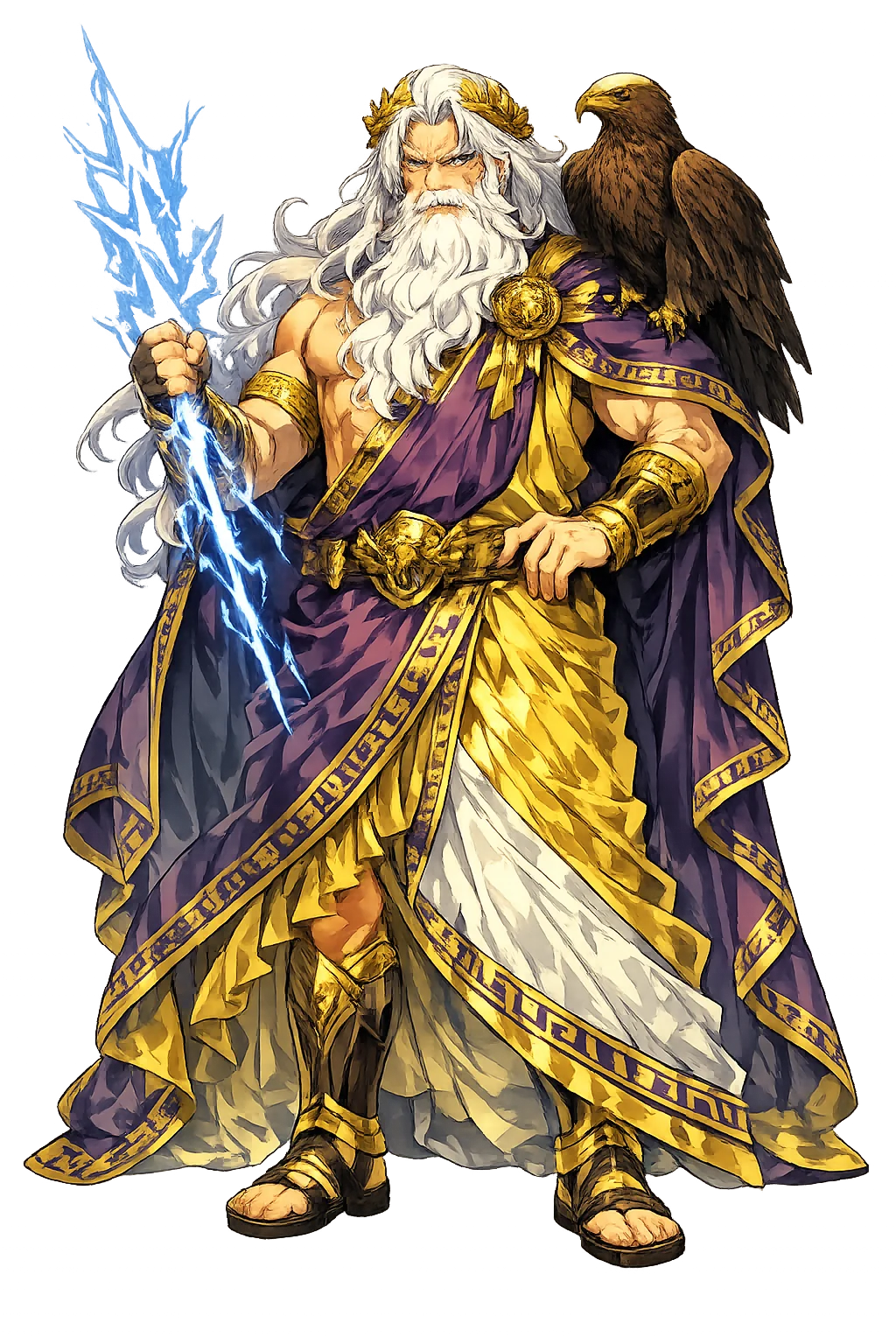
Iūpiter walks into a leadership, governance & public administration firm
Walk into any leadership, governance & public administration outfit and watch for ten minutes. You will see a very old act performed with newer props. The act has a name. It is Iūpiter.
Before the Office, the Story
Iovem Lapidem. The most binding Roman oath was sworn per Iovem Lapidem — by Jupiter the Stone — while holding a flint from his altar and reciting the formula of the fetial priests: "If I deceive, may Iuppiter strike me as I strike this pig. " Law, treaty, and contract all rested on his witness; the stone was his body in the courtroom of nations.
The Borrowed Face. In the triumph, the victorious general rode in Iūpiter's own regalia — purple and gold, face painted red like the god's terracotta statue — while a slave held the crown and whispered "memento mori. " Rome let its greatest man borrow the god's face for one day, and made the god remind him to give it back: sovereignty rehearsed and returned.
At a Glance
- Temple: Iūpiter
- Pantheon: Roman
- Domain of influence: Sky, Thunder, Sovereignty
- Pattern seats: 3
- Sectors touched: Commerce & Governance
- Strongest seat: Leadership, Governance & Public Administration
- Series: The Resonance Files, No. 122 of 271
The Reveal, Seat by Seat
Leadership, Governance & Public Administration
Now read the why-line with the office in mind: Optimus Maximus, best and greatest — the Capitoline sovereign under whom Rome’s magistrates, triumphs, and treaties all stood. The people doing this work did not borrow the archetype. They re-derived it — the way Iūpiter was always going to be re-derived wherever sky, thunder, sovereignty matters.
Legal, Justice & Compliance
Per Iovem Lapidem: every oath, treaty, and contract is sworn on his stone. Nobody in that trade worships at this temple. They just keep its hours.
Defense, Military & Security
The legion’s eagle was his; the oath of service is sworn in his name. The match is not poetic license. Strip the trade to its function and the function is the myth.
Not the First Rebrand
Everywhere Rome went, Iūpiter wore local faces: Zeús in the East, Ammon in Egypt (Alexander's "father"), Dolichenus in the Syrian legionary cult — a storm god in iron scale-armour worshipped by soldiers from Britain to the Danube — and the Celtic wheel-god Taranis on Jupiter-columns of the Rhineland. His very name is the syncretism that precedes all others: Zeús, Dyaus, Tiwaz, and Iūpiter are one father spoken in four dialects. The office is only the latest translation.
The Method, Stated Plainly
None of this is numerology. A seat exists only where the match can be argued from the deity’s documented domains and deeds — weighted, published, and falsifiable. The derivation, the weights, and the challenge process are public on the methodology page. If a seat in this file reads wrong, the atlas itself tells you how to prove it — and the correction becomes part of the record.
For the Ones Who Work There
For a sponsor in leadership, governance & public administration, the fit here is not adjacency — it is inheritance. Your trade already tells this story every working day; the temple simply holds the original. The patron tier and the advertising terms carry the mechanics; the myths above carry the reason.
The File Continues
This is one of 271 Resonance Files — the third dispatch from every flagship temple, where the myths meet the markets. The temple's founding dispatch tells the name's story; its Restoration File tells the spelling's; the blog index holds the whole archive.
Continue the series — previous: Iūnō (read it) · next: Jizō (read it).
The Resonance Files are argued from the same canonical record as the pattern atlas itself: the lexicon, the lore catalog, and the cited sources. Every seat can be challenged at the methodology page — and the challenge is the point.