
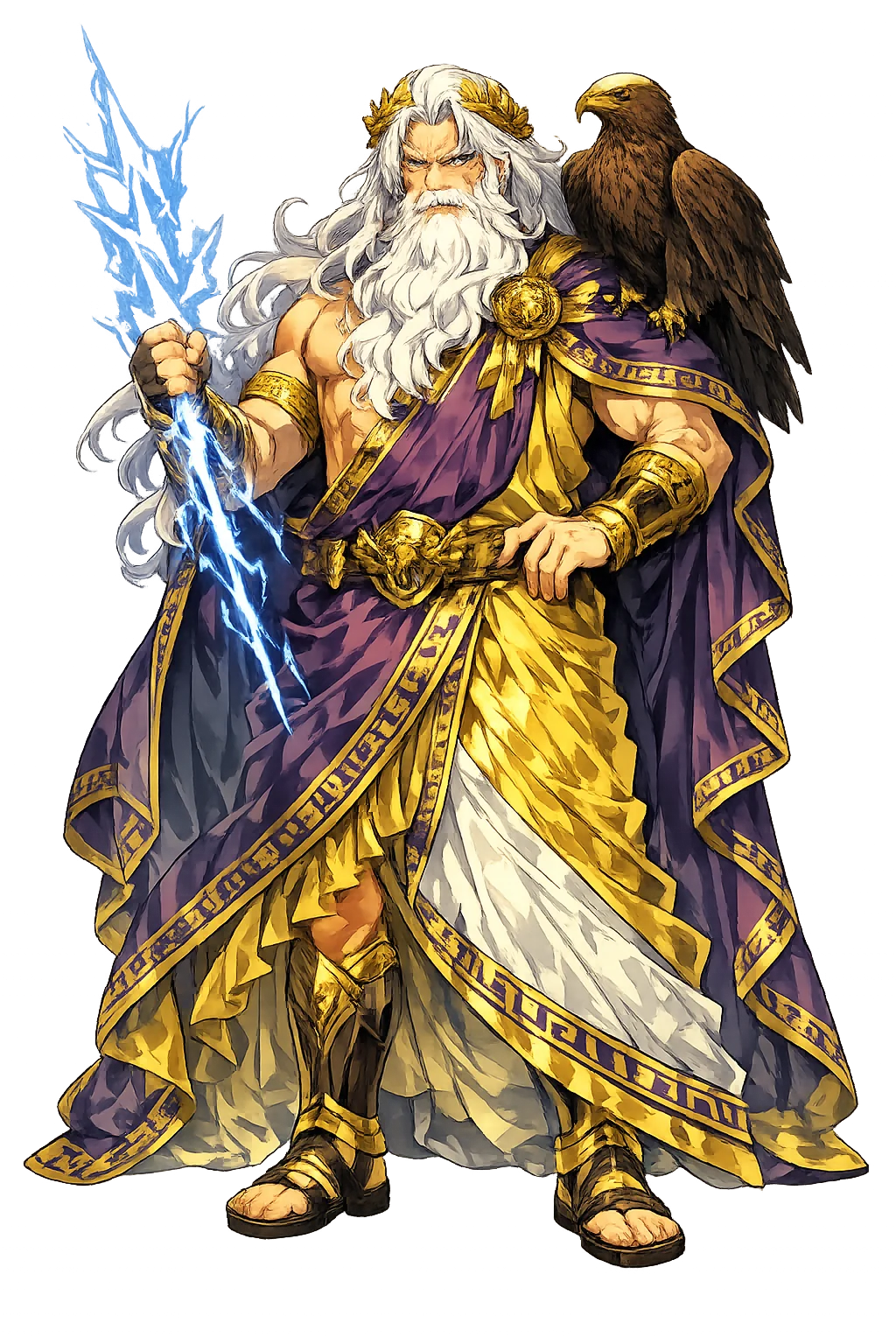
The hidden history behind Iūppiter
Behind the modern ASCII form iuppiter hides a much longer story. Iūppiter reaches back through manuscripts, inscriptions, and oral tradition long before it ever touched a keyboard, and every mark in the restored spelling is a receipt from that journey. In what follows we trace the name from its Original Script attestations through its mythology, its cult, its symbols, and its afterlife in other cultures — and we show how the PuniCodex project turned that philological record into a Unicode domain that resolves today. The history was never lost. It was only waiting for the infrastructure to catch up.
At a Glance
- Restored name: Iūppiter
- ASCII form: iuppiter
- Meaning: "'Sky-father' (from *Dyēu-pater)"
- Domain of influence: Sky, Thunder, Sovereignty
- Pantheon: Roman
- Classification: Tier 2
- Live domain: iūppiter.com
Overview
Iūppiter (iuppiter) — The Father of the Sky — belongs to the Roman tradition, where it is catalogued under the domain "Sky, Thunder, Sovereignty". The name means "'Sky-father' (from *Dyēu-pater)".
Iūppiter is the god in whose name Rome swore: Optimus Maximus, "best and greatest," the witness of every treaty, the dedicatee of every victory, and the direct linguistic heir of the Indo-European sky father — the oldest divine name the West still speaks.
PuniCodex restores the name as Iūppiter and serves its temple at iūppiter.com. The original preserves one prosodic feature — stress or vowel length — rather than both, which places the name in Tier 2. The plain ASCII form iuppiter survives as a modern convenience imposed by the early domain-name system; the restoration, not the fallback, is the form the project defends as philologically complete.
The Name
No indigenous written attestation survives for this name; Iūppiter is a scholarly transliteration of the reconstructed spoken form. Etymologically the name means "'Sky-father' (from *Dyēu-pater)".
The ASCII form iuppiter survives only because the early domain-name system could not carry diacritics; it is a technological compromise, not an ancient spelling. The Unicode restoration Iūppiter recovers the vowel length of the original directly in the address bar. The original preserves one prosodic feature — stress or vowel length — rather than both, which places the name in Tier 2.
The letter-by-letter transformation runs:
- i → I — Same letter
- u → ū — Macron marks the long vowel
- p → p — Same letter
- p → p — Same letter
- i → i — Same letter
- t → t — Same letter
- e → e — Same letter
- r → r — Same letter
The project holds the domain iūppiter.com (xn--ippiter-0sb.com) as the canonical home of this name.
The Original Script
The original script for this roman name has not yet been added to PUNICODEX. The form shown is a scholarly transliteration.
The form Iūppiter is therefore a scholarly transliteration rather than an attested ancient spelling; it encodes the reconstructed sound of the name for modern use, and no mark in it is decorative.
Pronunciation
The reconstructed pronunciation of the name is /ˈjuːp.pi.ter/ — Classical Latin.
For the modern speaker, the closest approximation is: YOO-pi-ter, with the geminate pp and long ū.
Kindred and historical forms of the name:
- Latin — Iūppiter
- Greek twin — Ζεύς
- Vedic twin — Dyaus-pitā
- Owned form — Iūppiter
Iūppiter compounds the vocative of the sky-father's ancient name — Dyēu-pəter, "O Father Sky" — the same formula that gives Greek Zeús and Vedic Dyaus-pitā. The doubled pp is the standard classical spelling; both macrons are certain, and the name is Latin's oldest continuous theonym.
Mythology
Roman myth made Zeús' biography his own, but Iūppiter's truest stories are Roman institutions: the oath, the triumph, the dedication of spoils — religion as constitutional machinery.
Iovem Lapidem (The Oath)
The most binding Roman oath was sworn per Iovem Lapidem — by Jupiter the Stone — while holding a flint from his altar and reciting the formula of the fetial priests: "If I deceive, may Iuppiter strike me as I strike this pig." Law, treaty, and contract all rested on his witness; the stone was his body in the courtroom of nations.
The Borrowed Face (The Triumph)
In the triumph, the victorious general rode in Iūppiter's own regalia — purple and gold, face painted red like the god's terracotta statue — while a slave held the crown and whispered "memento mori." Rome let its greatest man borrow the god's face for one day, and made the god remind him to give it back: sovereignty rehearsed and returned.
Opima Spolia (The Spoils)
The rarest honour in Rome belonged to Iūppiter Feretrius: the spolia opima, "rich spoils," taken when a Roman commander slew the enemy king in single combat — won by Romulus, by Cossus, and by Marcellus at Clastidium (222 BCE), and never again. Augustus blocked the fourth claimant on a technicality: some honours were too royal for an emperor's subjects.
The Standard (The Eagle)
Every legion carried his aquila into battle, and its loss was the deepest disgrace Rome knew — the eagles of Varus' three legions, lost in the Teutoburg Forest, were recovered a generation later by Germanicus' campaigns and treated as returning citizens. The sky father marched, in bronze, at the head of the army that built the Mediterranean's order.
Symbols & Iconography
The iconography associated with Iūppiter concentrates in a small set of recurring attributes, each a compressed statement about the name:
- The thunderbolt — The sky's verdict; sovereignty as sudden light
- The eagle — The highest flier, the king of birds for the king of gods
- The oak — The tree of Dodona and of the civic crown — strength that shelters
- The flint — Iuppiter Lapis, the stone by which oaths were sworn
Epithets & Cult Titles
Rome's god accumulated titles the way the city accumulated provinces.
- Optimus Maximus — 'Best and Greatest'; the Capitoline title, the state's formal address to him.
- Feretrius — 'of the Spoils'; the small, ancient Capitoline shrine of the spolia opima.
- Capitolinus — 'of the Capitol'; his civic residence-title.
- Stator — 'the Stayer'; Romulus' vow-title, the god who stops the rout.
- Tonans — 'the Thunderer'; Augustus' title after his narrow escape from lightning.
- Lapis — 'of the Stone'; the flint-oath, his most legal aspect.
- Invictus — 'the Unconquered'; the late-antique warrior-title.
Oracle Sites & Sanctuaries
The Capitoline temple — Iuppiter Optimus Maximus Capitolinus — was Rome's religious centre of gravity: vowed by the last kings, dedicated in 509 BCE as the Republic's first act, rebuilt after the fires of 83 BCE and 69 CE, its gilded doors and triple cella described by a dozen ancient authors. The small shrine of Iuppiter Feretrius beside it was said to be the city's first temple of all, founded by Romulus for the spoils of kings. In the provinces, his Jupiter-columns of the Rhineland and the legionary shrines of Dolichenus from Britain to Syria map the god's imperial diaspora in stone.
Archaeology & Evidence
The Capitoline temple of Iuppiter Optimus Maximus — dedicated 509 BCE, burned and rebuilt repeatedly — is documented by its massive podium under the Palazzo Caffarelli and by Pliny's and Dionysius' descriptions of its triple cella. The Jupiter-columns of the German provinces (reconstructed at Mainz, Stuttgart, and Hausen) show him riding down the giants. His oak of Dodona belongs to his Greek brother, but the flint-knives of the fetial oath and the aquilae standards of the legions fill the museums of two continents.
Realm & Domain
Iūppiter is the god in whose name Rome swore: Optimus Maximus, "best and greatest," the witness of every treaty, the dedicatee of every victory, and the direct linguistic heir of the Indo-European sky father — the oldest divine name the West still speaks.
The Thunderbolt
His weapon and signature — the bolt that marks where sovereignty lands.
The Capitol
His great temple, dedicated in 509 BCE — the year of the Republic's own beginning.
The Eagle
The bird at the head of every legion; to lose its standard was Rome's deepest shame.
The Triumph
The general robed as the god for one day — and the slave whispering mortality in his ear.
Across Cultures
Everywhere Rome went, Iūppiter wore local faces: Zeús in the East, Ammon in Egypt (Alexander's "father"), Dolichenus in the Syrian legionary cult — a storm god in iron scale-armour worshipped by soldiers from Britain to the Danube — and the Celtic wheel-god Taranis on Jupiter-columns of the Rhineland. His very name is the syncretism that precedes all others: Zeús, Dyaus, Tiwaz, and Iūppiter are one father spoken in four dialects.
Within the Roman tradition, closely related names in the corpus include [[diana|Diāna]], [[ianus|Iānus]], [[iuno|Iūnō]], [[neptunus|Neptūnus]], [[vulcanus|Vulcānus]], and [[anu|Anû]].
Cultural Legacy
"By Jove" keeps the oath in English; "jovial" preserves his planetary temperament; Thursday (dies Iovis, jeudi, giovedì) is his weekday across Romance Europe. Astronomy gave him the largest planet — fittingly, since Galileo's discovery of Jupiter's moons cracked the geocentric cosmos. Every invocation of supreme authority in the Western tradition is, etymologically, still addressed to the father sky.
The Scholarly Record
The account of Iūppiter given in this edition rests on the witnesses and reference works listed below. Lexica and etymological dictionaries secure the form and meaning of the name; the literary and religious texts supply the narrative evidence.
- Lewis & Short, A Latin Dictionary, Oxford, Clarendon Press; Perseus digitization, 1879. Full text
- Varro, De Lingua Latina / Antiquitates Rerum Divinarum, Loeb Classical Library, 45 BCE.
- Cicero, Marcus Tullius — collected works, Loeb Classical Library, 43 BCE. Full text
- Ennius, Annales, ed. Skutsch, The Annals of Q. Ennius (1985), 180 BCE.
- Macrobius, Saturnalia, Loeb Classical Library (Kaster), 430.
- Indogermanisches etymologisches Wörterbuch, 2 vols., Francke, 1959. Full text
- Cambridge Ancient History, Multiple volumes, 1970. Full text
A Meditation
Iūppiter is the god of the spoken bond. Lightning, empire, and law are one idea in his name: that the highest power is the one by which promises are kept. Every signature, every oath of office, every treaty since has borrowed his architecture — the sky as witness, the word as bond, the bolt as the penalty for perjury of the soul.
And the oaths continue, translated but recognizable: every courtroom's "the whole truth," every inauguration's raised hand, every treaty signed before witnesses rehearses the per Iovem Lapidem — the appeal to a witness greater than the parties. The Romans' insight stands unimproved: promises between mortals need a sky to be sworn by, or they are only weather.
The Unicode Restoration
Iūppiter is classified as Tier 2: the original preserves at least one philological feature that ASCII cannot encode. The ASCII fallback iuppiter still resolves everywhere, but it is the restored form that carries the name's full information. Across the 8 characters of the name, the restoration adjusts 1: 1 mark of length (ū). That is the whole thesis of this temple: the marks are the message.
Character by Character
The journey from iuppiter to Iūppiter, one character at a time:
- i → I — Same letter
- u → ū — Macron marks the long vowel
- p → p — Same letter
- p → p — Same letter
- i → i — Same letter
- t → t — Same letter
- e → e — Same letter
- r → r — Same letter
The Domain Name
The restored name is live as a working domain: iūppiter.com, which the DNS carries in punycode form as xn--ippiter-0sb.com — an ASCII-compatible encoding that lets a non-ASCII name travel the global network without breaking older infrastructure. The visitor sees Iūppiter; the machines see the encoding. That duality is the engineering compromise on which the entire restoration rests, and it is why a name written the way its own tradition wrote it in Original Script can now be typed into any browser on earth.
The Roman Pantheon
Iūppiter is one of 6 entries the PuniCodex lexicon catalogues under the Roman pantheon. The Pantheon page gathers the tradition's major figures in one place, and the Lexicon lets you filter all 915 restorations by tradition, tier, or script — the fastest way to see where this name sits among its kin.
Frequently Asked Questions
What does Iūppiter mean? The traditional gloss is "'Sky-father' (from *Dyēu-pater)."
Which tradition does Iūppiter belong to? Iūppiter is catalogued in the Roman pantheon of the PuniCodex lexicon.
Why is Iūppiter classified as Tier 2? Because the original preserves at least one philological feature that ASCII cannot encode — and the marks in the restored spelling preserve exactly that evidence.
Is Iūppiter a working domain? Yes — iūppiter.com resolves today and routes to this temple.
What is the punycode for iūppiter.com? The DNS encoding is xn--ippiter-0sb.com; browsers perform the translation automatically, so visitors only ever see the restored name.
Typing Iūppiter
You do not need a special keyboard to use this restoration. The PuniCodex Type Tool converts the ASCII form iuppiter into Iūppiter as you type, and the browser extension offers the same conversion inside any text field. Copy the restored form, paste it into the address bar, and the DNS does the rest.
Sister Temples
Other temples in the Roman pantheon include Diāna — each with its own restoration story, its own scholarly record, and its own place in the lexicon.
Why This Restoration Matters
The story of Iūppiter did not end in antiquity; it changed medium. Names that survive for millennia do so because each generation finds a new carrier for them — clay, papyrus, print, and now DNS. The PuniCodex restoration simply makes the carrier honest: the spelling that resolves is the spelling the evidence supports. If this post showed anything, it is that iuppiter and Iūppiter are not the same name with different styling. They are a summary and the text it summarizes. The web can now serve the text.
Explore Further
This post is one doorway into the temple. The home page carries the full character breakdown and the ambient canvas; the lore page tells the myths in long form; the Scholarly Edition preserves the sources, pronunciation data, and revision history; and the patron wall supports the restoration directly. For the wider map, browse the Lexicon, explore the Pantheon, or return to the PuniCodex blog.
Related Names
Sources
The full scholarly apparatus — every citation, revision, and review — lives in the Scholarly Edition. Key references for this post:
- Virgil (Publius Vergilius Maro), Aeneid / Eclogues / Georgics, Loeb Classical Library / Oxford Classical Texts, 19 BCE.
- Lewis & Short, A Latin Dictionary, Oxford, Clarendon Press; Perseus digitization, 1879.
- Cicero, Marcus Tullius — collected works, Loeb Classical Library, 43 BCE.
- Indogermanisches etymologisches Wörterbuch, 2 vols., Francke, 1959.
- Cambridge Ancient History, Multiple volumes, 1970.
- Ennius, Annales, ed. Skutsch, The Annals of Q. Ennius (1985), 180 BCE.
- Varro, De Lingua Latina / Antiquitates Rerum Divinarum, Loeb Classical Library, 45 BCE.
- Macrobius, Saturnalia, Loeb Classical Library (Kaster), 430.
- Livy 1.12 (Stator), 10.28–29; Suetonius, Augustus 29 (Tonans).
- Lexicon authorities for this entry: Lewis & Short, Ennius, Virgil.