
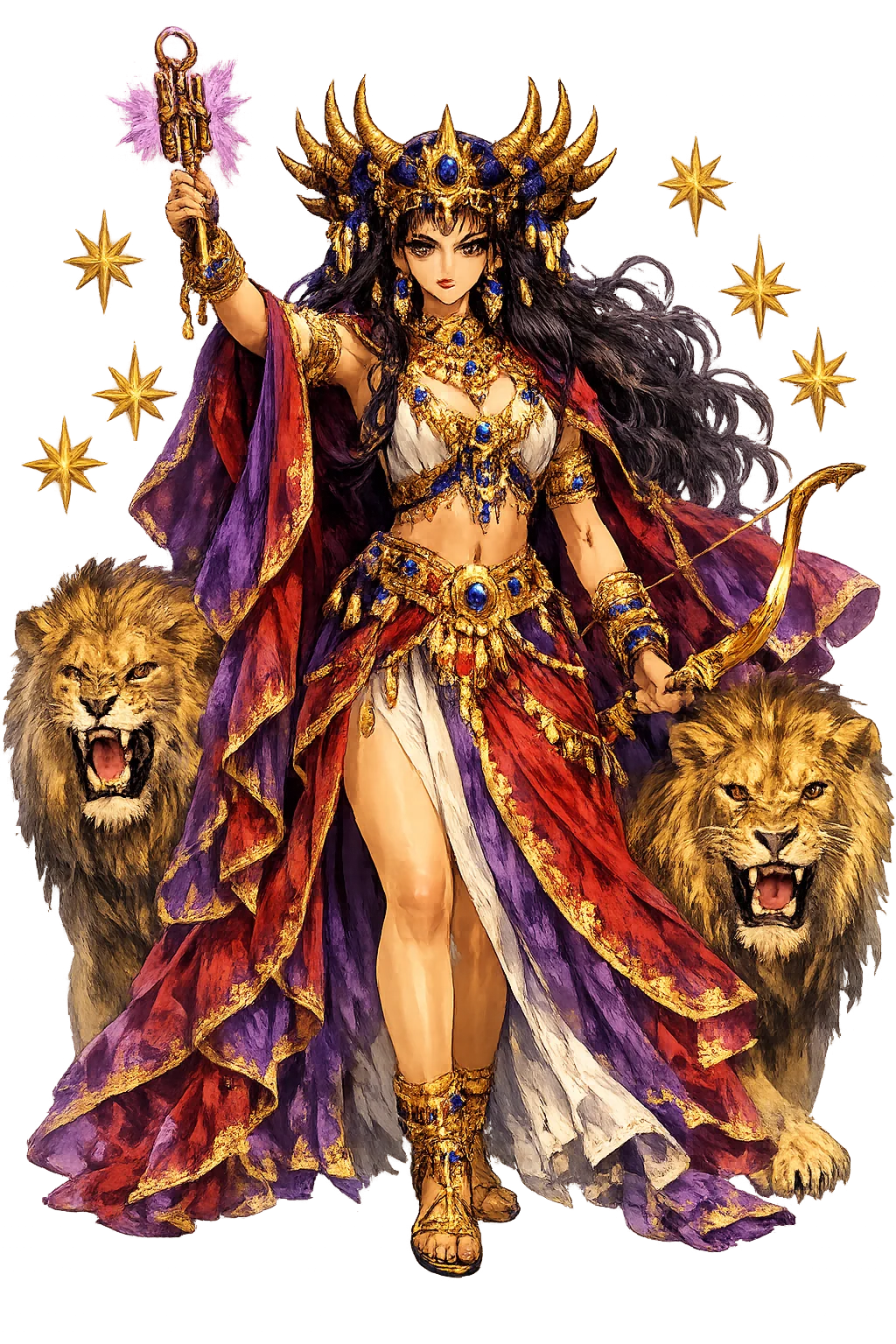
The appointments Ištar made — and who is keeping them
The mistake is reading myths as entertainment. Ištar's cycle reads more like a charter — each story assigning a duty the modern world still pays for.
At a Glance
- Temple: Ištar
- Pantheon: Mesopotamian
- Domain of influence: Love, War, Fertility, Venus
- Pattern seats: 4
- Sectors touched: Home & Lifestyle · Commerce & Governance · Technology & Innovation
- Strongest seat: Love, Dating & Relationships
- Series: The Resonance Files, No. 118 of 271
The Cycle, Read Forward
Love, Dating & Relationships — through Inanna's Descent to the Underworld
In the Sumerian Descent of Inanna, the goddess abandons heaven and earth to descend to the netherworld ruled by her sister Ereshkigal. At each of the seven gates she is stripped of a garment or ornament until she stands naked before the throne of the dead.
The atlas states the seat in one line: Love and war together; Mesopotamia’s queen of hearts. The story above is the long version of the same sentence. The trade thinks it is optimizing a process. It is re-enacting a charter.
Beauty, Fashion & Cosmetics — through Ištar and the Bull of Heaven
In Tablet VI of the Epic of Gilgamesh, Ištar proposes marriage to Gilgamesh, king of Uruk. He rejects her, listing the fates of her previous mortal lovers — Dumuzi, the shepherd; the lion; the horse; the shepherd-bird; and the gardener Išullanu.
The atlas states the seat in one line: Love and glory; the adorned queen of heaven. The story above is the long version of the same sentence. That is the cycle working: story becomes duty, duty becomes trade.
Defense, Military & Security — through Dumuzi and Inanna
The Sumerian sacred-marriage songs celebrate the union of Inanna and Dumuzi, the shepherd-king. Their love ensures the fertility of the land and the legitimacy of the king.
The atlas states the seat in one line: Love and war in one figure; the Mesopotamian front line. The story above is the long version of the same sentence. Industries do not invent their archetypes; they inherit them and call them best practice.
Space, Astronomy & Celestial Science — through Ištar in the Enuma Elish and Atrahasis
In the Enuma Elish, Marduk's victory over Tiamat echoes older Sumerian narratives in which Inanna confronts the forces of chaos. In Atrahasis, Ištar/Belet-ili mourns the destruction of her human children and helps broker the post-diluvian order.
The atlas states the seat in one line: Venus as goddess; the planet carries her sign. The story above is the long version of the same sentence. The trade thinks it is optimizing a process. It is re-enacting a charter.
The Theme That Runs the Cycle
Ištar's myths are stories of extremity: descent into death, demand for the impossible, and the transformation of gender and power. She is never merely an object of desire; she is desire in motion, war in motion, the star that crosses the boundary between heaven and the underworld.
The Method, Stated Plainly
Skeptical? Good — the system is built for you. Every seat in this file carries its why-line and its weight, the full derivation is public at the methodology page, and the challenge process is part of the design. Falsifiable is not a posture here; it is the mechanism.
For the Ones Who Work There
If you work in love, dating & relationships, beauty, fashion & cosmetics, or any trade this temple holds a seat in, this is the honest version of what a placement means: your industry beside the story it has been re-telling all along — on the temple floor itself, before an audience that came specifically to read it. The patron tier and the advertising terms describe the mechanics; the resonance above describes the fit.
The File Continues
One of 271 Resonance Files — the series where the pantheon goes to work. Read the founding dispatch for the name, the Restoration File for the spelling, or the whole archive end to end.
Continue the series — previous: Íris (read it) · next: Ꜣst (read it).
The Resonance Files are argued from the same canonical record as the pattern atlas itself: the lexicon, the lore catalog, and the cited sources. Every seat can be challenged at the methodology page — and the challenge is the point.