
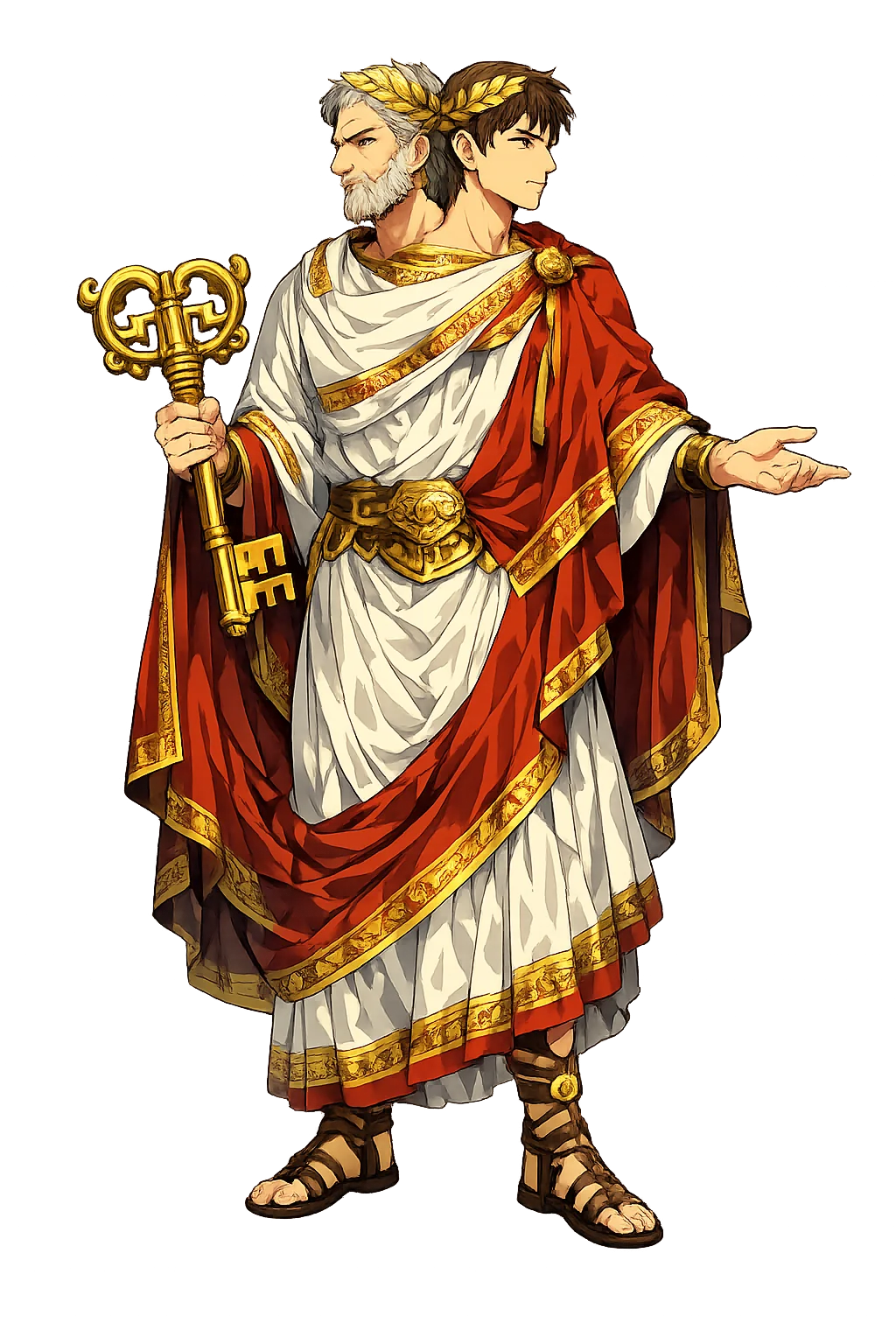
The working life of Iānus: from the myths to the modern trades
Every age hires the same gods; only the job titles change. Iānus never stopped working.
Ovid's Fasti gives him the one great scene: the poet asks the two-faced god why he looks both ways, and Iānus answers for himself — the only extended self-explanation any Roman god gets in verse.
The pattern atlas — which maps every flagship temple to the industries its archetype demonstrably resonates with, each match argued and open to challenge — seats this temple in 3 industries. This file reads those seats the way they were earned: through the myths.
At a Glance
- Temple: Iānus
- Pantheon: Roman
- Domain of influence: Beginnings, Doors, Transitions
- Pattern seats: 3
- Sectors touched: Technology & Innovation · Culture & Entertainment · Commerce & Governance
- Strongest seat: Cybersecurity & Digital Protection
- Series: The Resonance Files, No. 115 of 271
The Myth at Work
Fasti 1. Ovid asks Iānus why, alone among gods, he sees both behind and before. The god replies: whatever you see — sky, sea, earth — all things are closed and opened by my hand; I preside over the gates of heaven with the gentle Seasons; I am called Chaos, for I was the ancient confusion out of which order came. — that is not just a story. It is a business model, four thousand years early.
Ianus Geminus. Numa, the peace-king, founded the rite: the gates of the Ianus in the Forum stand open while Rome is at war, closed in peace. Livy records that since Numa's day they had been closed only twice — in 235 BCE, in the consulship of Titus Manlius Torquatus, and by Augustus, who boasted of closing them three times — and Nero closed them again after the Armenian settlement. — remember the shape of that act. You will see it again, wearing a logo.
The Seats
Each of these is argued in the atlas with a weight and a why-line. What the atlas cannot fit in one line is the whole myth — so here is each seat with its story restored.
Cybersecurity & Digital Protection
Threat defense, authentication, and digital trust. (Sector: Technology & Innovation)
The gate and its keeper; access control’s oldest patron. Swap the costume and the sentence is indistinguishable from the myth. That is what a resonance seat means.
Timekeeping & Calendar Systems
Watches, calendars, and time sciences. (Sector: Culture & Entertainment)
January keeps his name; the year’s door is his. — the atlas stops there, out of discipline. The myth keeps going: the function Iānus performs in the stories is precisely the function this industry sells.
Startups & Venture Creation
Startups, incubators, and venture capital. (Sector: Commerce & Governance)
The why-line says it in one breath: The god of beginnings; every launch is his threshold. That is not a resemblance; it is the same act, performed in a newer building.
Read the myth again after the seats and it stops sounding ancient: Ovid's Fasti gives him the one great scene: the poet asks the two-faced god why he looks both ways, and Iānus answers for himself — the only extended self-explanation any Roman god gets in verse. The age changed. The work did not.
The Method, Stated Plainly
None of this is numerology. A seat exists only where the match can be argued from the deity's documented domains and deeds — weighted, published, and falsifiable. The full derivation, the weights, and the challenge process are public on the methodology page. If a seat in this file reads wrong, the atlas itself tells you how to prove it — and the correction becomes part of the record.
For the Ones Who Work There
If you work in cybersecurity & digital protection, timekeeping & calendar systems, or any trade this temple holds a seat in, this is the honest version of what a placement means: your industry beside the story it has been re-telling all along — on the temple floor itself, before an audience that came specifically to read it. The patron tier and the advertising terms describe the mechanics; the resonance above describes the fit. The story is the pitch; the seats are just where it already works.
The File Continues
This is one of 271 Resonance Files — the third dispatch from every flagship temple, where the myths meet the markets. The temple's founding dispatch tells the name's story; its Restoration File tells the spelling's; the blog index holds the whole archive.
Continue the series — previous: Hýpnos (read it) · next: Iásōn (read it).
The Resonance Files are argued from the same canonical record as the pattern atlas itself: the lexicon, the lore catalog, and the cited sources. Every seat can be challenged at the methodology page — and the challenge is the point.