
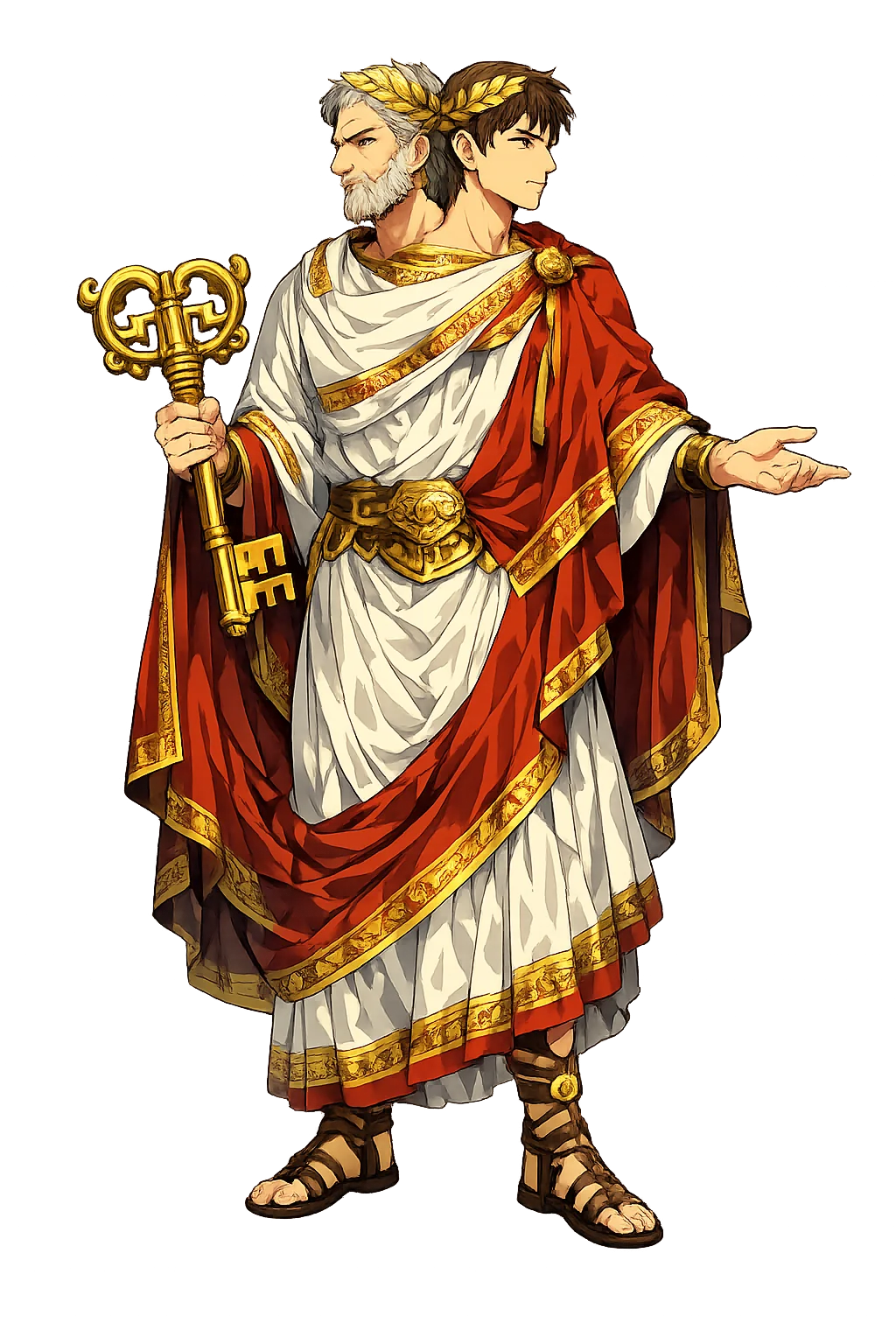
Iānus in 2026: why scholars still care
In 2026, names are treated as data points. Iānus is a reminder that they are also cultural artifacts — and that the difference matters for search engines, AI training corpora, and anyone who types the name of a Roman figure into a browser. Scholars never stopped caring about the difference between ianus and Iānus; the web simply made that care actionable. What follows is the full scholarly picture — name, script, sound, myth, cult, and legacy — followed by the engineering compromise that lets a restored spelling live at a real address. The question is not whether the name is old. It is whether the digital world is old enough to hold it.
At a Glance
- Restored name: Iānus
- ASCII form: ianus
- Meaning: "'Passage, arched door' (from ianua)"
- Domain of influence: Beginnings, Doors, Transitions
- Pantheon: Roman
- Classification: Tier 2
- Live domain: iānus.com
Overview
Iānus (ianus) — The God of Two Faces — belongs to the Roman tradition, where it is catalogued under the domain "Beginnings, Doors, Transitions". The name means "'Passage, arched door' (from ianua)".
Iānus has no Greek equivalent and no mythology of adventure: he is Rome's god of passages themselves — doors, bridges, beginnings, the month that opens the year. His two faces look both ways because every threshold faces two worlds.
PuniCodex restores the name as Iānus and serves its temple at iānus.com. The original preserves one prosodic feature — stress or vowel length — rather than both, which places the name in Tier 2. The plain ASCII form ianus survives as a modern convenience imposed by the early domain-name system; the restoration, not the fallback, is the form the project defends as philologically complete.
The Name
No indigenous written attestation survives for this name; Iānus is a scholarly transliteration of the reconstructed spoken form. Etymologically the name means "'Passage, arched door' (from ianua)".
The ASCII form ianus survives only because the early domain-name system could not carry diacritics; it is a technological compromise, not an ancient spelling. The Unicode restoration Iānus recovers the vowel length of the original directly in the address bar. The original preserves one prosodic feature — stress or vowel length — rather than both, which places the name in Tier 2.
The letter-by-letter transformation runs:
- i → I — Same letter
- a → ā — Macron marks the long vowel
- n → n — Same letter
- u → u — Same letter
- s → s — Same letter
The project holds the domain iānus.com (xn--inus-qsa.com) as the canonical home of this name.
The Original Script
The original script for this roman name has not yet been added to PUNICODEX. The form shown is a scholarly transliteration.
The form Iānus is therefore a scholarly transliteration rather than an attested ancient spelling; it encodes the reconstructed sound of the name for modern use, and no mark in it is decorative.
Pronunciation
The reconstructed pronunciation of the name is /ˈjaː.nus/ — Classical Latin.
For the modern speaker, the closest approximation is: YAH-nus, long ā on the first syllable.
Kindred and historical forms of the name:
- Latin — Iānus
- His month — Iānuārius (January)
- Owned form — Iānus
Latin Iānus scans with a long i and long ā; Varro connected the name to ire, "to go," and Cicero to ianua, "door" — both folk etymologies of a genuinely old Italic god. The circumflex-less Roman name keeps its macrons in the restoration Iānus, the form dictionaries print. The poets scan both vowels long (Iānus); the temple calendars abbreviate him simply KAL, the Kalends he owns.
Mythology
Ovid's Fasti gives him the one great scene: the poet asks the two-faced god why he looks both ways, and Iānus answers for himself — the only extended self-explanation any Roman god gets in verse.
Fasti 1 (The Interview)
Ovid asks Iānus why, alone among gods, he sees both behind and before. The god replies: whatever you see — sky, sea, earth — all things are closed and opened by my hand; I preside over the gates of heaven with the gentle Seasons; I am called Chaos, for I was the ancient confusion out of which order came. Then he teaches the poet why the year begins in winter: the door of the year opens with the sun's rebirth.
Ianus Geminus (The War Gates)
Numa, the peace-king, founded the rite: the gates of the Ianus in the Forum stand open while Rome is at war, closed in peace. Livy admits they were closed only twice before Augustus — who boasted of closing them three times — and Nero closed them again after the Armenian settlement. An open temple as the norm: Rome's two faces were usually turned outward, toward war.
Carna and the Hawthorn (The Nymph)
Ovid also tells how Iānus wooed the nymph Carna, goddess of hinges, who tricked her suitors into a cave and fled — until the two-faced god, who cannot be crept up on, saw her behind him. Their union gave her power over doorways and the beans-and-bacon rites of June 1: Rome's folklore of thresholds, domestic and divine at once.
Symbols & Iconography
The iconography associated with Iānus concentrates in a small set of recurring attributes, each a compressed statement about the name:
- The key — The opener and shutter — claviger, the key-bearer
- The staff — The doorkeeper's rod of admission
- The double face — Simultaneous sight of before and after
Epithets & Cult Titles
His titles are the grammar of the threshold.
- Geminus — 'the Twin'; the Forum shrine's name, the two faces as one god.
- Bifrons — 'Two-faced'; the poets' standing epithet.
- Patulcius — 'the Opener'; paired in the old formulae with Clusius, 'the Shutter.'
- Iunonius — 'of the Kalends'; Macrobius explains: the month's opening day is his.
- Consivius — 'of sowing'; the title under which beginnings are agricultural as well as temporal.
- Pater — 'the Father'; the oldest invocations call him simply the god who was there first.
Oracle Sites & Sanctuaries
The Ianus Geminus in the Roman Forum — the gated shrine between the Curia and the comitium — was less a temple than a state instrument: its bronze doors, open in war and closed in peace, were Rome's public barometer for seven centuries. A second gate-shrine stood on the Janiculum, the hill across the Tiber that bears his name, guarding Rome's western approach. The gates themselves are described from Augustus to Procopius; their loss is one of the Forum's small archaeological griefs — the god of doors has no door left standing.
Archaeology & Evidence
The Ianus Geminus stood in the Forum near the Curia; its bronze gates survived into late antiquity (Procopius describes them), though the structure's exact footprint is debated. His most durable monument is numismatic: the heavy cast bronze aes grave of the 3rd century BCE bears the double-faced head — one of the earliest portrait-types of Roman coinage — and the denarius tradition continued it. A small shrine of Ianus on the Janiculum, the hill that probably bears his name, tied the god to Rome's western gate.
Realm & Domain
Iānus has no Greek equivalent and no mythology of adventure: he is Rome's god of passages themselves — doors, bridges, beginnings, the month that opens the year. His two faces look both ways because every threshold faces two worlds.
The Gates of War
The Ianus Geminus, open while Rome fought, closed in peace — shut only a handful of times in seven centuries.
Bifrons
The two-faced one: past and future, entrance and exit, watched simultaneously.
January
Iānuārius — his month still opens the civil year of half the world.
The As
His double face stamped the earliest Roman bronze coinage, with the prow of a ship on the reverse.
Across Cultures
The Etruscans knew a two-faced gate-spirit (Culsans, paired with the one-faced Culsu), and Iānus absorbed that numinous door-power early. Having no Greek twin, he puzzled the mythographers: some aligned him with the sky, some with Chaos itself — Ovid reports both. Modern physics borrowed him for "Janus particles" (two-faced colloids), and psychology for "Janus-faced" ambivalence: the god of two ways of seeing became the name for the condition itself.
Within the Roman tradition, closely related names in the corpus include [[diana|Diāna]], [[iuno|Iūnō]], [[iuppiter|Iūppiter]], [[neptunus|Neptūnus]], [[vulcanus|Vulcānus]], and [[ganesha|Gaṇeśa]].
Cultural Legacy
January keeps his name on every calendar; the janitor keeps his keys in every school; "Janus-faced" remains the standard charge in diplomacy and the standard diagnosis in literature. Historians read the rarity of his closed gates as Rome's autobiography: a republic that could count its years of peace on one hand, and a god whose open temple was the weather of empire.
The Scholarly Record
The account of Iānus given in this edition rests on the witnesses and reference works listed below. Lexica and etymological dictionaries secure the form and meaning of the name; the literary and religious texts supply the narrative evidence.
- Ovid (Publius Ovidius Naso), Metamorphoses / Fasti / Heroides, Loeb Classical Library, 17. Full text
- Lewis & Short, A Latin Dictionary, Oxford, Clarendon Press; Perseus digitization, 1879. Full text
- Varro, De Lingua Latina / Antiquitates Rerum Divinarum, Loeb Classical Library, 45 BCE.
- Cicero, Marcus Tullius — collected works, Loeb Classical Library, 43 BCE. Full text
- Macrobius, Saturnalia, Loeb Classical Library (Kaster), 430.
- Cambridge Ancient History, Multiple volumes, 1970. Full text
A Meditation
Iānus is the god of the door you are standing in. Every beginning contains its end; every entrance is also an exit watched from the other side. He does not judge the passage — he is the passage. To honour him is to pause at thresholds: to look back once, look forward once, and only then walk through.
Modernity made him its secret patron: every pivot, every launch, every new year, every door held open for a stranger is his small liturgy. The Romans began everything — journeys, marriages, consulates, the year itself — by naming him first, on the principle that a beginning honoured is half accomplished. His two faces are the correct posture for any threshold: gratitude backward, attention forward, and then — the god's whole point — through.
It is no accident that Rome's rarest public celebration was his closed gates: peace was so unusual it needed a god's doorway to mark it. The open gates were the default, the ordinary weather of a martial state — and the god watched both conditions with the same two faces, praising neither. His neutrality is the lesson: thresholds do not judge what passes through them; they only insist that passing is a choice, and that someone remember to look both ways first.
The Unicode Restoration
Iānus is classified as Tier 2: the original preserves at least one philological feature that ASCII cannot encode. The ASCII fallback ianus still resolves everywhere, but it is the restored form that carries the name's full information. Across the 5 characters of the name, the restoration adjusts 1: 1 mark of length (ā). That is the whole thesis of this temple: the marks are the message.
Character by Character
The journey from ianus to Iānus, one character at a time:
- i → I — Same letter
- a → ā — Macron marks the long vowel
- n → n — Same letter
- u → u — Same letter
- s → s — Same letter
The Domain Name
The restored name is live as a working domain: iānus.com, which the DNS carries in punycode form as xn--inus-qsa.com — an ASCII-compatible encoding that lets a non-ASCII name travel the global network without breaking older infrastructure. The visitor sees Iānus; the machines see the encoding. That duality is the engineering compromise on which the entire restoration rests, and it is why a name written the way its own tradition wrote it in Original Script can now be typed into any browser on earth.
The Roman Pantheon
Iānus is one of 6 entries the PuniCodex lexicon catalogues under the Roman pantheon. The Pantheon page gathers the tradition's major figures in one place, and the Lexicon lets you filter all 915 restorations by tradition, tier, or script — the fastest way to see where this name sits among its kin.
Frequently Asked Questions
What does Iānus mean? The traditional gloss is "'Passage, arched door' (from ianua)."
Which tradition does Iānus belong to? Iānus is catalogued in the Roman pantheon of the PuniCodex lexicon.
Why is Iānus classified as Tier 2? Because the original preserves at least one philological feature that ASCII cannot encode — and the marks in the restored spelling preserve exactly that evidence.
Is Iānus a working domain? Yes — iānus.com resolves today and routes to this temple.
What is the punycode for iānus.com? The DNS encoding is xn--inus-qsa.com; browsers perform the translation automatically, so visitors only ever see the restored name.
Typing Iānus
You do not need a special keyboard to use this restoration. The PuniCodex Type Tool converts the ASCII form ianus into Iānus as you type, and the browser extension offers the same conversion inside any text field. Copy the restored form, paste it into the address bar, and the DNS does the rest.
Sister Temples
Other temples in the Roman pantheon include Iūppiter — each with its own restoration story, its own scholarly record, and its own place in the lexicon.
Why This Restoration Matters
In 2026 the stakes are practical. Search indexes, language models, and localization pipelines all inherit whatever spelling the web normalizes — which means every Unicode domain is also a training signal. Iānus teaches the machinery that the restored form exists, that it is used, and that it points to a real place. That is why a project built on philology ends up caring about DNS: the infrastructure decides which names the future sees. This restoration makes sure the future sees the whole name.
Explore Further
This post is one doorway into the temple. The home page carries the full character breakdown and the ambient canvas; the lore page tells the myths in long form; the Scholarly Edition preserves the sources, pronunciation data, and revision history; and the patron wall supports the restoration directly. For the wider map, browse the Lexicon, explore the Pantheon, or return to the PuniCodex blog.
Related Names
Sources
The full scholarly apparatus — every citation, revision, and review — lives in the Scholarly Edition. Key references for this post:
- Ovid (Publius Ovidius Naso), Metamorphoses / Fasti / Heroides, Loeb Classical Library, 17.
- Lewis & Short, A Latin Dictionary, Oxford, Clarendon Press; Perseus digitization, 1879.
- Cicero, Marcus Tullius — collected works, Loeb Classical Library, 43 BCE.
- Cambridge Ancient History, Multiple volumes, 1970.
- Macrobius, Saturnalia, Loeb Classical Library (Kaster), 430.
- Varro, De Lingua Latina / Antiquitates Rerum Divinarum, Loeb Classical Library, 45 BCE.
- Ovid, Fasti 1; Macrobius, Saturnalia 1.9.
- Livy 1.19; Augustus, Res Gestae 13; Procopius, Gothic War 5.25.
- Lexicon authorities for this entry: Lewis & Short, Ovid, Macrobius.