
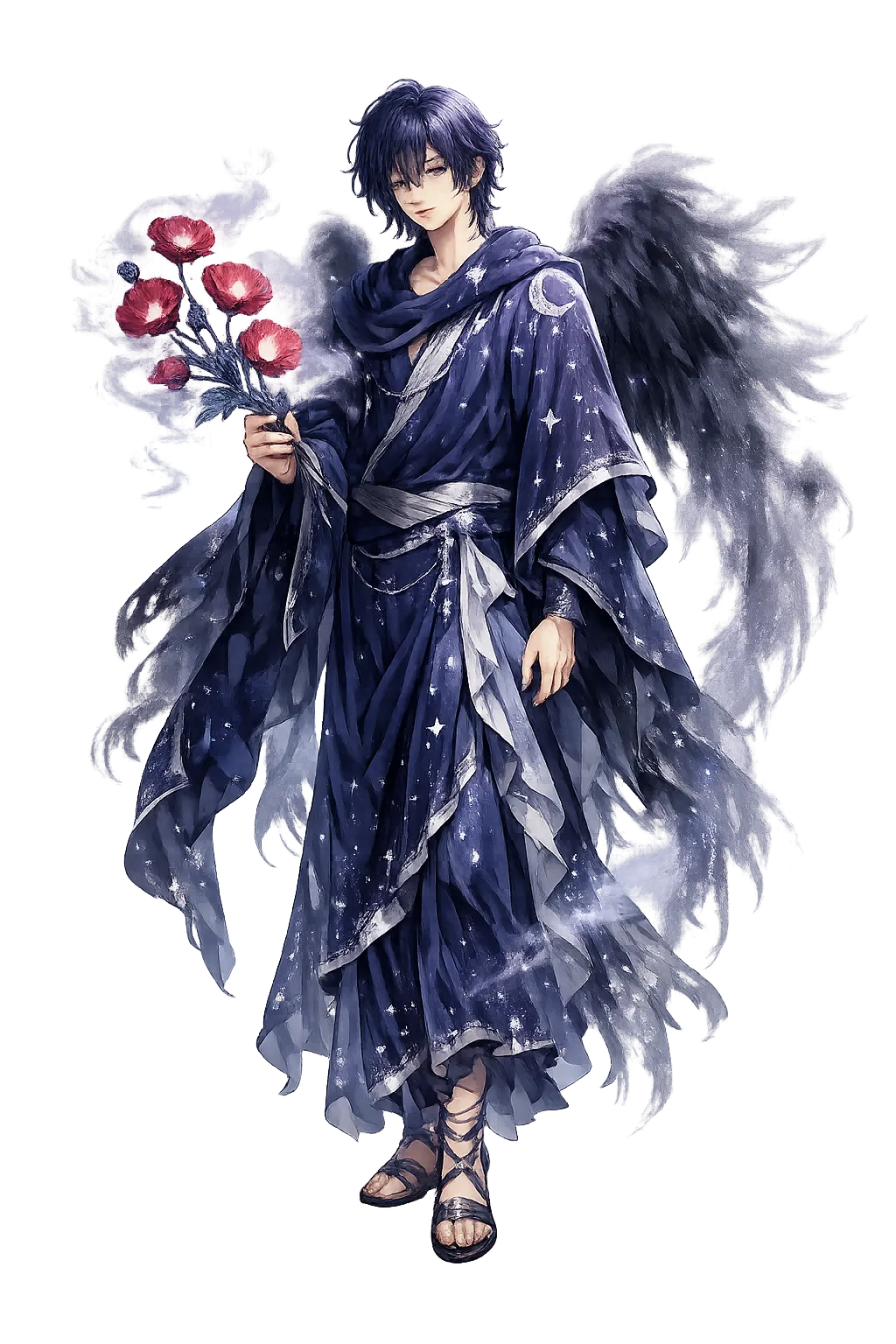
From Greek to Unicode: the journey of Hýpnos
Long before it was a domain, this name traveled through scripts. Hýpnos begins in Greek, passes through scholarly transliteration, and ends — for now — inside the punycode machinery of the global DNS. Each stage of that journey preserves some information and loses some, and the craft of restoration is knowing exactly which marks matter. This post follows the name stage by stage: the original script, the reconstructed pronunciation, the mythological record, the material evidence, and finally the Unicode form that carries all of it into the address bar. Think of it as a biography of a name, told through its spelling.
At a Glance
- Restored name: Hýpnos
- ASCII form: hypnos
- Meaning: "Sleep"
- Domain of influence: Sleep
- Pantheon: Greek
- Classification: Tier 2
- Original script: Ὕπνος (Greek)
- Live domain: hýpnos.com
Overview
Hýpnos (hypnos) is the Greek personification of sleep — the ordinary noun ὕπνος made god. Hesiod makes him a son of [[nyx|Nýx]] (Night), born without a father beside his twin [[thanatos|Thánatos]] (Death), and sets their dwelling at the edge of the world where the sun never shines; Sleep alone goes out over the earth, gentle toward mortals, while his brother's heart is iron.
Homer grants him two of epic's finest scenes. In Iliad 14 [[hera|Hēra]] bargains with him to lull Zeus unconscious, swearing by the Styx and promising him the Grace Pasithea; in Iliad 16 he and Death lift the fallen [[sarpedon|Sarpēdōn]] from the battlefield and bear him home to Lycia — the image Greek art never tired of repeating.
PuniCodex restores the name as Hýpnos and serves this temple at hýpnos.com. The restoration carries the acute stress of the Greek Ὕπνος but marks no vowel length, so the name sits in Tier 2; the ASCII form hypnos is the modern fallback imposed by the early domain-name system.
The Name
Ὕπνος (masculine) is the common Greek noun for 'sleep' serving directly as a god's name — the Greeks prayed to the thing itself. The word is impeccable Indo-European inheritance: sup-nó-, from the root swep- 'to sleep', whose closest cousins are Sanskrit svápna-, 'sleep, dream', and Latin somnus. The rough breathing of the ὑ- continues the old initial s-, which Greek regularly weakens to h; the acute on the first syllable fixes the pitch peak.
The PuniCodex restoration Hýpnos reproduces that accent. The ASCII spelling hypnos is a modern convenience of the early domain-name system; antiquity's real translational equivalent is not a transliteration at all but the cognate Latin somnus — the same word, evolved separately.
The letter-by-letter transformation runs:
- h → H — H uppercase
- y → ý — Acute on y
- p → p — p same
- n → n — n same
- o → o — o same
- s → s — s same
The project holds the domain hýpnos.com (xn--hpnos-qva.com) as the canonical home of this name.
The Original Script
The name is written in Greek as Ὕπνος: capital upsilon with rough breathing and acute, then pi, nu, omicron, sigma. The rough breathing is historically meaningful — it continues the s- of the root swep- that Latin keeps intact in somnus — so the two classical spellings, Ὕπνος and Somnus, record the same ancestral word at two removes. Accents and breathings are Alexandrian editorial signs; Classical inscriptions show simply ΥΠΝΟΣ.
This original script is the measure of both the ASCII fallback hypnos and the PuniCodex restoration Hýpnos: the restoration keeps the acute of the edited Greek, so that a reader typing the modern address still speaks the ancient name.
Pronunciation
The reconstructed pronunciation of the name is /hýp.nos/ — Attic Greek Reconstruction.
Phoneme by phoneme:
- Hýp- — Rough breathing on upsilon with acute [hýp], the pitch peak of the name.
- -nos — Nu-omicron-sigma; the second-declension nominative ending.
For the modern speaker, the closest approximation is: 'HOOP-nohs' — the first syllable is pitched high and begins with a rough 'h'; the second is short and level.
Kindred and historical forms of the name:
- Greek — Ὕπνος (Hýpnos), the personification of sleep
- PIE — Possible root *(s)up- 'to sleep'; cognate with Latin sopor and English 'sleep'
- Twin — Θάνατος (Thánatos), his twin brother, the personification of death
Hýpnos is Tier 2 because the Greek Ὕπνος preserves the acute stress on the first syllable but has no long vowel. He and his twin Thánatos are children of Night (Nyx) and live near the sunset.
Mythology
Hýpnos is a minor but indispensable power: gods call on him when someone must lose consciousness, and poets love him as the brother who daily rescues humanity from wakefulness.
Son of Night (Hesiod, Theogony)
Nyx bore Sleep and Death without a father. Their house stands beside their mother's at the world's edge, where the sun never looks; Death goes out to seize and never releases, but Sleep roams the earth and the wide back of the sea, and is calm and gentle to men.
Hera's Bargain (Iliad 14)
[[hera|Hēra]] asks Hypnos to pour sleep over Zeus so she can aid the Greeks. He refuses at first: once before, after Herakles' sack of Troy, he did the same favor, and Zeus in his rage would have hurled him into the sea had Night not saved him. Hera swears by the inviolable water of the Styx and promises him Pasithea, one of the younger Graces; he takes the shape of a singing bird, perches in a pine on Ida, and sheds sleep over the king of the gods.
The Carrying of Sarpedon (Iliad 16)
When Zeus's son [[sarpedon|Sarpēdōn]] falls to Patroklos, the father orders Apollo to wash the body, anoint it, and give it to the twin brothers Sleep and Death, who set it down in rich Lycia for burial — the tenderest death-scene in the poem and the one Greek painters chose for their god.
The Cave of Somnus (Ovid, Metamorphoses 11)
Roman poetry gives him a house: a hollow mountain near the Cimmerians where the sun never enters, where Lethe's murmuring stream flows over pebbles, poppies bloom at the door, and Sleep lies on a downy couch — with his sons, the thousand shapes of dream, waiting outside.
Hera Bribes Hypnos (Iliad)
In Iliad 14, Hera asks Hypnos to lull Zeus to sleep so she can aid the Greeks. Hypnos recalls an earlier occasion when Zeus had hurled him from heaven in anger and demands a guarantee. Hera promises him Pasithea, one of the Graces, and he agrees. He pours sleep over Zeus's eyes while the god embraces Hera on Mount Ida.
Sleep and Death Carry Sarpedon (Iliad)
When Zeus's son Sarpedon is killed by Patroklos, he instructs Apollo to have Hypnos and Thanatos carry the body to Lycia for burial. The twins lift the hero gently, 'swift as thought,' and bear him away. The scene is one of the Iliad's tenderest images of death.
Symbols & Iconography
Hýpnos's attributes are few, and all of them are instruments of his single act:
- Poppy — the soporific flower: Ovid plants poppies at the threshold of Somnus' cave, and artists put the stalks in the god's hand.
- Wings at the temples — small bird-wings marking the speed and silence of his arrival, fixed in the sculptural type known from the Roman copies.
- Branch or horn — the wand with which he sprinkles sleep: Virgil's Somnus shakes over Palinurus a bough dripping with the dew of Lethe.
- Dark mist — the garment of night in which he wraps the sleeper; he is Night's son working Night's element.
Hýpnos is a winged, beautiful youth — sleep's gentleness made visible. His most famous ancient appearance is on the red-figure calyx-krater signed by Euphronios (c. 515 BCE), where he and Thanatos lift the dead Sarpedon from the battlefield, illustrating the command Zeus gives in Iliad 16. On white-ground funerary lekythoi the twins recur with poppies and down-turned torches. Roman art loved the type: the bronze head in the British Museum, from Civitella d'Arna, shows him with small wings sprouting at his temples, the attribute that never leaves him. That head — a Roman copy of a Greek original of about 325–275 BCE — belongs to a type known from several copies, including a full marble in the Prado that shows the whole figure leaning far forward, one arm outstretched, pouring slumber over the sleeper below.
Epithets & Cult Titles
As a personification rather than a cult god, Hýpnos carries poetic predicates more than sacred titles:
- ἄναξ πάντων (ánax pántōn) — 'lord of all [gods and men]'; Hera's flattering address in Iliad 14.
- Νυκτὸς υἱός (Nuktòs huiós) — 'son of Night'; his Hesiodic genealogy serves as his standing description.
- νήδυμος (nḗdumos) — 'sweet'; the stock Homeric formula for the sleep he embodies (nēdumos hupnos).
- Θανάτου κασίγνητος (Thanátou kasígnētos) — 'brother of Death'; the twin pairing Hesiod describes and Iliad 16 makes visible over Sarpedon's body, when he and [[thanatos|Thánatos]] bear the hero home.
- Somnus — his Roman name, under which Ovid describes his silent cave.
The Homeric Hymns
No Homeric Hymn is addressed to Hýpnos, though Homer grants him one of epic's finest scenes: in Iliad 14 Hera hails him as 'Hypnos, lord of all gods and all men,' and he descends to Ida in the likeness of a bird, perched in a high pine, to pour sleep over Zeus. Hesiod makes him a son of Night, housed beside Death at the edge of the world — gentle toward mortals, where his twin is iron-hearted. The Orphic corpus later devoted a hymn to him (Orphic Hymn 85), the nearest thing to a cult hymn Sleep ever received; its prescribed offering is the poppy, the same soporific flower that fills his iconography.
Oracle Sites & Sanctuaries
No sanctuary or oracle of Hýpnos is securely attested anywhere in the Greek world: Sleep was petitioned within other cults but never housed in temples of his own. Pausanias, our most thorough witness to what stood where in Greek sanctuaries, records no temple of Sleep in his entire itinerary — an argument from silence with real weight. His nearest cultic association is the incubation rite of the Asklepieia — at Epidauros, Athens, and Pergamon the patient's sleep was itself the medium of cure, though supervision belonged to Asklepios, not to Hypnos. Greek imagination housed him in literature instead: Hesiod sets his dwelling beside Death where the sun never shines, and Ovid later gives Somnus his famous cave among the Cimmerians.
Archaeology & Evidence
No sanctuary of Hýpnos is securely attested anywhere in the Greek world; his material record is iconographic, not cultic. Its centerpiece is the calyx-krater signed by Euphronios as painter and Euxitheos as potter, c. 515 BCE, now in the Metropolitan Museum, where Hypnos and Thanatos lift the dead [[sarpedon|Sarpēdōn]] in exact obedience to Iliad 16. The twins recur on white-ground funerary lekythoi of the fifth century, poppies and down-turned torches in hand.
Sculpture's most famous witness is Roman: the bronze head in the British Museum, found at Civitella d'Arna near Perugia and acquired in 1868, a Roman copy of a Greek original of about 325–275 BCE, with small wings sprouting at the temples — the attribute that never leaves him.
Realm & Domain
Hýpnos's domains are the borders of consciousness: everything he touches loses the world for a while.
Personified Sleep
A child of Night, born beside Death and the tribe of Dreams; Hesiod makes him the one member of that dark household who is gentle to mortals, wandering the earth while his iron-hearted brother stays home.
Wings of Quiet
He moves as a bird moves: in Iliad 14 he takes the shape of a singing bird and settles in a high pine on Ida, and art gives him small wings at his temples or heels.
Dream-Giver
Hesiod makes the tribe of Dreams his brothers; Ovid instead makes them his sons — Morpheus, Icelos, and Phantasos — the shapes that walk out of Sleep's cave into the minds of mortals.
Brother of Death
The twins act together at the borders of battle: when [[sarpedon|Sarpēdōn]] falls, Zeus commands that Sleep and Death carry his body home to Lycia.
Across Cultures
Rome did not translate Hýpnos; it inherited him. Latin somnus is the same Indo-European word as Greek ὕπνος, so the Roman god is a continuation, not an identification — and Roman poetry filled out the figure Greece had sketched: Ovid's cave of Somnus, and Virgil's 'Sleep, kinsman of Death' (consanguineus Leti Sopor) stationed at the underworld's gate.
The twins' pairing belongs to a wider Mediterranean imagination in which sleep is death's rehearsal and its opposite at once. Homer already calls the sleep that falls on Odysseus 'most sweet, unawaking, nearest to death'. The modern sciences then reclaimed the name itself: in the 1840s the Scottish surgeon James Braid coined 'hypnotism' for the trance state he studied, naming it after the god of sleep before concluding the state was not sleep at all — he later preferred 'monoideism', but the god's name had already stuck.
Cultural Legacy
Hýpnos's afterlife runs through the dictionary. 'Hypnosis', 'hypnotic', and 'hypnotherapy' descend from Braid's nineteenth-century coinage, while Latin somnus supplies 'insomnia', 'somnolent', and 'soporific' — the god and his Roman twin divided the modern vocabulary of sleep between them.
His image fared as well as his name. The winged youth carrying a dead hero beside his brother [[thanatos|Thánatos]] became, through the Euphronios krater and the bronze head in the British Museum, one of the defining images of Greek art in the modern imagination — gentleness personified, set permanently beside the horror it softens. And the Greek intuition he embodies survives as common wisdom: every sleep is a small rehearsal for death, and every waking a return the myths never guarantee.
The Scholarly Record
The account of Hýpnos given in this edition rests on the witnesses and reference works listed below. Lexica and etymological dictionaries secure the form and meaning of the name; the literary and religious texts supply the narrative evidence.
- Liddell-Scott-Jones Greek-English Lexicon, 9th ed. with 1996 supplement, s.v. ὕπνος. Full text
- Beekes, Etymological Dictionary of Greek, s.v. ὕπνος.
- Homer, Iliad, Books 14 and 16.
- Homer, Odyssey 11.14–19 and 13.79–80.
- Hesiod, Theogony 211–212, 756–766 (Loeb Classical Library No. 57). Full text
- Ovid, Metamorphoses 11.592–649.
- Virgil, Aeneid 5.835–861 and 6.278.
- Lexicon Iconographicum Mythologiae Classicae (LIMC), s.v. 'Hypnos'.
- British Museum, object 1868,0606.9. Collection page
- Braid, Neurypnology (1843).
A Meditation
Hýpnos is the god who visits everyone. Rich and poor, hero and coward, all close their eyes at his touch. In this he is more democratic than any Olympian. Yet he is also dangerous: sleep can be bribery, escape, or the doorway to deception, as when Hera uses him against Zeus.
The Greeks did not trust sleep entirely. Dreams could be true or false, divine or merely digestive. Hypnos therefore carries ambivalence: he restores and he disables, he heals and he makes vulnerable. To honor him is to acknowledge our daily surrender of consciousness — the small death without which no waking is possible.
The Unicode Restoration
Hýpnos is classified as Tier 2: the original preserves at least one philological feature that ASCII cannot encode. The ASCII fallback hypnos still resolves everywhere, but it is the restored form that carries the name's full information. Across the 6 characters of the name, the restoration adjusts 1: 1 mark of stress (ý). That is the whole thesis of this temple: the marks are the message.
The Domain Name
The restored name is live as a working domain: hýpnos.com, which the DNS carries in punycode form as xn--hpnos-qva.com — an ASCII-compatible encoding that lets a non-ASCII name travel the global network without breaking older infrastructure. The visitor sees Hýpnos; the machines see the encoding. That duality is the engineering compromise on which the entire restoration rests, and it is why a name written the way its own tradition wrote it in Greek can now be typed into any browser on earth.
Why This Restoration Matters
Every stage of the journey from Greek to Unicode was an act of care: the scribe who first wrote the name, the lexicographer who glossed it, the engineer who taught the DNS to carry it. The PuniCodex restoration is the latest stage, not the last word — the Scholarly Edition is revised as the evidence improves. What does not change is the principle: a name deserves to be written the way its own tradition wrote it. Hýpnos in the address bar is that principle, made routable.
Explore Further
This post is one doorway into the temple. The home page carries the full character breakdown and the ambient canvas; the lore page tells the myths in long form; the Scholarly Edition preserves the sources, pronunciation data, and revision history; and the patron wall supports the restoration directly. For the wider map, browse the Lexicon, explore the Pantheon, or return to the PuniCodex blog.
Related Names
Sources
The full scholarly apparatus — every citation, revision, and review — lives in the Scholarly Edition. Key references for this post:
- Hesiod, Theogony 211–212 and 756–766 (birth and dwelling of Sleep and Death).
- Liddell-Scott-Jones Greek-English Lexicon, 9th ed. with 1996 supplement, s.v. ὕπνος.
- British Museum, object 1868,0606.9 (bronze head of Hypnos from Civitella d'Arna).
- Homer, Iliad, Books 14 and 16 (Hera's bargain; the carrying of Sarpedon).
- Beekes, Etymological Dictionary of Greek, s.v. ὕπνος (Indo-European sup-nó-).
- Homer, Iliad 14 (Hypnos as a bird on the pine of Ida); Lexicon Iconographicum Mythologiae Classicae (LIMC), s.v. 'Hypnos'.
- Ovid, Metamorphoses, Book 11 (the sons of Somnus).
- Lexicon authorities for this entry: Hesiod, LSJ.