
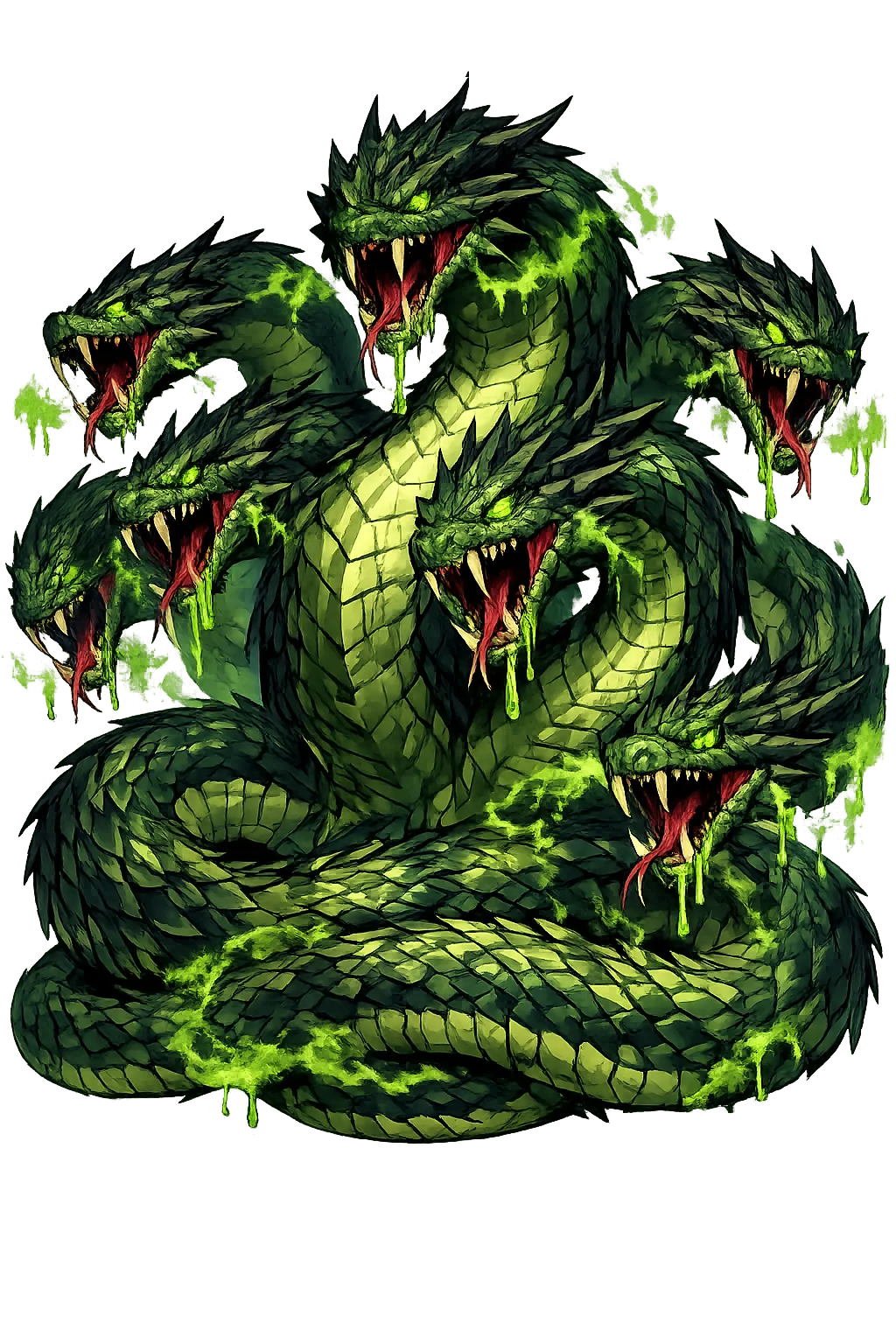
The provenance file on Hýdra
Catalogue entry — Hýdra. Every claim below carries its chain of custody.
Provenance
1. The attestation. Ὕδρα — "Water serpent". On record: LSJ, Beekes, Etymological Dictionary of Greek, Apollodorus, Bibliotheca, Hesiod, Theogony.
2. The preserved evidence. y → ý (Acute on y) — absent from the ASCII form hydra, present in the restoration, verifiable against the sources above.
3. The narrative record. The Second Labor — Eurystheus assigned Herakles the Hydra of Lerna. The creature had a huge dog-like body and many heads, one of them immortal. Iolaos and the Fire — Seeing the heads multiply, Iolaos brought fire and cauterized each neck as Herakles cut it. This stopped the regeneration.
4. The physical record. The Lerna region in the Argolid preserves Bronze Age remains and a late mythic association with the Hydra. The combat was a favorite subject in Greek vase painting from the Archaic period onward, showing Herakles and Iolaos attacking the multi-headed serpent. The constellation Hydra was catalogued by Ptolemy and transmitted through medieval and Renaissance star atlases.
5. The current holding. The temple at /sites/hydra/, classified Tier 2. Tier-2 here means one preserved truth — not less important, just singular. The temple shows it and names it.
6. The documented resonances. Cybersecurity & Digital Protection, Software, Cloud & Developer Infrastructure, Gaming, Fantasy & Entertainment IP — seats argued and weighted in the pattern atlas, read through the myths in this temple's Resonance File.
7. The primary sources. Theogony, Homeric Hymns, Works and Days — the library this file answers to, open at the Sacred Texts collection.
8. The continuing record. 'Hydra-headed' has become an idiom for any problem that grows worse when attacked. The monster appears in comic books, films, and political metaphors as the image of resilient, multiplying evil.
At a Glance
- Restored name: Hýdra
- ASCII form: hydra
- Meaning: "Water serpent"
- Domain of influence: Many-Headed Serpent
- Pantheon: Greek
- Classification: Tier 2
- Original script: Ὕδρα
- Series: The Restoration Files, No. 112 of 271
The Emblems
The name does not travel alone. Serpent heads — Multiplicity, regeneration, and the seemingly endless forms of evil; Torch — The fire used by Iolaos to cauterize the stumps and prevent regrowth; Lerna swamp — Stagnant water as the breeding ground of plague and monster. Each emblem is filed in the temple's record with its own provenance, the same discipline the spelling gets.
For the Voice
'HOO-drah' — the first syllable is pitched high and begins with a rough 'h'; the final -a is short. The reconstructed line runs `/hý.dra/` — the temple's pronunciation atlas carries the phonemes one by one.
The Discipline It Answers To
This restoration belongs to Greek, a tradition that invented both the chorus and the critique. The rules that govern it are not house style; they are the tradition's own scholarship, applied with the same care here as in any edition — and published, with the sources, so the file can be checked the way an edition can be checked. Tier-2 here means one preserved truth — not less important, just singular. The temple shows it and names it.
The File Continues
Read the founding dispatch for the name's full story, the Resonance File for the archetype at work — or the whole archive in one sitting.
Continue the series — previous file: Huītzilōpōchtli (read it here) · next file: Hygíeia (read it here).
The Restoration Files are written from the same canonical record as the temples themselves: the lexicon, the lore catalog, the pattern atlas, and the cited scholarly sources. If a file ever disagrees with its temple, the temple is right — tell us, and the file will be corrected.