
Ancient Domain
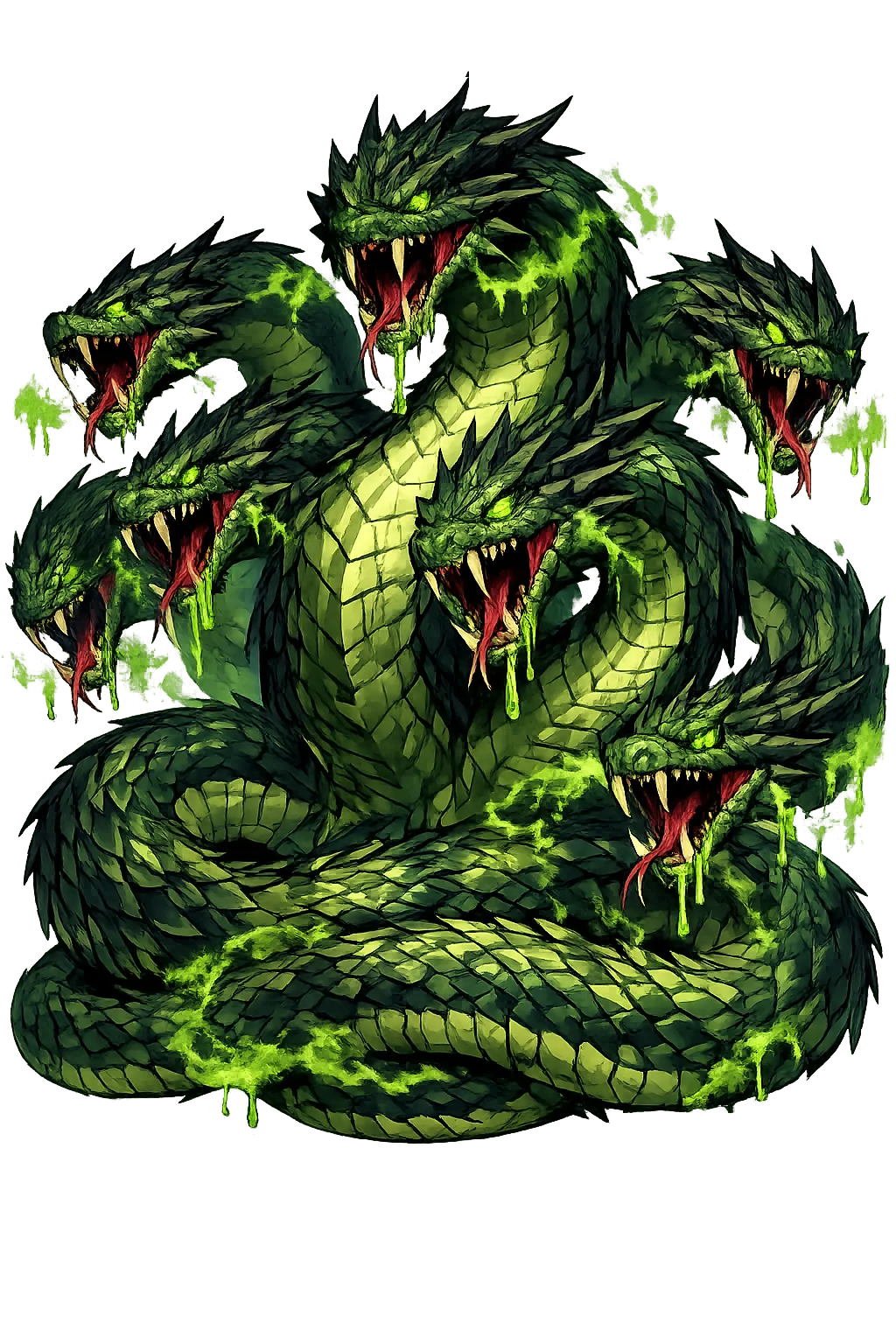
Hýdra is the monstrous water-serpent of Lerna, whose heads grew back when cut off. For Herakles, killing it required more than strength; it required fire, teamwork, and the recognition that some evils multiply when opposed directly.
Extended Lore
Etymology · Phonology · Orthography · Cultural Legacy · Primary Sources
Essential information about Hýdra, Many-Headed Serpent
From original script to Unicode restoration
Hýdra is Tier 2 because the Greek Ὕδρα preserves the acute stress on the first syllable but has no long vowel. The rough breathing on the upsilon is essential to the name's sound and identity.
Character-by-character philological analysis
| Character | Unicode | Name | Block | Phonetic Role |
|---|---|---|---|---|
| H | U+0048 | Latin Capital Letter H | Basic Latin | H uppercase |
| ý | U+00FD | Latin Small Letter Y with Acute | Latin-1 Supplement | Acute on y |
| d | U+0064 | Latin Small Letter D | Basic Latin | d same |
| r | U+0072 | Latin Small Letter R | Basic Latin | r same |
| a | U+0061 | Latin Small Letter A | Basic Latin | a same |
The Tier 2 classification reflects which ancient features stress, length, or script are preserved in this restoration.
From ancient cult to modern Unicode
Hýdra is the monstrous water-serpent of Lerna, whose heads grew back when cut off. For Herakles, killing it required more than strength; it required fire, teamwork, and the recognition that some evils multiply when opposed directly.
The Hydra has no independent cult but belongs to a broader Greek and Near Eastern tradition of multi-headed water serpents defeated by storm-gods or heroes. The Lernaean Hydra influenced later dragon lore, including medieval accounts of regenerating dragons. In modern biology, 'hydra' names a genus of freshwater cnidarian capable of remarkable regeneration — a scientific tribute to the myth. The constellation Hydra preserves the serpent in the southern sky.
'Hydra-headed' has become an idiom for any problem that grows worse when attacked. The monster appears in comic books, films, and political metaphors as the image of resilient, multiplying evil. Its scientific namesake, the hydra, makes the myth literal: a tiny animal that regenerates from fragments, immortal in its own small way.
Restoring Hýdra in a domain name is more than orthographic accuracy. It is a statement that the internet should recognize the full range of human writing — not only the ASCII keyboard.
Common questions about Hýdra, Many-Headed Serpent, and Unicode restoration
In reconstructed pronunciation, Hýdra is /hý.dra/ — approximately 'HOO-drah' — the first syllable is pitched high and begins with a rough 'h'; the final -a is short..
Hýdra means Water serpent in the greek tradition.
Hýdra is associated with Serpent heads (Multiplicity, regeneration, and the seemingly endless forms of evil), Torch (The fire used by Iolaos to cauterize the stumps and prevent regrowth), Lerna swamp (Stagnant water as the breeding ground of plague and monster), Crab (The crab sent by Hera to harass Herakles during the combat).
Plain ASCII hydra strips the stress, length, and script that make the name specific. Unicode restoration returns the name to its original written dignity.
Eurystheus assigned Herakles the Hydra of Lerna. The creature had a huge dog-like body and many heads, one of them immortal. Herakles struck off heads with his club, but for every head lost, two grew back. Hera also sent a crab to nip at his feet.
The philological foundations of this restoration
Every claim on this page is grounded in established scholarship. The orthographic restorations follow disciplinary convention. The etymological chain follows the best available reference works. This is not invention — it is resurrection through scholarship.
You have traced the name from its earliest attestation to its Unicode restoration. Now return to the myth. The story is where the name lives.
Back to Lore